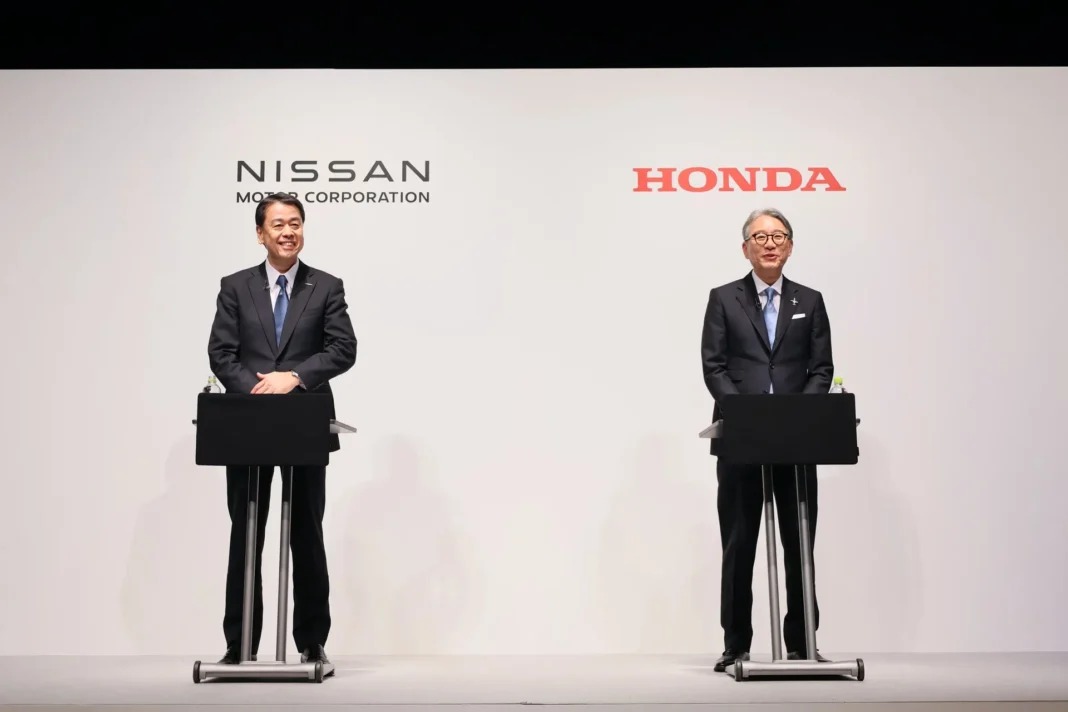

The anticipated merger between Honda and Nissan announced last December, is encountering significant challenges that may lead to its cancellation.
Initially, both automakers planned to finalize their decision by the end of January, but the deadline has been pushed back to mid-February. New tariff threats by the Trump administration are also likely to be weighing on the decision making.
Now a series of reports indicate that Nissan is reconsidering its participation in the merger. Citing several sources, Reuters reported on Wednesday that Nissan’s management expressed concerns over Honda’s proposal to make Nissan a subsidiary, a move that could diminish Nissan’s decision-making authority within the partnership.
Japan’s Asahi Shimbun also reported on Wednesday that Honda executives are frustrated with Nissan’s slow progress in both the merger discussions and the implementation of a restructuring plan. This plan includes the reduction of 9,000 jobs and a 20% decrease in production capacity.
The Financial Times in its own report on Wednesday highligted that Nissan’s recent poor financial performance has caused its market capitalization to shrink to just one-fifth of Honda’s, altering the balance of power in the negotiations.
Mitsubishi, which is already partially owned by Nissan, was invited to join the merger. However, reports from January suggested that Mitsubishi preferred to stay out of the merger, citing its smaller size and concerns over losing independence within the combined entity.
Despite these challenges, there remains a possibility that the merger could evolve. Comments from some of Reuters’ sources suggest that the option to restart negotiations remains open.
Combined sales of Honda and Nissan in 2023 totaled more than 8 million vehicles. That would make the merged automaker, estimated to have a value of around $58 billion, the third largest by sales volume after Toyota and the Volkswagen Group, which sold 11.2 million and 9.2 million vehicles in 2023, respectively.
Unlike Honda, Nissan has been struggling with declining sales, particularly in the U.S. and China, raising uncertainty about its future without the merger. Without a clear path forward, the merger was seen as a potential lifeline, making its possible cancellation even more significant for Nissan’s long-term strategy.