Mazda on Tuesday unveiled yet another update to its electrification plans—culminating in what appears to be a more independent approach than the automaker has taken thus far.
The 2025 Mazda CX-50 hybrid uses a Toyota-sourced hybrid system, and the EZ-6 electric sedan was developed in partnership with China’s Changan Automobile. But such partnerships may be limited in the future, Mazda CEO Masahiro Moro and other executives indicated in a presentation held Tuesday in Tokyo.
Mazda is moving ahead with plans, first discussed last November, to launch an in-house developed hybrid system in the CX-5 crossover, as well as an all-electric crossover SUV based a dedicated platform also developed in-house, in 2027. That platform will accommodate “diverse types of batteries,” a Mazda press release said.
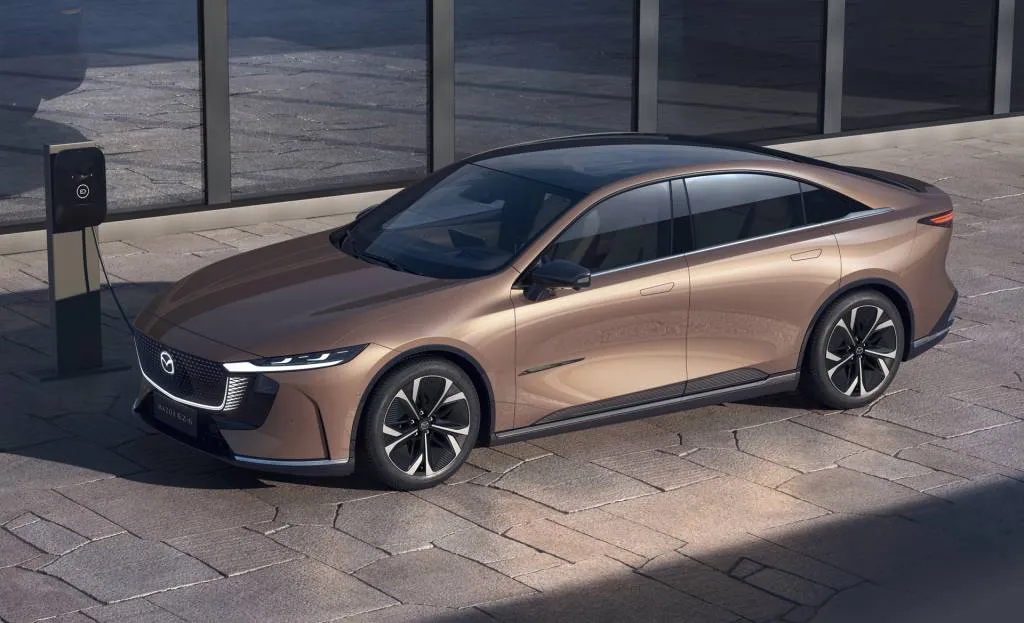
2025 Mazda EZ-6
A next-generation combustion engines, dubbed Skyactiv-Z, aimed at meeting the latest global emissions standards, is also part of the plan. One of these engines, likely an inline-4, due to packaging requirements, will be the combustion component for the CX-5 hybrid powertrain. But Mazda said an inline-6 for larger vehicles will be part of the Skyactiv-Z family as well, and that the underlying tech will be used in continuing rotary-engine development.
Mazda also said that, for the EV it plans to launch in 2027, it aims to “reduce development investment by 40% and development man-hours by 50% compared to conventional development through collaboration and partnership.” No specific partner was named though, indicated that Mazda could lean on suppliers rather than pursuing another partnership like the ones with Toyota and Changan.

Mazda dedicated EV platform spawning first model in 2027
Going it alone would give Mazda more flexibility to pursue streamlined manufacturing plans, which include producing EVs and internal-combustion vehicles on the same assembly lines. That could reduce initial capital investment by 85% and the time to mass production by 80% compared to building new EV assembly plants, Mazda estimates. The automaker does plan to build a new EV battery factory in Japan, however.
If this goes well, it could play out like Honda sees it, with the EVs informing better internal-combustion models. But Mazda certainly has more limited resources to work with.