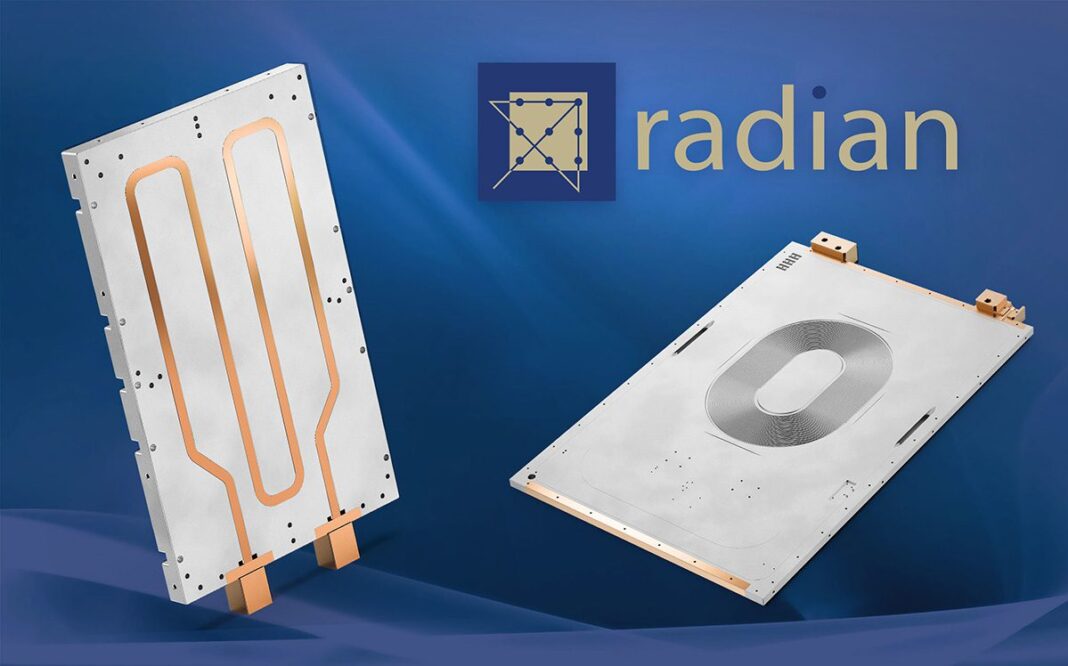

Radian Thermal Products, a global manufacturer of cooling devices, has expanded its line of skived micro-fin cold plates for high-power-density cooling across industries from automotive to aerospace.
Liquid cold plates are precision-engineered heat exchangers that transfer heat away from critical components through internal channels carrying coolant. This design maximizes thermal contact and provides an efficient method of heat removal compared to traditional air-cooled systems.
Friction stir welding (FSW) and diffusion bonding have emerged as preferred fabrication techniques, allowing for fine-tuned designs that achieve mechanical integrity and thermal conductivity without introducing filler materials.
Radian designs and manufactures custom liquid cold plates using advanced methods including FSW, brazing, and copper tube embedding. Each design is optimized for thermal efficiency, pressure drop, and manufacturability to meet the unique requirements of high-power applications.
The range includes increased heat transfer, machined channel cold plates for use with thermal electric coolers and standard cold plates with multi-loop pipe arrangements.
EVs, 5G infrastructure, and renewable energy systems are among the fastest-growing sectors adopting liquid cold plate cooling for performance and energy efficiency. In EVs, liquid cooling supports optimal battery temperature and system safety.
Liquid cold plates provide the consistency needed to ensure electronics remain within operational limits even in harsh environments, according to Radian.
The company’s research indicates that combining liquid cold plate cooling with hybrid air-liquid systems may further expand performance, offering modular solutions that scale with power density requirements.
Innovations in microchannel designs and additive manufacturing enable smaller channel diameters and complex flow paths that enhance heat transfer efficiency. Meanwhile, smart monitoring sensors integrated into cooling systems now allow engineers to track temperature, flow rate, and pressure in real time, improving predictive maintenance and system optimization.
“Power densities are increasing faster than ever, especially with the rise of AI and its effects on data centers and telecom networks,” said Thierry Sin, CEO of Radian Thermal Products. “Liquid cold plates and liquid cooling solutions have an increasingly important role in maintaining efficiency, reliability, and system longevity.”
“Today’s cooling solutions need to be adaptive,” Sin added. “As heat dissipation becomes harder to manage, thermal management systems should become more innovative. Combining liquid cooling with air cooling and two-phase cooling gives engineers new ways to solve complex thermal dissipation problems.”
Source: Radian Thermal Products