Saturday, March 14, 2026
11.8 C
London

Charged EVs | Navitas unveils 5th-generation SiC MOSFET platform with 35% improved switching figure of merit


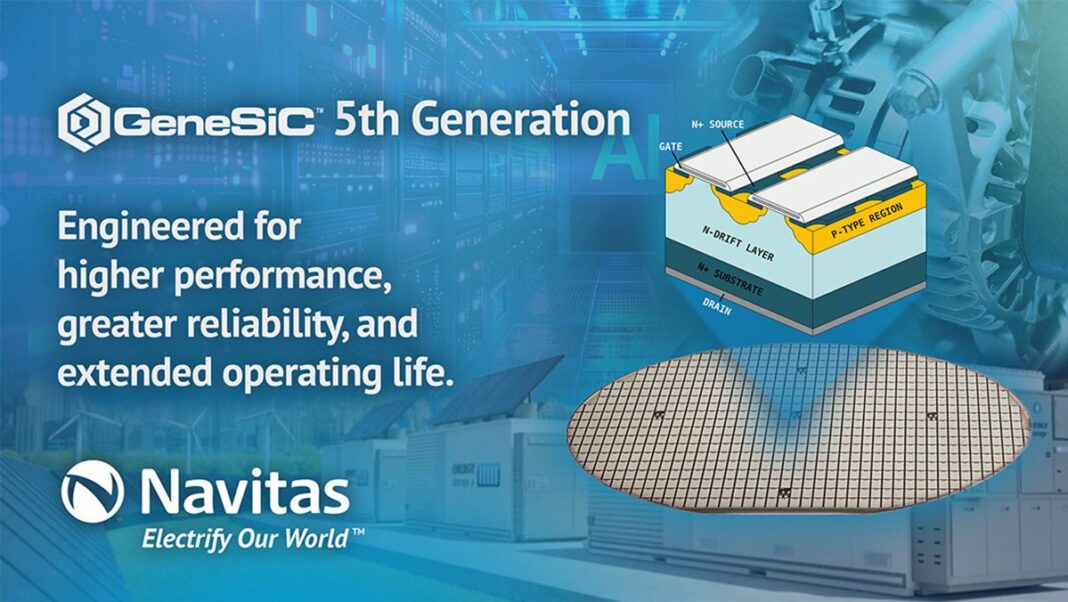
Navitas Semiconductor has launched its 5th-generation GeneSiC technology platform, a 1200 V SiC MOSFET line based on what the company calls Trench-Assisted Planar (TAP) architecture. The design combines the ruggedness of a planar gate structure with the performance benefits of a trench in the source region.

The headline improvement is a 35% better RDS(on) x QGD figure of merit compared to the previous-generation 1200 V technology, which translates to lower switching losses and the ability to operate at higher frequencies. The platform also achieves a roughly 25% improvement in the QGD/QGS ratio, which paired with a stable threshold voltage (VGS(th) ≥ 3 V) helps prevent parasitic turn-on in high-noise environments.

On the reliability side, Navitas is qualifying the parts to what it calls “AEC-Plus” grade—exceeding standard AEC-Q101 and JEDEC requirements. That includes 3x longer duration for static high-temperature, high-voltage stress testing and dynamic reverse bias and gate switching tests designed for fast-switching mission profiles. The company claims an extrapolated gate-oxide failure time exceeding one million years at 18 V operating VGS and 175° C.

“Our customers are redefining the boundaries of power conversion in AI data centers and energy infrastructure,” said Paul Wheeler, VP and GM of Navitas’ SiC business unit. “Significant technological improvements in our 5th-generation GeneSiC technology underscore Navitas’ commitment to delivering industry-leading performance and reliability in silicon carbide MOSFETs.”

The new platform complements Navitas’ existing ultra-high-voltage 2300 V and 3300 V SiC lines from the 4th-generation GeneSiC platform. New products based on the 5th-generation technology will be announced in the coming months. A white paper on the TAP architecture is available on the Navitas website.

Source: Navitas Semiconductor



Source link

Hot this week

Charged EVs | Group14 begins EV-scale production of silicon battery material in South Korea

Group14 Technologies has started EV-scale production of its silicon...

Charged EVs | NRCan awards Nano One $3 million to support LFP cathode material supply in Canada

Nano One Materials, a process technology company specializing in...

Charged EVs | U Power’s electric trucks complete operational testing and battery-swapping system integration

U Power has completed comprehensive operational testing and full-stack...

Charged EVs | Tesla opens first Megacharger station to Semi customers in California

After years of development, Tesla is ramping up production...

Charged EVs | Harbinger unveils new electric/hybrid medium-duty work truck

Commercial EV manufacturer Harbinger has unveiled a new medium-duty,...

Topics

Charged EVs | Group14 begins EV-scale production of silicon battery material in South Korea

Group14 Technologies has started EV-scale production of its silicon...

Charged EVs | NRCan awards Nano One $3 million to support LFP cathode material supply in Canada

Nano One Materials, a process technology company specializing in...

Charged EVs | Tesla opens first Megacharger station to Semi customers in California

After years of development, Tesla is ramping up production...

Charged EVs | Harbinger unveils new electric/hybrid medium-duty work truck

Commercial EV manufacturer Harbinger has unveiled a new medium-duty,...

Charged EVs | Webinar: Reducing thermal interface material scrap—how Fujipoly is rethinking waste

Thermal interface materials are playing an increasingly important role...

Charged EVs | Saarland researchers use 3D-printed metallic glass motor parts to cut iron losses

Researchers at Saarland University say they have developed iron-rich...

Charged EVs | Moog Construction’s AEMS combines EV components to save space and cost

Motion and fluid control system specialist Moog has unveiled...
spot_img

Related Articles

Popular Categories

spot_imgspot_img