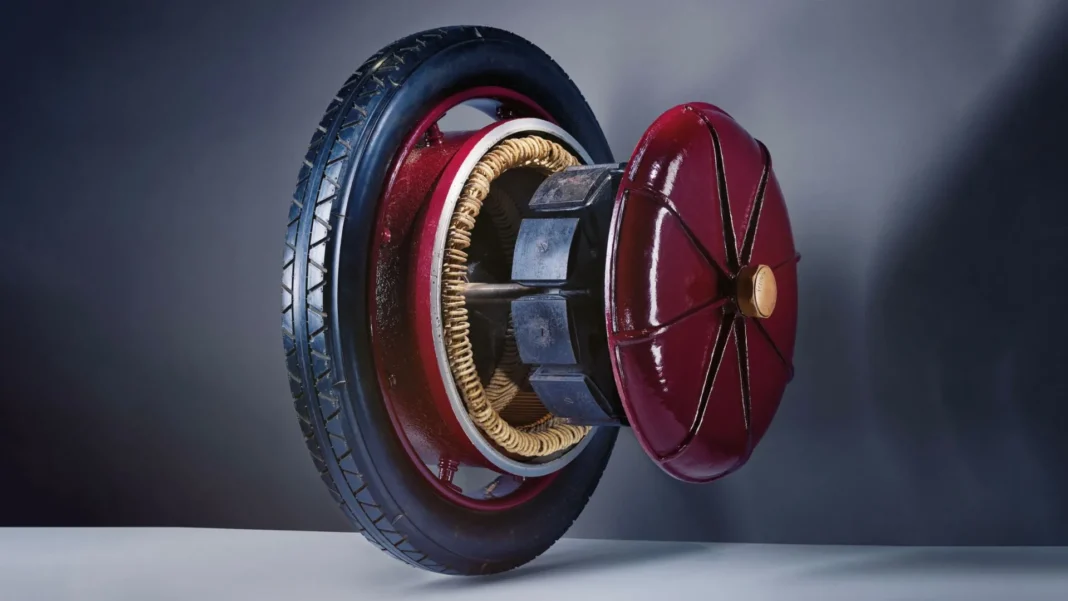

Porsche built its reputation with internal-combustion sports cars, but at the turn of the 20th century Ferdinand Porsche, whose son Ferry would later start the sports-car brand, tinkered with electric motors—including in-wheel hub motors.
The first electric-vehicle boom occurred at the turn of the 20th century, before internal combustion established itself as the dominant technology. And on Apr. 4, 1900, an EV that the then 24-year-old Porsche helped develop was unveiled at the Paris World’s Fair.
Having previously a complete electric car in 1898, Porsche designed electric motors to be integrated with the front hubs of a vehicle built by the Austrian firm of Jason Lohner & Co. in a period of only 10 weeks. Each motor generated 2.4 hp, which got the vehicle, known as a Lohner-Porsche, up to a top speed of 19.8 mph. Besides the motors, another notable innovation of the Lohner-Porsche was four-wheel braking—a rarity at the time.
Working with Ludwig Lohner, Porsche continued to develop hub motors, creating three sizes with outputs up to 11.8 hp for use in trucks and buses as well as passenger cars. These motors were intended for use with lead-acid batteries—typical of the time—that provided a claimed range of up to 31 miles.

Lohner-Porsche Semper Vivus hybrid
Porsche also designed an all-wheel drive electric race car named La Toujours Contente (French for “the one who’s always happy”), with one 13.8-hp motor powering each wheel. But the engineer’s hub motors saw the most use in hybrids—starting with the Lohner-Porsche Semper Vivus (Latin for “always alive”), which combined front hub motors with a gasoline engine.
Lohner and Porsche eventually applied the same hybrid layout to about 300 production vehicles, including 40 for the Viennese fire department, as well as assorted taxis and private passenger cars.
More than a century later, in-wheel motors are still attracting interest, although adoption for production vehicles has been slow. Chinese automaker Dongfeng claimed to be the first to use them in a fully-homologated passenger car in 2023, although they were also intended for the Lightyear 0 and Lordstown Endurance before production of both vehicle stalled.
Aptera is also including hub motors in what it claims will be a super-efficient 3-wheeler, and patent filings from Ferrari, Hyundai, and Toyota indicate they’re being studied by established automakers as well.