Since the current US administration eliminated federal EV tax credits, several states have implemented their own pro-EV measures, or beefed up existing programs.
The proposed $200-million incentive program will be limited to first-time EV buyers, will include price caps adopted by Congress in 2022, and will require automakers to contribute matching funds. The incentive amounts and other key details have not yet been announced.
Officials from the California Air Resources Board recently met with representatives of the Detroit Three automakers to talk about the plans.
CARB would seem to be facing a tough audience. All three automakers recently cancelled flagship EV programs, causing them to write off a chunk of change in sunk costs (an estimated $19.5 billion at Ford, $6 billion at GM), and arguably sabotaging their long-term competitiveness in the global market. If, as some suspect, their real reason for turning down the voltage was to appease an anti-EV federal administration, then they may dare to support a new incentive program in California.
One might speculate that relations are a little frosty between California and Detroit at the moment. Automakers have been only too willing to cooperate with the US administration as it undid much of the progress made by the California Air Resources Board towards reducing air pollution over the last few years. Last September, Newsom harshly criticized GM, saying that CEO Mary Barra “sold us out.”
CARB told The Mercury News that it plans to hold a workshop in the spring that will “gather stakeholder input,” and that more details “will be finalized in the coming months.”
Battery materials and technology company Talga has been granted a patent in Japan that builds on its Talnode-C product line, which combines shaping and coating methods as well as purification to make battery anode materials for use in high-power applications such as hybrid vehicles.
Japanese Patent No. 7779483, titled “Anode Material and Method for Producing Same”, protects Talga’s proprietary process for producing natural graphite anode material delivering superior energy density, long life and fast-charge capability for lithium-ion batteries.
The patent provides Talga with exclusive rights in Japan until at least 2040 and follows the granting of a patent in the US for the same technology.
The company has concluded anode test programs with several Japanese cell producers, and aims to capitalize on the Chinese Ministry of Commerce’s recent announcement of an immediate prohibition on exports of graphite products to Japan.
“The grant of this Japanese patent is a significant validation of our innovative anode technology at a time when global supply chains are under unprecedented strain. As China’s latest export controls highlight the fragility of graphite reliance, Talga’s Vittangi project offers a secure, high-performance and low-emission solution that can support the broader battery industry and rapidly growing energy storage transition,” said Mark Thompson, Talga’s founder and MD.
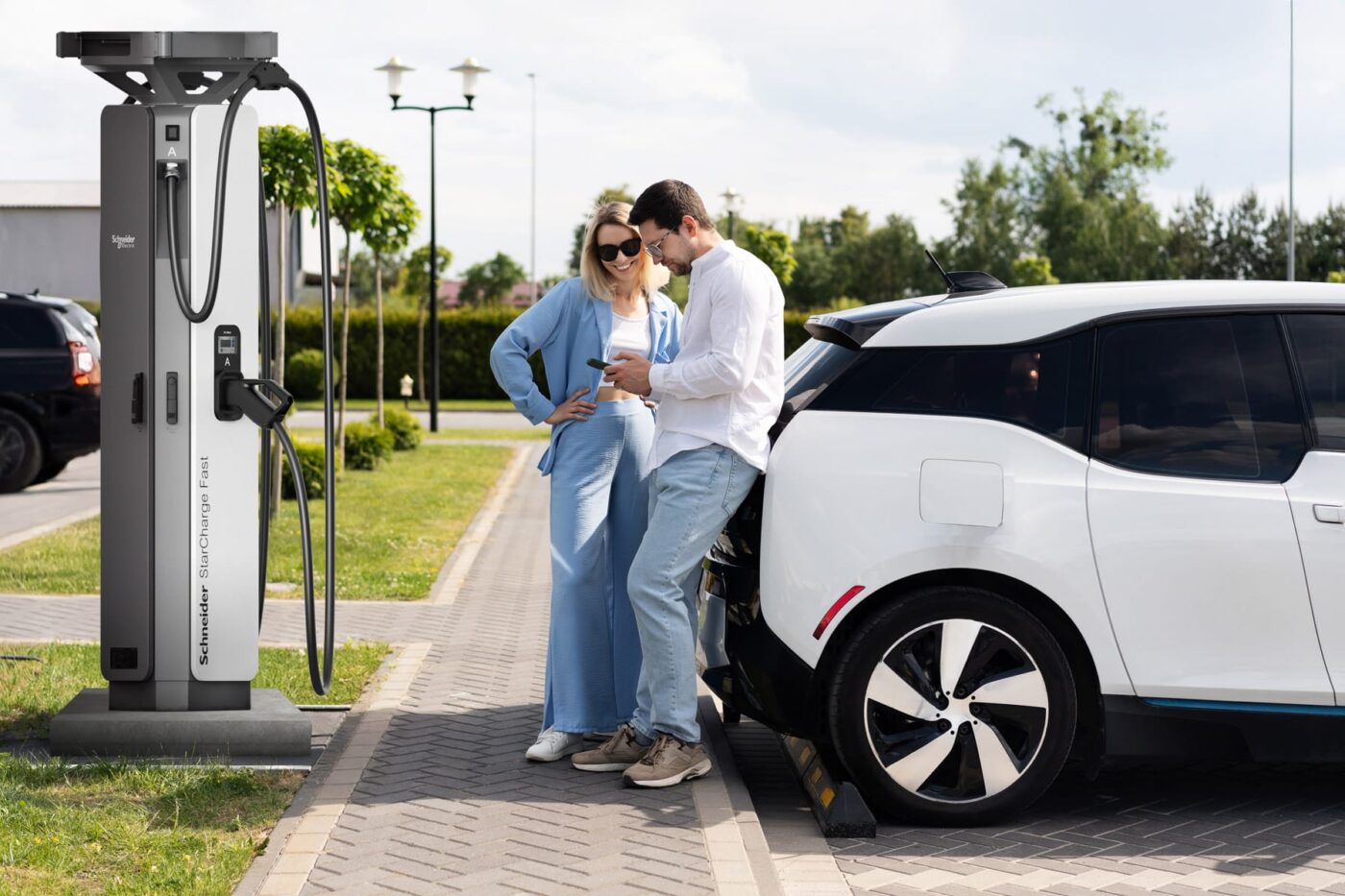
Schneider Electric has introduced Schneider StarCharge Fast 720, an EV charging system for commercial and industrial sites and fleet operators in Europe. The system delivers up to 720 kW and can charge up to 12 vehicles simultaneously, targeting higher-throughput charging as demand for eMobility grows.
Schneider Electric reports 97% efficiency for StarCharge Fast 720 and says it uses dynamic load management to optimize charging across multiple vehicle types, including e-trucks, buses and passenger cars. The company positions the product as a high-power option for sites that need to serve mixed fleets and keep vehicles moving.
The system uses a decentralized architecture to improve site layout flexibility. Operators can place up to six dispensers within an 80-meter radius of the power cabinet, enabling scalable configurations for different site footprints.
For installation and operations, Schneider Electric says the design can minimize grid connections, simplify installation, and reduce noise. StarCharge Fast 720 includes lifecycle support from installation through tailored maintenance plans, with 24/7 assistance and remote monitoring via Schneider Electric’s EcoStruxure Energy Asset Portal.
Cyclic Materials has closed a $75-million Series C equity round to scale its rare earth element recycling operations across the US and Europe and accelerate its Canada-based research and development footprint. The company says the funding will speed deployment of locally anchored recycling infrastructure for magnet-containing end-of-life scrap and magnet production waste—materials it processes to produce magnet rare earth elements, including heavy rare earth elements that it notes are less commonly available from Western mining deposits.
Cyclic Materials says that the new capital will support commercial rollout and global expansion with “a substantial focus” on North American market needs.
Cyclic Materials operates a two-stage physical and hydrometallurgical recycling technology to produce rare earth elements from end-of-life products and magnet production waste. It claims its approach reduces carbon footprint by 61.2%, cuts water use to five percent of what mining requires, and achieves recovery rates exceeding 98%. The company also says its recycling infrastructure can be deployed years faster than traditional mining projects, and it positions the system as a pathway to supply heavy rare earths used in high-performance permanent magnets.
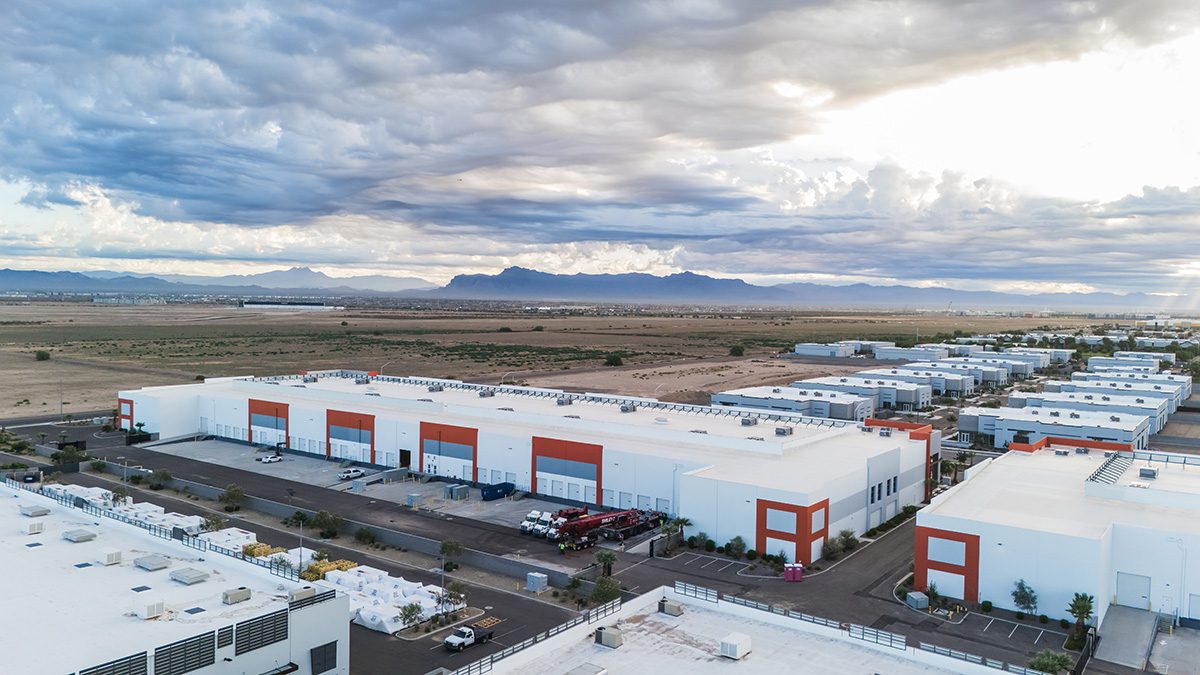
Cyclic Materials’ Mesa, Arizona site, the very first scale-up of a commercial plant for recycling and local production of rare earths in the US, with a focus on heavy and light rare earth magnets.
Cyclic Materials says its proprietary technologies can economically and sustainably recover critical raw materials from end-of-life electric vehicle motors (as well as wind turbines, MRI machines, and data center electronic waste). The company links these feedstocks to demand growth in e-mobility and other permanent-magnet-driven systems.
WattEV offers a Truck-as-a-Service solution for carriers and owner-operators—not only does the company have its own fleet of electric trucks, it also operates five heavy-duty EV charging depots, and has 15 more under development. Now the company has added more charging ports and increased the available charging power at its busiest electric truck charging depot, located in San Bernardino, California.
The San Bernardino truck charging depot, located adjacent to I-215, one of Southern California’s busiest freight corridors, has added thirty 250 kW CCS ports and six 1.2 MW MCS ports to its existing 24 ports, and offers 11.5 MW of total charging power. The site will now be able to charge up to 200 electric trucks per day while offering megawatt charging capability for trucks compatible with the MCS standard.
“At our San Bernardino depot, strong and sustained utilization—currently averaging approximately 700 MWh per month—has created the need to more than double the site’s capacity” said CEO Salim Youssefzadeh. “San Bernardino sits at the center of some of the most freight-dense corridors in the country, and scaling this depot enables us to support real-world fleet growth with reliable charging, dependable operations and infrastructure designed for long-term commercial deployment.”
Canada-based Northern Graphite and Saudi industrial group Obeikan Investment have signed a financing agreement to jointly develop and operate a large-scale battery anode material (BAM) facility in Saudi Arabia through a joint venture company.
The $200-million BAM facility will have an initial annual production capacity of 25,000 tonnes. Construction of the facility is expected to start in 2026 and first-phase production is expected to begin in 2028. The facility will be scalable over time to meet growing global demand for graphite anode materials sourced outside of China.
The facility will be located in Yanbu, a strategically positioned industrial and logistics hub on the Red Sea that has direct access to European, North American and Middle Eastern markets.
Obeikan will hold a 51% stake in the joint venture company and Northern Graphite will hold 49%.
Obeikan will lead the organizing of local debt funding required to finance construction, development and commissioning of the plant. The partners will provide the remaining funding as equity in proportion to their ownership interests and through commercial banks.
Northern and Obeikan are in negotiations with battery manufacturers to secure long-term offtake agreements for the initial 25,000 tonnes per year of production. The joint venture will also enter into a long-term offtake agreement to purchase up to 50,000 tonnes of graphite concentrate annually from Northern’s Okanjande project in Namibia. That agreement will accelerate the restart and potential expansion of the graphite mine, which has been in a care and maintenance status since 2018.
“We are partnering with a well-financed and experienced industrial player, gaining scale, financing strength, and access to one of the world’s most strategically important industrial hubs, while accelerating the restart of our Okanjande mine in Namibia and advancing our broader mine-to-market strategy,” said Hugues Jacquemin, Chief Executive Officer of Northern Graphite.
EVgo is expanding deployment of the North American Charging Standard (NACS) connectors across its public DC fast-charging network. After a 2025 pilot that installed nearly 100 NACS connectors across 22 major metropolitan areas, EVgo plans to accelerate deployment to reach more than 500 NACS connectors installed by the end of 2026, aiming to support rising demand from vehicles equipped with a NACS inlet.
EVgo says it will install NACS connectors at both existing and new sites, targeting both Tesla drivers and drivers of newer NACS-equipped EV models. The company expects that more than 80% of new EVs sold in North America will be NACS-compatible by 2030.
For 2026, EVgo says it intends to deploy additional NACS stalls in “key markets with increasing NACS vehicle penetration,” listing Austin, Houston, Las Vegas, Orlando, Phoenix, Chicago, Dallas, Detroit and San Francisco. Most sites are planned to include two to four NACS connectors, with the option to add more based on observed customer behavior and demand.
“We are already seeing an increase in NACS throughput on our network, and with more than 35 NACS models expected on American roads by the end of the year, we expect that to grow as we add more connectors throughout the country,” said Badar Khan, CEO of EVgo.
EVgo says drivers can enroll in Autocharge+ in the EVgo app to automatically start charging sessions at EVgo NACS locations without an adapter. EVgo also says most CCS (Combined Charging System) drivers can enroll in Autocharge+ as well, and that Autocharge+ has enabled over five million sessions on the EVgo network since its 2022 launch.
“Backed by rigorous testing at the EVgo Innovation Lab, we launched not only a market-leading product with our liquid-cooled NACS cables, but also a great customer experience by expanding Autocharge+ compatibility to serve both NACS and CCS drivers,” said Alex Keros, Senior VP of Product at EVgo.
Heilind Electronics is adding the Molex SideWize High-Voltage Connectors to its portfolio of high-power interconnect solutions. The connectors target space-constrained, high-power designs where engineers are balancing packaging, electrical safety and power density in power-distribution hardware, like EV charging systems, data-center power shelves, UPS equipment and industrial automation.
The Molex SideWize Connectors use a right-angle architecture intended to maximize power transfer in constrained environments. The connectors are rated up to 80 A and 1,500 V per UL 4128, positioning them for high-voltage, high-current systems. The design supports higher-wattage, denser power architectures “without increasing heat generation or installation complexity.”
The right-angle design is intended to eliminate cable bend-radius challenges, while color-coding, positive locking, and 360° cable rotation are meant to simplify mating and reduce cable wear.
South Korean metals producer Korea Zinc has signed a strategic partnership with US-based Alta Resource Technologies to produce rare earth oxides for applications including EVs.
The two companies plan to establish a joint venture in the US and build production facilities on the site of Korea Zinc’s US subsidiary to separate rare earth elements using Alta’s biochemical technology. The biochemical process platform technology uses custom-designed proteins to selectively separate and purify low-concentration rare earth elements contained within complex mixtures.
Korea Zinc is building a $7.4-billion integrated smelter in Tennessee to meet demand for supply outside of China.
The JV aims to start commercial operations in 2027, starting with an annual processing and production capacity of 100 tons of high-purity rare earth oxides. The JV plans to gradually expand production.
Production will focus on high-purity rare earth oxides such as neodymium oxide, praseodymium oxide, dysprosium oxide and terbium oxide, using permanent magnet waste located in the US as raw material.
The goal is to establish the foundation for a stable supply chain of rare earth oxides to both South Korea and the US.
Since 2022, Korea Zinc subsidiary PedalPoint has been forming a recycling value chain in the US through strategic acquisitions, including e-waste recycling company Igneo, electronics recycling company evTerra, scrap metal trading company Kataman Metals and IT asset management company MDSi. The recycling business is expected to ensure a stable supply of waste to the JV.
“Following our strategy to play a central role in the Korea-US core mineral supply chain by building a smelter in the US, this collaboration will be an important milestone in the rare earths sector, which has recently become increasingly strategically important worldwide,” said Choi Yoon-beom, Chairman of Korea Zinc.
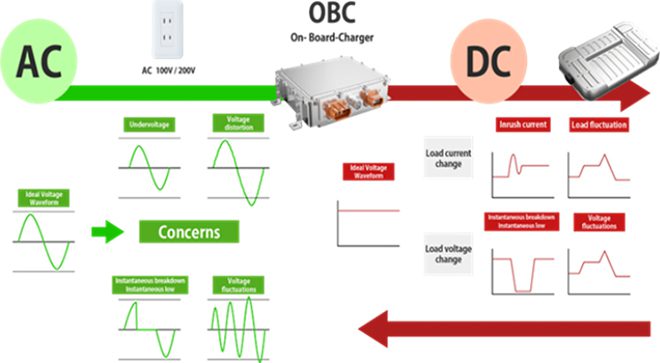
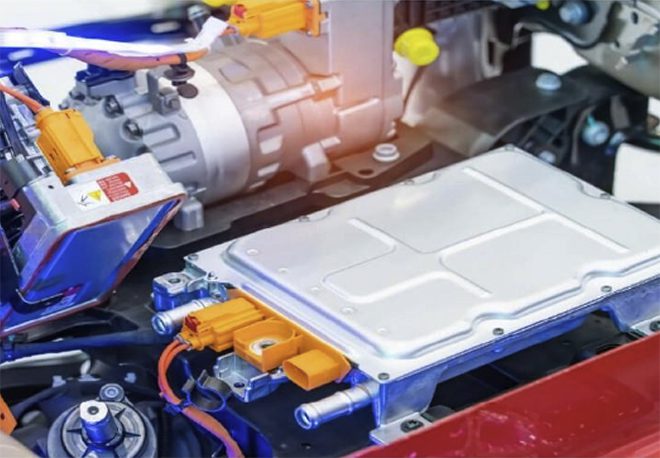
The global electric vehicle industry is experiencing rapid growth, driving an urgent demand for power conversion systems that are not only efficient but also highly reliable. Among these, the on-board charger (OBC) is a critical component, tasked with converting alternating current (AC) from various charging infrastructures, residential, commercial, or public, into direct current (DC) suitable for charging high-voltage battery systems.
The performance and safety of the OBC directly impact overall vehicle efficiency, battery health, and user experience. As the EV ecosystem evolves to incorporate advanced functionalities such as vehicle-to-grid (V2G), vehicle-to-home (V2H), and modular, distributed power electronics, the requirements for testing and validation have become more complex and rigorous, particularly under variable and dynamic electrical conditions.
This article presents a comprehensive overview of how Kikusui’s cutting-edge power testing solutions specifically, the PCR-WEA/WEA2 series of programmable AC/DC power supplies, the PXB series of bidirectional DC power supplies, and the PLZ-5WH2 high-speed DC electronic loads enable detailed evaluation, functional testing, and seamless system integration of OBCs and other critical EV power electronic components, including traction batteries. These tools support robust characterization across a range of real-world scenarios, contributing to improved design validation, compliance, and performance optimization in next-generation electric mobility systems.
Electric vehicle OBCs serve as the primary interface between the power grid and a vehicle’s high-voltage battery, enabling safe AC-to-DC conversion across a wide range of input conditions. Modern OBCs must not only provide efficient unidirectional charging but increasingly support bidirectional energy flow for V2H/V2G functions, grid-interactive services, and energy storage applications.
At the same time, automotive manufacturers are shifting toward compact, modular, and multifunctional power electronic assemblies, combining OBCs, DC/DC converters, and junction boxes into integrated units to reduce size, weight, and cost.
These advancements increase the need for:
Robust AC-side resilience against voltage sags, frequency variations, momentary interruptions, and harmonic distortion.
Stable DC-side control, ensuring proper charging behavior, battery protection, and compliance with global standards.
Test equipment capable of reproducing worldwide grid conditions, enabling repeatable and accelerated development.
Kikusui’s laboratory-grade power systems provide this controlled environment, ensuring OBCs and battery systems are verified under real-world electrical variability with high fidelity.
Figure 1. AC–DC Conversion of Voltage and Current Waveforms in an On-Board Charger (OBC).
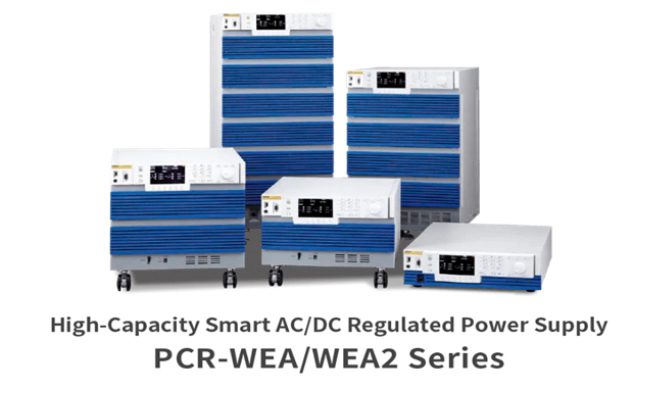
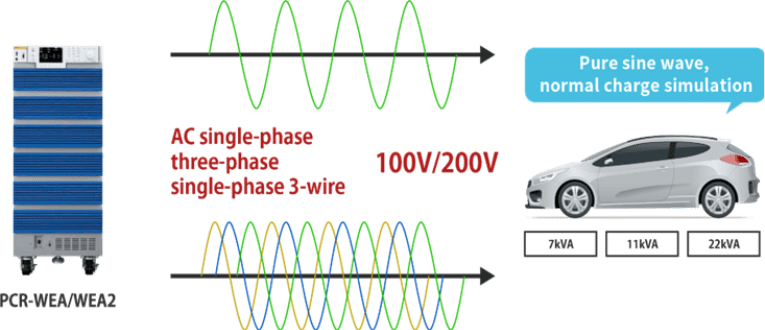
AC-Side Evaluation of On-Board Chargers The PCR-WEA/WEA2 Series is a high-capacity AC/DC regulated power supply designed for flexible, high-precision grid simulation. It supports all major global AC configurations used for electric vehicle (EV) charging, including:
Single-phase 120 V (commonly used in USA)
Single-phase 200 V three-wire (L1-N-L2, typically 100 V line-to-neutral, 200 V line-to-line)
Three-phase 208V (line-to-line), common in industrial or commercial charging applications
A single PCR-WEA/WEA2 unit can replicate these voltage and phase conditions without requiring additional hardware, significantly reducing test complexity and enabling rapid configuration changes for global compliance testing.
The 15-model PCR-WEA2 lineup offers AC/DC output from 1 kVA to 36 kVA, with variable single- and three-phase output from 6 kVA upward. It features a regenerative mode for reduced power consumption and supports mix-and-match parallel operation up to 144 kVA for scalable test systems, the series offers:
Output frequency flexibility up to 5 kHz
4x rated peak current capability
1.4x inrush current tolerance for 500 ms
These features enable engineers to accurately evaluate OBC performance during startup, simulate real-world grid disturbances, and validate transient handling during rapid load transitions.
Available power configurations options 1 kVA and 2 kVA, 4 kVA, 8 kVA, 12 kVA, 16 kVA, 20 kVA, and 24 kVA. For applications requiring higher capacity, parallel operation can extend the output up to 96 kVA. Additionally, the three-phase PCR-WEA2 series is available in 3 kVA, 6 kVA, 12 kVA, 18 kVA, 24 kVA, 30 kVA, and 36 kVA models, with parallel expansion possible up to 144 kVA.
Figure 2. AC Power Simulation for EV Charging: Single-Phase and Three-Phase 100V/200V Inputs Delivering Pure Sine Wave Outputs for 7kW, 11kW, and 22kW Charging.
Key Features and Benefits of PCR-WEA/WEA2:
Versatile Output Configurations supporting all major EV charging voltages.
Ultra-Compact Design providing high power density for reduced lab footprint.
Exceptional Transient Handling for inrush and peak-load events.
Advanced Sequencing Functions to simulate disturbances, harmonics, and advanced grid behavior.
Global Grid Simulation with adjustable voltage, frequency, and phase.
Proven Reliability, widely used in Japanese automotive and consumer electronics industries.
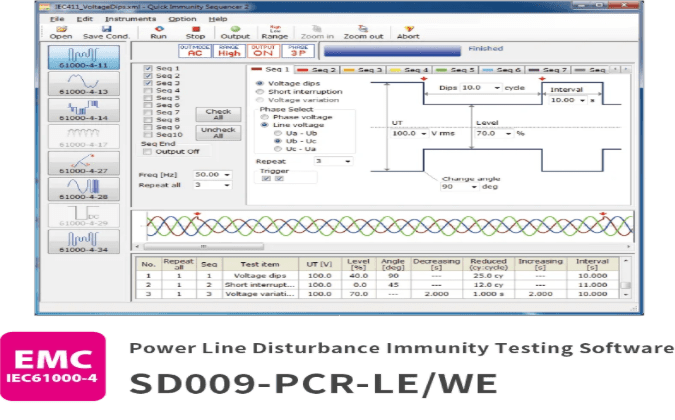
Sequence Functions for Advanced AC Simulation The PCR-WEA/WEA2 Series incorporates sophisticated waveform programming that allows engineers to replicate complex utility grid behavior with precision. These functions are essential for evaluating OBC reliability, EMC performance, and compliance with international test standards.
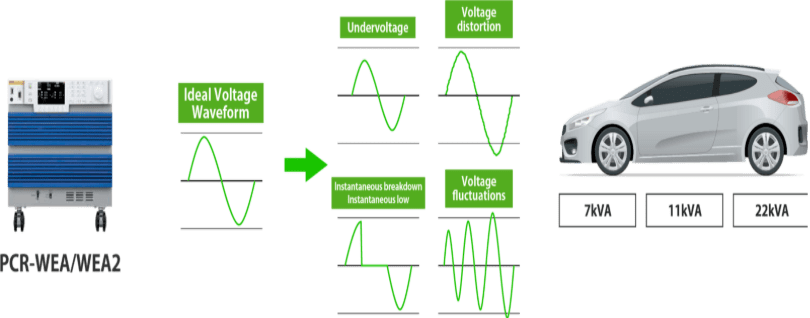
Simulation of Power Disturbances
The system can reproduce a range of real-world anomalies, including:
Undervoltage/Overvoltage
Voltage dips, swells, and fluctuations
Instantaneous interruptions
Waveform distortion
These simulations help verify OBC operation during brownouts, unstable infrastructure, and transient grid events.
Harmonic and Phase Control
The PCR-WEA/WEA2 supports harmonic synthesis up to the 40th order, enabling detailed analysis of power factor correction (PFC) behavior and OBC EMI performance. Adjustable initial phase settings (e.g., 0°, 90°, 270°) enable worst-case startup scenario testing.
Compliance and Standards Testing
The series supports testing aligned with major global power quality standards, such as:
IEC 61000-4-11 – Voltage dips, short interruptions, variations
IEC 61000-4-28 – Frequency variations
IEC 61000-4-34 – Voltage disturbances for high-current equipment
These features help manufacturers validate devices before formal certification, reducing development cycles and compliance risk.
Figure 3. Various Sequence Functions: Simulation of Voltage Dips, Interruptions, and Harmonic Waveforms for Compliance with IEC 61000 Standards
DC-Side Evaluation of On-Board Chargers To complement AC-side testing, Kikusui provides powerful DC-side test instruments, including the PXB Series bidirectional DC power supply and the PLZ-5WH2 Series high-speed DC electronic load.
PXB Series – Bidirectional High-Capacity DC Power Supply
The PXB Series offers bidirectional operation, allowing both sourcing and sinking of power for energy-regenerative testing. This reduces total energy consumption during extended test cycles.
Supporting voltages up to 1,500 V, the PXB series is ideal for evaluating high-voltage battery systems (300–750 VDC typical). Its regenerative capability simulates both charging and discharging conditions, closely reflecting actual EV operating environments.
PLZ-5WH2 Series – DC Electronic Load
The PLZ-5WH2 Series provides high-speed transient response and precise dynamic load control, enabling accurate measurement of OBC output characteristics such as voltage regulation, ripple, and transient response.
With voltage handling up to 1,000 V, it allows engineers to evaluate the OBC’s behavior under sudden load changes, ensuring safety and reliability in real-world operation.
System Integration and Application Flexibility By combining the PCR-WEA/WEA2, PXB, and PLZ-5WH2 systems, Kikusui delivers a fully integrated OBC test environment capable of simulating both grid-side and battery-side conditions with precision.
This integrated platform allows:
End-to-End AC–DC performance testing under variable grid conditions
Long-term endurance and efficiency testing through regenerative power flow
Harmonic, transient, and compliance testing per global standards
Optimized energy use through power regeneration
Such a setup ensures comprehensive validation and accelerated development of next-generation OBC and EV power systems.
Conclusion As EV power electronics expand in capability and complexity, the need for high-precision, globally representative test environments continues to grow. Kikusui’s PCR-WEA/WEA2, PXB, and PLZ-5WH2 series provide a comprehensive solution for AC and DC evaluation of OBCs, high-voltage battery systems, and related power electronics.
By delivering advanced harmonic simulation, regenerative operation, fast transient control, and compliance-oriented sequence functions, these instruments enable engineers to design, validate, and integrate next-generation EV charging and energy-management systems with confidence.