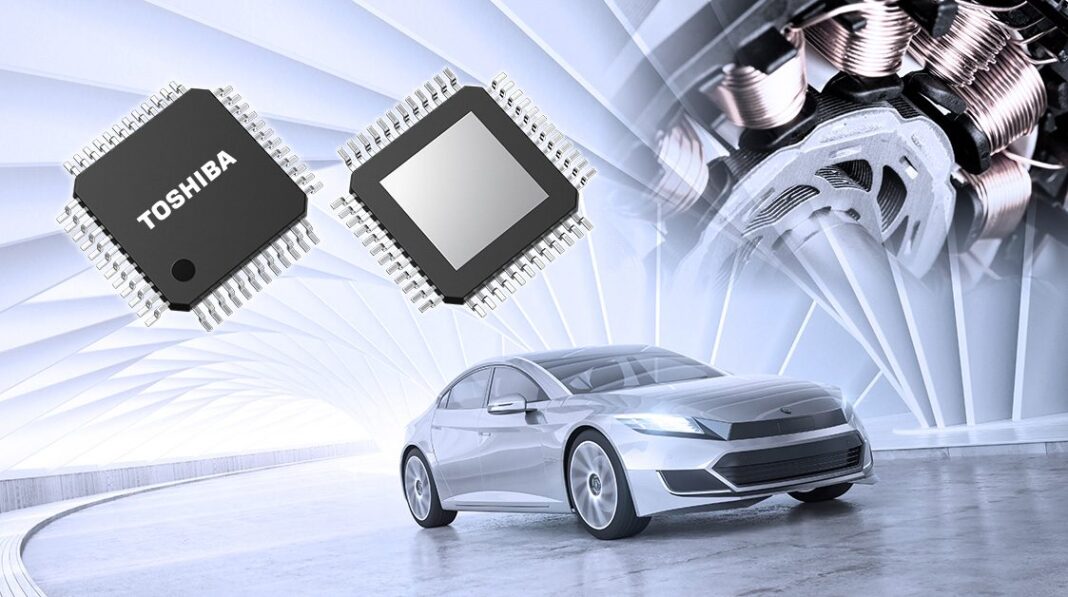

Toshiba Electronic Devices & Storage Corporation has started shipping engineering samples of the TB9M030FG, the latest in its SmartMCD series of automotive motor control devices. The chip combines a microcontroller and gate driver in a single package and adds a proprietary sensorless approach that enables position-sensorless FOC from zero speed—without the acoustic noise produced by standard high-frequency signal injection methods.
The challenge with sensorless control of three-phase brushless DC motors is detecting rotor position at low speed. Standard approaches superimpose a high-frequency voltage signal onto the drive waveform to infer position, but that harmonic injection generates noise and audible motor sound. Toshiba says its approach enables stable sensorless FOC from zero speed through the low-speed range on salient-pole motors, without that acoustic penalty.
| Spec | Value |
|---|---|
| MCU core | 32-bit Arm Cortex-M0, 40 MHz |
| Memory | 64 KB flash (ECC), 12 KB ROM, 4 KB RAM |
| Package | 9×9 mm QFP48 |
| Supply voltage (Vbat) | 6–18 V operating; –0.3 to +40 V abs. max |
| Operating temp (Ta) | –40 to +150 °C |
| Junction temp (Tj) | –40 to +175 °C |
| Communication | LIN (1ch, responder), UART, SPI, PWM |
| Current sensing | 1-shunt resistor current sense amplifier |
| ADC | 12-bit and 10-bit |
| Qualification | AEC-Q100 Grade 0 |
Target applications include electric water pumps, oil pumps, fans and blowers, where electrification of automotive auxiliary systems is pushing demand for more integrated, quieter motor control. Built-in vector engine hardware handles FOC computation offboard the CPU core, reducing software overhead and program size.
Mass production is scheduled for January 2027.
Source: Toshiba Electronic Devices & Storage Corporation