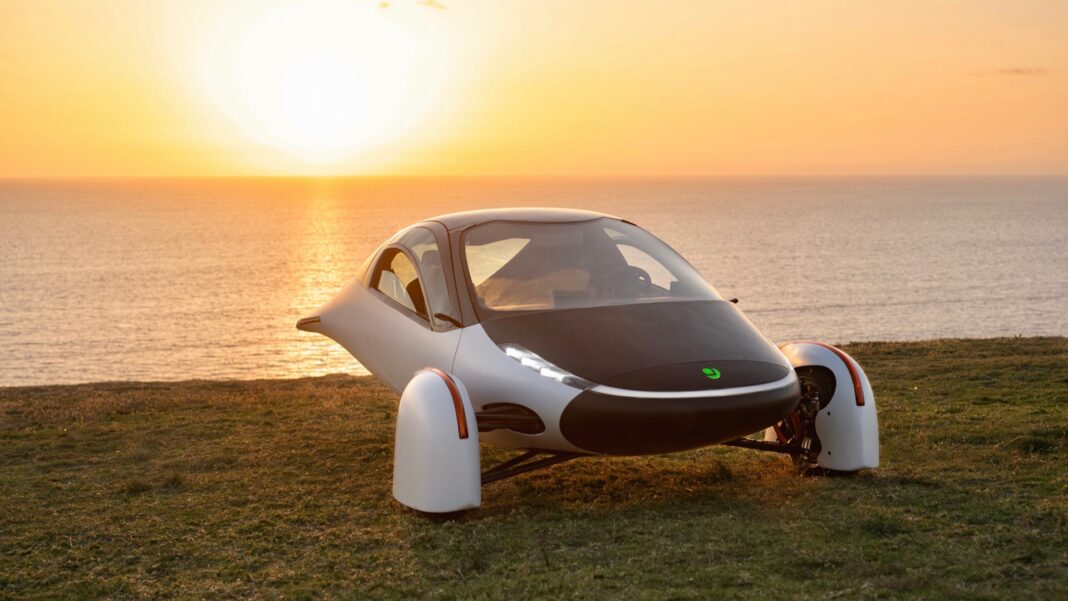

- “Real-world validation testing” completed on inboard-motor setup
- Aptera switched to the layout, instead of in-wheel motors, for its future solar EV
- Per-mile energy consumption remains in line with previous layout
Aptera last week announced that it had completed the first round of “real-world validation testing” of its solar-assisted 3-wheeled electric vehicle—after effectively starting over on some aspects of its powertrain.
An Aptera press release said the company had completed this first round of testing—primarily focused on aerodynamics—at a proving ground in the Mojave Desert. But as Aptera said with 2022 Aptera performance preview video, it did lots of real-world dynamic testing and validation, looking at handling, dive, lift, and high-speed stability with the original in-wheel motor configuration.
But this latest round of tests is the first using electric motors in the conventional inboard position, Aptera co-founder and co-CEO Steve Fambro clarified in a statement to Green Car Reports.

Aptera with Elaphe motors
“As we complete the first round of validation with our new in-board powertrain, we’re seeing strong results that align with our efficiency and performance targets,” Fambro said, in a response to a question about how the inboard motors are measuring up. “While we can’t offer a direct comparison—since Aptera never had a production-intent vehicle with in-wheel motors—our initial testing with our in-board powertrain confirms that we continue to achieve Aptera’s signature ultra-efficiency, with energy consumption per mile remaining in line with our expectations.”
Aptera only completed its first production-intent vehicle last October, combining the new inboard powertrain with other production-spec elements for validation testing. That included coast-down tests, in which vehicles are allowed to coast to a stop to measure aerodynamic drag and driveline energy losses. Aptera claimed one of its production-intent vehicles took three minutes to coast from 60 mph to a complete stop. That’s a positive sign for high aerodynamic efficiency.
Aptera’s release said the company also conducted aerodynamic “tuft testing,” in which material is applied to areas such as the wheel fairings to visually check airflow, and a highway drive cycle measuring energy consumption over hundreds of miles. It plans to conduct range and charging tests next, once more production-spec parts are available and panel fit is further dialed in.

Aptera production-intent vehicle
Dropping in-wheel motors, which was reportedly a cost-related move, was surprising as Aptera had banked a lot of its image and innovation on the tech. Aptera’s Chris Anthony had explained to Jay Leno that engineers could get 30% more regenerative braking than from an induction motor this way, because of in-wheel motors’ greater leverage with magnets away from the axis.
Aptera wants to be more than a niche firm, and it’s mentioned again in recent months that it aspires to build a million vehicles by 2033—amid finances that appear so thin that it might be limited in how many more prototypes it can build.