Sunday, April 19, 2026
6.9 C
London
Home Blog Page 113

Supreme Court rejects challenge to California EV mandate—for now

0


The U.S. Supreme Court on Friday declined to hear a challenge to California’s emissions authority, allowing the state to, for the time being, continue with plans to gradually phase out sales of new internal-combustion vehicles.

The Court denied a petition by Ohio and other states to consider the merits of challenges by oil and gas companies to California’s Clean Air Act waiver, which allows the state to set its own, stricter emissions standards. The Court said it would only consider whether those companies had standing to bring their claims.

This removes one potential threat to California’s regulatory authority, but there’s likely more where that came from. As California prepares to ban the sale of non-plug-in gasoline vehicles by 2035, conservative interests are targeting its EV-friendly policies.

Rivian Adventure Network charging site in Joshua Tree, California

Rivian Adventure Network charging site in Joshua Tree, California

The Heritage Foundation’s Project 2025, which might serve as a blueprint for the incoming Trump Administration, doesn’t call for an outright revocation of the waiver, but does aim for it to be reduced to cover only pollution issues specific to that state, as well as ensuring that other states that adopt California environmental standards only do so for “traditional/criteria pollutants”—not greenhouse gas emissions.

This would effectively excise the EV portion of California’s emissions standards, making for a much more surgical strike against EV policy than in the previous Trump Administration, which acted to remove California’s emissions authority outright in 2019. That challenge went to the courts, for different reasons, and the emissions authority was eventually restored by the Biden Administration.
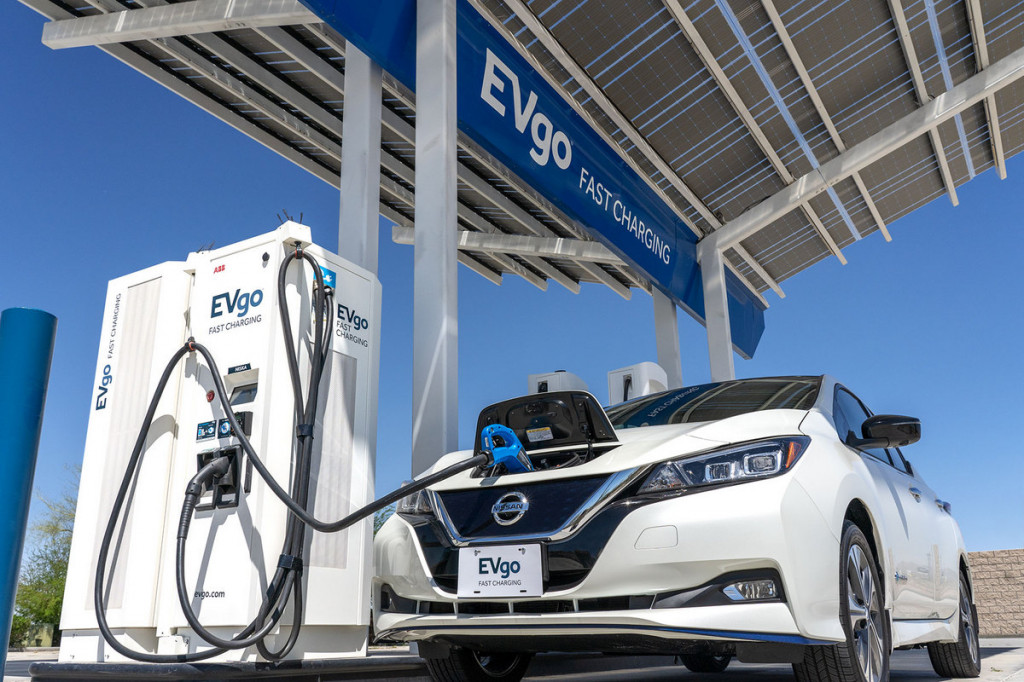
Nissan Leaf charging at EVgo fast charger in Baker, California

Nissan Leaf charging at EVgo fast charger in Baker, California

Last time around, a series of automakers made side deals with California, backing it because it simply made better sense on the global landscape. BMW, Ford, Honda, Volkswagen, and Volvo asked a federal court to uphold California’s emissions authority, while General Motors, Fiat Chrysler Automobiles (now Stellantis), and Toyota sided with Trump.

It’s unclear how aggressive the second Trump Administration will be in trying to dismantle Biden’s clean-energy and EV-focused policy, but things do not look good on that front. In this case, though, attacking policies will also mean attacking states’ rights—ostensibly one of the core values of the Republican Party.


Source link

Audi Q5 and A7 PHEV recalled due to fire concerns

0


Audi is recalling 4,616 plug-in hybrids because of a battery issue that could lead to fires.

The recall includes certain 2022 and 2023 Audi Q5 plug-in hybrid crossovers, as well as 2022 Audi A7 plug-in hybrid hatchbacks. These vehicles may have defective battery modules that could overheat, presenting a fire risk, according to the National Highway Traffic Safety Administration (NHTSA).

While the root cause of the defect is still under investigation, the safety regulator said “current analysis results show that certain manufacturing deviations may have occurred” that could have led to the overheating issue.

2022 Audi A7

2022 Audi A7

Audi estimates that just 1% of the recalled vehicles actually have the defect, which was discovered in markets outside the U.S. Audi told the NHTSA that it is unaware of any injuries, crashes, or fires, related to this issue in the U.S.

For now, the remedy is additional diagnostic software, which Audi expects to be ready by the second quarter of 2025. Dealers will install this software free of charge when it’s available.

Some vehicles have online data monitoring, for which Audi will check for problematic modules and advise owners not to charge their vehicles until the battery pack can be replaced. For vehicles without this data monitoring, owners are being advised from the get-go to avoid charging until a final remedy can be devised.

Audi plans to mail initial notification letters Jan. 24, 2025, with a second notification once a final remedy is devised. Owners can contact Audi customer service at 1-800-253-2834 for more information. Audi’s reference number for this recall is 93AA.


2022 Audi Q5 55 TFSI e plug-in hybrid

2022 Audi Q5 55 TFSI e plug-in hybrid

The Q5 plug-in hybrid arrived for the 2020 model year and impressed us with its excellent drivability, while the A7 plug-in hybrid arrived for the 2021 model year. The two models share a powertrain, which returns an EPA-rated 23 miles of electric range for the Q5 and 26 miles for the A7.

Battery recalls can escalate into expensive and complicated episodes for automakers. After attempted software fixes, Jaguar last month decided to buy back nearly 3,000 I-Pace crossovers due to a battery issue that presented a fire risk. General Motors was forced to replace many Chevrolet Bolt EV battery packs as part of its own massive recall.


Source link

Green Car Reports Best Car To Buy 2025 finalist

0


  • Base price of $34,270 secures a 200-mile EPA range from less than 50 kwh
  • Fast-charging times lag Hyundai’s E-GMP (Ioniq) EVs, but V2L adds usefulness
  • Smart interior design, latest infotainment system amount to a modern look and feel 

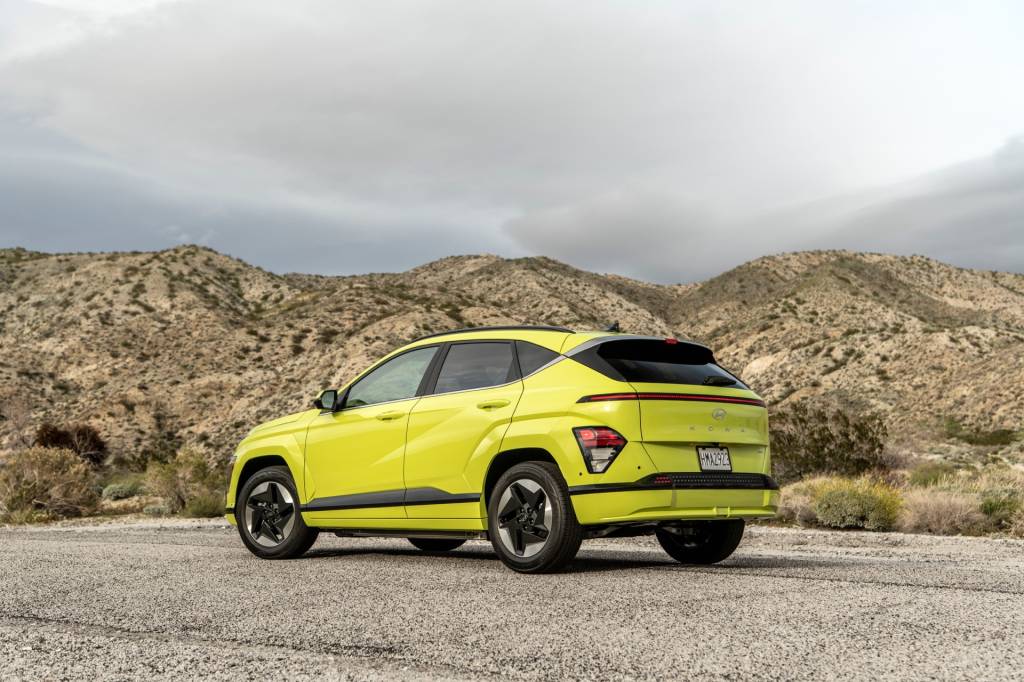
The Hyundai Kona Electric is one of Green Car Reports’ Best Car To Buy 2025 finalists, and it exemplifies a formula that’s in short supply in today’s U.S. electric vehicle market: that of the roomy, affordable small car that makes good driving range from a relatively modest battery pack.

The Kona Electric isn’t built on a dedicated electric-vehicle platform, but it might be mistaken for it. Despite its 171.5-inch length, the Kona Electric can fit four adults comfortably—or five in a pinch. Packaging is smart, allowing a roomy 25.5 cubic feet behind the second row and 63.7 cubic feet when folded forward. 

This time around, the Kona Electric outshines gasoline versions of this small-car family in performance, ride, and refinement, with all but the base SE getting a perky 201-hp electric motor at the front wheels. It drives with a lean, responsive feel, and its crisp, modern displays and switchgear feel directly inherited from Hyundai’s Ioniq 5 and Ioniq 6 EVs. All models get a large 12.3-inch touchscreen, wireless Apple CarPlay and Android Auto, a built-in wifi hotspot, over-the-air update capability, and V2L (vehicle-to-load) compatibility in all versions offers up to 3.6 kw of AC power for worksite tools, camping accessories, and more. 

2024 Hyundai Kona Electric

2024 Hyundai Kona Electric

2024 Hyundai Kona Electric

2024 Hyundai Kona Electric

2024 Hyundai Kona Electric

2024 Hyundai Kona Electric

The Kona Electric runs on 400 volts, unlike those 800-volt Ioniq models and their E-GMP platform, but its DC fast-charging time of 43 minutes from 10-80% is respectable for urban commuters who take the occasional highway trip. 

With the Chevrolet Bolt EV on hiatus until at least late calendar-year 2025 and the 2026 model year, the Kona Electric is the closest modern-EV alternative, landing in a corner of the market—high value, small size—that’s otherwise not well represented in the American market. The Kona Electric starts at $34,270, including the $1,395 destination fee. That’s for the SE, with the 48.6-kwh battery pack and 200-mile EPA range rating. SEL models, which step up to the 64.8-kwh battery pack and 261-mile range rating, cost $38,270, get heated front seats and a power driver seat, and are probably the sweet spot of the lineup for most considering this model. 

Sporty N Line versions start at $40,270, and get various sporty cosmetic upgrades plus Bose premium audio, while top $42,445 Limited versions have a hands-free tailgate, a surround-view camera system, and several additional active-safety systems. At that price, however, you run into some of the same value-for-money hurdles we’ve pointed out for the Kia Niro EV.

2024 Hyundai Kona Electric

2024 Hyundai Kona Electric

Competition is sparse—only the dated Nissan Leaf; the Fiat 500e, which is a two-door model; and the Mini Countryman SE ALL4, which starts at $46,195 and is now a larger vehicle than the Kona. The overdue-and-delayed Volvo EX30, which was due to start at $36,245 will make an especially strong rival to the Kona Electric, when it does arrive. 

Does the Hyundai Kona Electric make a big enough impact on the EV market to top the other four Best Car To Buy 2025 Finalists? Check back Jan. 6.


Source link

Electric Lamborghini delayed to 2029 because market isn’t ready

0


Lamborghini is delaying its first fully electric model by a year, hoping that market conditions will be more favorable at that time, Reuters reports.

“We do not think 2029 is late to have an electric cars,” CEO Stephan Winkelmann told Reuters and other media outlets Monday at Lamborghini’s headquarters in Sant’Agata Bolognese, Italy. “We do not think that, in our segment, the market will be ready in 2025 or 2026.”

Lamborghini Lanzador concept

Lamborghini Lanzador concept

Winkelmann said Lamborghini is also waiting for regularity clarification in Europe. In 2026, the European Union is scheduled to undertake a review of its plan to phase out sales of new internal-combustion vehicles by 2035 that Winkelmann believes could give Lamborghini an out from going all-electric.

“There are discussions around synthetic fuels and this is an opportunity for our kind of cars,” the Lamborghini CEO said.

In 2023, Lamborghini confirmed that its first EV would be a 2+2 grand tourer targeting 300 miles of range and a comfortable rear seat. It subsequently previewed this model with the Lanzador concept, announcing a 2028 target launch date.

Lamborghini Lanzador concept

Lamborghini Lanzador concept

Lamborghini has maintained throughout that its signature supercars will be the last to go electric. The automaker plans to stick with plug-in hybrid powertrains in those models for now, while reserving all-electric powertrains for other vehicle types. That view is shared by rival McLaren. In 2023, the British automaker’s CEO said he didn’t expect an electric supercar to be viable until 2030.

Meanwhile, Lamborghini’s traditional rival, Ferrari, is moving ahead with plans for its own $500,000 EV. Due for a later 2025 reveal, the electric Ferrari will be assembled at a new factory just north of the automaker’s existing campus in Maranello, Italy.


Source link

Ford and SK On get $9.63B government loan for battery plant

0


Ford and SK On will receive a $9.63 billion government loan for their BlueOval SK battery joint venture, according to a report Monday from Reuters.

The news ups the original loan amount, which was $9.2 billion, reported in June by The New York Times.

The Department of Energy loan—the largest so far by the Biden administration related to EV manufacturing—will help finance construction of battery plants in Kentucky and Tennessee.

Ford announced the plants in 2021, quoting a record $11.4 billion investment and the creation of nearly 11,000 new jobs at the two mammoth manufacturing complexes. The automaker and SK On said in 2021 that the BlueOval SK joint venture would target 60 gigawatt-hours of annual battery cell production by the middle of the decade.

BlueOvalSK Battery Park - rendering, September 2021

BlueOvalSK Battery Park – rendering, September 2021

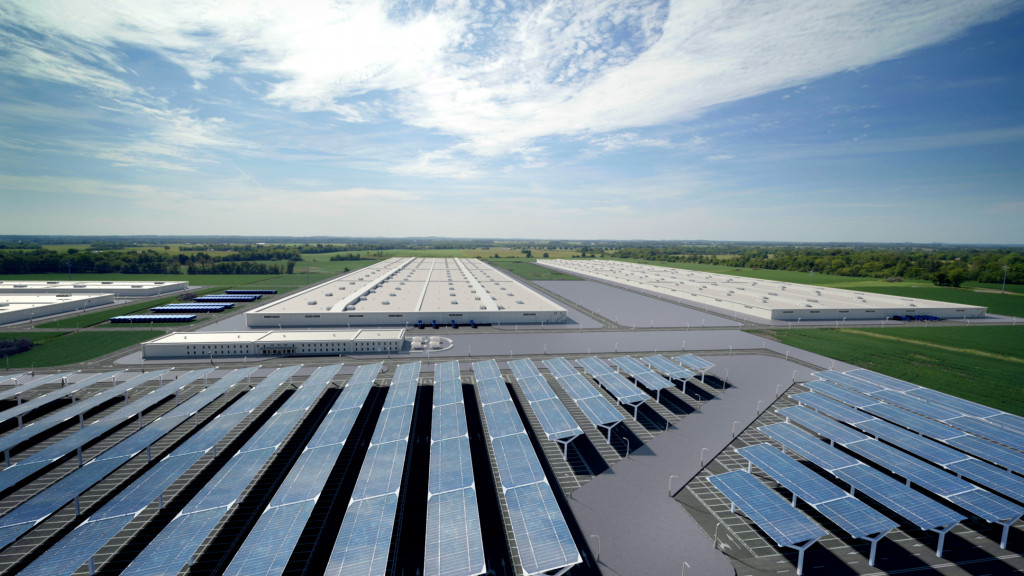
The plans include Blue Oval City, in west Tennessee, and BlueOval SK Battery Park, with twin battery plants at the same site, in central Kentucky. Ford said in 2021 that it would build both complexes, and planned to have them operational by 2025.

Blue Oval City encompasses not only a battery plant, but also a supplier park and vehicle assembly plant that will produce electric trucks, including the next-generation F-150 Lightning. SK On is already manufacturing cells for the current-generation Lightning in Georgia.

The BlueOval SK Battery Park complex in central Kentucky will consist of two battery plants producing cells for future Ford and Lincoln EVs.

BlueOvalSK Battery Park - rendering, September 2021

BlueOvalSK Battery Park – rendering, September 2021

In addition to the BlueOval SK complexes, Ford in February announced a deal with CATL for a $3.5 billion battery plant in Marshall, Michigan. The automaker also continues to assemble the Mustang Mach-E in Mexico using LG cells sourced from a factory in Poland.

The Energy Department loan is the largest so far under a revived program once used by the Obama administration to fund Tesla, Nissan, and Ford, among others, but ignored by the Trump administration. Under President Biden, the Energy Department has extended a $2 billion loan to Tesla veteran JB Straubel’s Redwood Materials battery-recycling company and a $2.5 billion loan to General Motors’ Ultium Cells LLC battery joint venture with LG.

Note – This story was update to reflect a new loan amount as of December


Source link

Audi Q8 E-Tron production ends in February

0


  • Production of the Audi Q8 E-Tron ends Feb. 28
  • It’s unclear if 2025 Q8 E-Trons will arrive in the U.S.
  • Audi’s EV lineup will continue with the Q4 E-Tron, Q6 E-Tron, A6 E-Tron, and E-Tron GT

Audi will stop Q8 E-Tron production two months into the new year, bringing an end to the electric SUV that—in its original E-Tron form—ushered in Audi’s electric era.

First reported by Reuters, the factory in Brussels, Belgium, that builds the Q8 E-Tron will shut down by Feb. 28. Audi had been seeking to sell the Belgian plant, and a shutdown has seemed likely since November, when the automaker told Reuters that it had been unable to find a buyer. And Automotive News reported in July that the Q8 E-Tron might be on the chopping block.

2025 Audi Q8 E-Tron

2025 Audi Q8 E-Tron

Now we know that the Q8 E-Tron is indeed on the way out, as production will not be shifted to another plant. While Audi has already announced 2025-model-year pricing, a spokesperson told Green Car Reports that all vehicles currently in the automaker’s U.S. inventory are 2024 models. The availability of 2025 models will depend on whether any remaining production is allocated to the U.S.

Audi was only planning small changes to feature content for 2025, plus a $600 base-price bump to $76,095 (including a $1,295 destination charge).

2025 Audi Q8 E-Tron

2025 Audi Q8 E-Tron

The Q8 E-Tron was only launched for the 2024 model year, as a heavy update of the Audi E-Tron, the automaker’s first volume EV. It carried over all the good things from the E-Tron—including good safety ratings—but with somewhat sharpened handling and more driving range. It achieved up to 300 miles of EPA range in sleeker Sportback form with the efficiency-focused Ultra Package, but that option was due to be discontinued for 2025, knocking range down to 272 miles.

While the Q8 E-Tron shares its MLB platform with gasoline models, Audi now has multiple dedicated EV platforms at its disposal. The entry-level Q4 E-Tron shares with MEB platform with Volkswagen EVs like the ID.4, the E-Tron GT is based on the same J1 platform as the Porsche Taycan, and the incoming Q6 E-Tron and A6 E-Tron use the same Premium Platform Electric (PPE) as the Porsche Macan EV. PPE will likely serve as the basis for Audi EVs going forward—including any potential replacement for the Q8 E-Tron.


Source link

2025 Toyota bZ4x price drops by up to $6,000

0


  • The 2025 Toyota bZ4x costs $38,465
  • Toyota gave the bZ4x a $6,000 price cut; Limited trims are now $5,380 less expensive
  • EPA range ratings should max out at 252 miles

Expected to arrive at U.S. dealerships early next year, the 2025 Toyota bZ4x gets a price cut, as well as more driver-assist features and a new Nightshade Edition grade.

The base price of the entry-level XLE is now $38,465 with the $1,395 destination charge. That is $6,000 lower than the equivalent 2024 model.

The Limited grade now starts at $43,195 with destination, which is a $5,380 price cut. Limited models replace the XLE’s 18-inch wheels with 20-inch rolling stock, and add convenience features like power front seats with heating and cooling. For 2025, traffic jam assist, lane change assist, and front cross-traffic alerts are now standard on Limited models as well.

2025 Toyota bZ4x

2025 Toyota bZ4x

Also new for 2025 is a Nightshade Edition that brings the blackout treatment previously seen on Toyota hybrids to the all-electric bZ4X for $41,815 with destination. Based on the XLE grade, Nightshade models add black 20-inch wheels, as well as a black rear spoiler, door handles, and badges, on the outside, and red contrast stitching on the inside.

A single-motor front-wheel-drive powertrain rated at 201 hp remains standard. Dual-motor all-wheel drive, with a bump to 214 hp, is a $2,080 option on the XLE and Limited grades, and standard on the Nightshade. Single-motor models continue with a 71.4-kwh battery pack using cells from Panasonic, while dual-motor models have a 72.8-kwh pack with CATL cells.

Toyota expects unchanged EPA range ratings, maxing out at 252 miles for single-motor XLE models. That drops to 228 miles for dual-motor XLE models. With their bigger wheels, Limited models should remain at 236 miles with the single-motor powertrain and 222 miles with the dual-motor powertrain. The latter number also applies to Nightshade models.

Introduced for the 2023 model year, the bZ4x is a virtual twin of the Subaru Solterra, and is also closely related to the Lexus RZ. It remains the only EV in Toyota’s U.S. lineup, but that will change soon as the automaker looks to start U.S. EV production within the next two years.


Source link

Honda Prelude returns as sporty hybrid in 2025

0


  • The Honda Prelude returns as a hybrid coupe in 2025
  • The new Prelude likely won’t have a manual transmission
  • The Prelude is expected to use the Civic Hybrid’s powertrain

The Honda Prelude coupe will return to the U.S. as a hybrid late next year, Honda announced Tuesday.

Honda unveiled a Prelude hybrid concept at the 2023 Tokyo auto show, and subsequently confirmed a production version for Europe while remaining quite about similar plans for the U.S. But Honda’s renewal of the U.S. trademark on the Prelude name in 2023 hinted that the hybrid coupe would reach this market as well.

Launched in Japan in November of 1978, the Prelude was one of Honda’s longest-running nameplates, with production ending in 2002 with a fifth-generation model. For most of that time, the Prelude clothed the mechanical components from more mainstream Honda models in more attractive bodywork, but it never had a hybrid powertrain.

Honda Prelude concept

Honda Prelude concept

Honda is still vague on the specifics of that hybrid powertrain, but noted that it will feature a new Honda S Shift+ drive mode that builds on the Linear Shift Control used in the Civic Hybrid to offer a more engaging driving experience. Linear Shift Control is meant to replicate the feel of a transmission shifting through gears in Honda’s transmission-less two-motor hybrid system.

Simulated shifts will likely be as far as things go. Despite the sporty character of past Preludes, Honda has indicated the hybrid will not have a manual transmission. That’s something Honda did offer in its original hybrid coupe, the Insight, which went on sale in the U.S. 25 years ago as Honda’s first production hybrid and narrowly beat the Toyota Prius to market.

Hybrids now make up a significant portion of sales of many of Honda’s most popular models. Honda claims 50% of Accord and CR-V sales are now hybrids, and expects 40% of Civic sales to be hybrids as well. The automaker has also dabbled with hybrid reinventions of iconic nameplates in the form of the last Acura NSX, but the Prelude will take that idea to a larger market.


Source link

2024 Cadillac Lyriq misses Top Safety Pick rating

0


  • Eight EVs have earned Top Safety Pick+ ratings from the IIHS
  • The Cadillac Lyriq was not one of those EVs
  • Mazda and Volvo PHEVs joined the list of Top Safety Pick+ winners

A few more electric vehicles and plug-in hybrids earned the industry’s toughest safety award with a Top Safety Pick+ rating in the year’s final round of testing by the IIHS, but one model missed out.

The IIHS toughened requirements to earn the Top Safety+ award and second-tier Top Safety Pick award this year, but eight EVs achieved Top Safety Pick+ status in the first round of awards announced in September, with a further nine models earning the lower Top Safety Pick award.

2024 Ford Mustang Mach-E Rally

2024 Ford Mustang Mach-E Rally

On Tuesday the IIHS announced that, after an additional round of testing meant to accommodate models that hadn’t yet undergone the updated moderate front-overlap crash test or had been changed to achieve better performance, the 2024 Ford Mustang Mach-E and 2025 Rivian R1S have joined the list of Top Safety Pick+ winners.

Plug-in hybrid versions of the 2025 Mazda CX-70 and 2024 and 2025 Volvo XC90 are also newly minted Top Safety Pick+ winners. No new EVs or plug-in hybrids joined the ranks of Top Safety Pick winners this time around.

To qualify for either award, vehicles now need the highest “Good” rating in the small front-overlap and updated side crash tests, an “Acceptable” or “Good” rating in the pedestrian front-crash prevention tests, and headlights with those same ratings across all trim levels. The latter requirement tripped up the 2024 Cadillac Lyriq, which received a “Poor” headlight rating.

2025 Rivian R1S

2025 Rivian R1S

Introduced for the 2023 model year, the Lyriq sees minor changes for 2025, as well as a price cut, but nothing that would likely impact its headlight ratings. That being said, automakers sometimes work with the IIHS to address issues found in the organization’s testing, so Cadillac could make changes that filter in later in the model year.

The Top Safety Pick+ award also requires a “Good” or “Acceptable” score in the updated moderate front-overlap test, which adds a second crash test dummy behind the driver and looks closer at rear-seat safety. A “Good” rating in the original version of this test is enough for the lower-tier Top Safety Pick award.


Source link

Green Car Reports Best Car To Buy 2025 finalist

0


  • Macan Electric builds on Taycan’s 800V tech
  • Leads a new generation of very quick-charging EVs
  • Up to 315 miles of range, 21 minutes from 10-80%

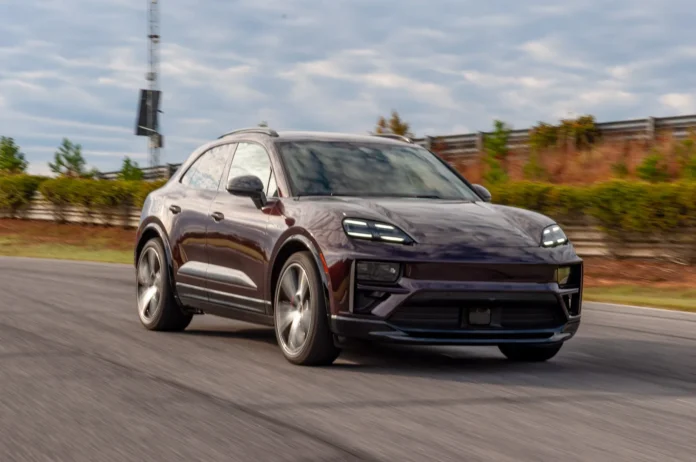
The Porsche Macan Electric is brimming with technology and engineering innovation that will help transform the middle of the luxury market, not just the fringes. That’s why it’s one of Green Car Reports’ Best Car To Buy 2025 finalists

As other brands have shuffled toward EVs in fits and starts, Porsche hasn’t wavered in its effort to remake nearly all its lineup around EVs, and redesigning a next-generation Macan, its top seller, without a combustion engine has been an especially bold move. 

Porsche’s sharp focus on electrifying its lineup started with the Mission E concept nine years ago, resulting in the production Porsche Taycan, sandwiched between the 911 and Panamera. Fully electric, and arriving for the 2020 model year, it was one of our Best Car To Buy 2020 finalists

PPE platform for VW Group, developed by Porsche/Audi

PPE platform for VW Group, developed by Porsche/Audi

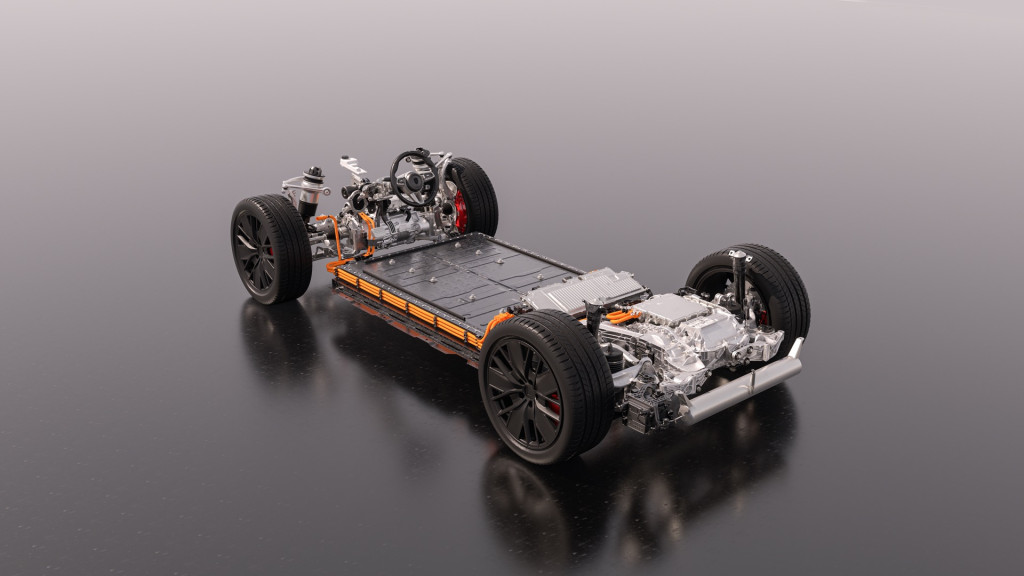
This past year, the 2025 Porsche Taycan has received all sorts of improvements to gain efficiency, boost performance, and make good on the mission. But the Macan Electric’s Premium Platform Electric (PPE) takes all Taycan’s tech in perspective—by allowing easier scalability, and simplifying for a higher level of mass production. It all shows that the electric version can be more space-efficient, comfortable, and luxurious, in addition to all those other clean-energy qualities. 

The Macan and its PPE platform-mates, including the Audi Q6 E-Tron, evolve the motor tech and carry over the Taycan’s 800-volt basis for battery and propulsion tech. However, it’s built with a 100-kwh battery pack that reduces complexity and shifts to a smaller number of prismatic cells and improved thermal regulation—enabling a 10-80% DC fast-charging time of as little as 21 minutes. With an EPA range rating of up to 315 miles, and 288 miles in even the top Macan Turbo, that’s not a lot of road-trip time spent charging. 

2024 Porsche Macan EV

2024 Porsche Macan EV

2024 Porsche Macan EV

2024 Porsche Macan EV

2024 Porsche Macan EV

2024 Porsche Macan EV

So far, the German luxury establishment has been missing out on faster 800-volt charging, but the Macan and PPE shepherd it out to the 2025 Audi Q6 E-Tron and SQ6 E-Tron, also arriving now, and next year to the Audi A6 E-Tron hatchback and more. 

The Macan Electric’s thermal systems and performance credentials were well proven by our editorial team during Best Car To Buy testing at Georgia’s Atlanta Motorsports Park, where the battery, brakes, or motors never overheated, despite this performance SUV’s curb weight of nearly 5,400 pounds—although the Pirelli P Zero Corsa summer performance tires were definitely worse for wear. 

2024 Porsche Macan EV

2024 Porsche Macan EV

The Porsche Macan Electric is offered at a range of different power levels, including the 335-hp Macan, 402-hp Macan 4, the 509-hp Macan 4S, and the 630-hp Macan Turbo—with the latter achieving a 0-60 mph dash in just 3.1 seconds. An air suspension and adaptive damping are included, allowing the Macan to raise or lower its ride height based on the drive mode, and the PPE underpinnings for the Macan Electric also include a new front suspension geometry plus a steering gear that’s rigidly attached to the structure for better steering feedback. On the street and on the track alike, the Macan’s rear-wheel steering is its secret weapon, allowing for better maneuverability in tight corners and better stability in high-speed maneuvers. 

Fun track time aside, it’s the Macan Electric and the platform it’s built on that will help prove that EVs don’t have to involve compromise, which can help elevate this technology to a broader market. 

It’s not “mission complete” yet, but this bigger mission is just starting.


Source link