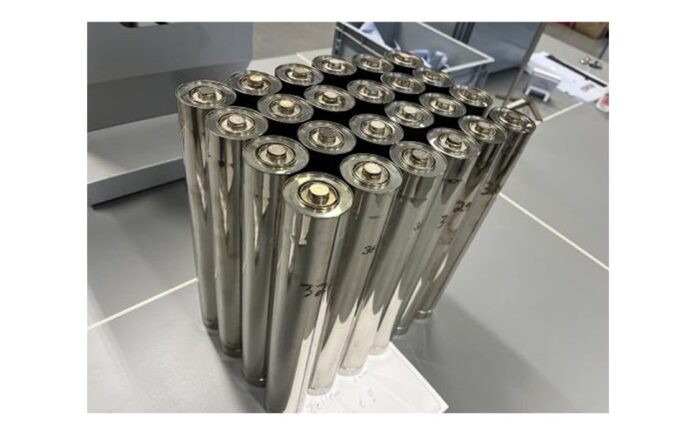
Solid-state battery developer Altech Batteries has completed a full suite of safety self-destruction validation tests on its sodium-nickel-chloride (SNC) battery technology, which it recently began selling.
The tests were designed to simulate the most severe field hazards that can occur during storage, transport or operation. Across all the scenarios, which included direct fire exposure, rod penetration, over-charge, ballistic impact, drop test, impact test and submersion, the SNC cells and modules demonstrated chemical stability and mechanical resilience. No explosions, thermal runaways or uncontrolled reactions were recorded in the tests, Altech said.
The SNC cells remained sealed and intact after being exposed to an 850° C gasoline fire for 30 minutes, while rod penetration and water exposure produced only harmless steam. The flames were extinguished within one minute. A drop of 10 meters onto a steel pole, simulating an impact at approximately 30 mph and crash at 48 km/h caused minor dents, without leakage or rupture. Immersion for 2.5 hours in 3.5% saltwater did not cause any external reaction or voltage loss, while an over-charge at 145% nominal voltage for one hour produced no venting, swelling or heat generation. Bullet impacts only caused brief smoke, while the structure and voltage remained stable.
“These independent abuse tests confirm what long-term field data has been telling us for years—our sodium-nickel-chloride technology batteries produced by partner company AMPower, are exceptionally safe,” said Altech Managing Director Iggy Tan. “Even under direct fire, impact or over-voltage, the cells remain sealed and stable. This level of intrinsic safety is a major differentiator for Altech. Our SNC batteries can endure conditions well beyond certification limits while maintaining integrity and performance.”
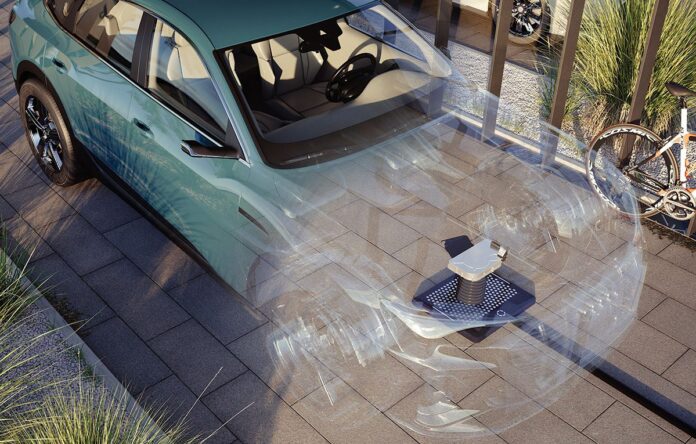
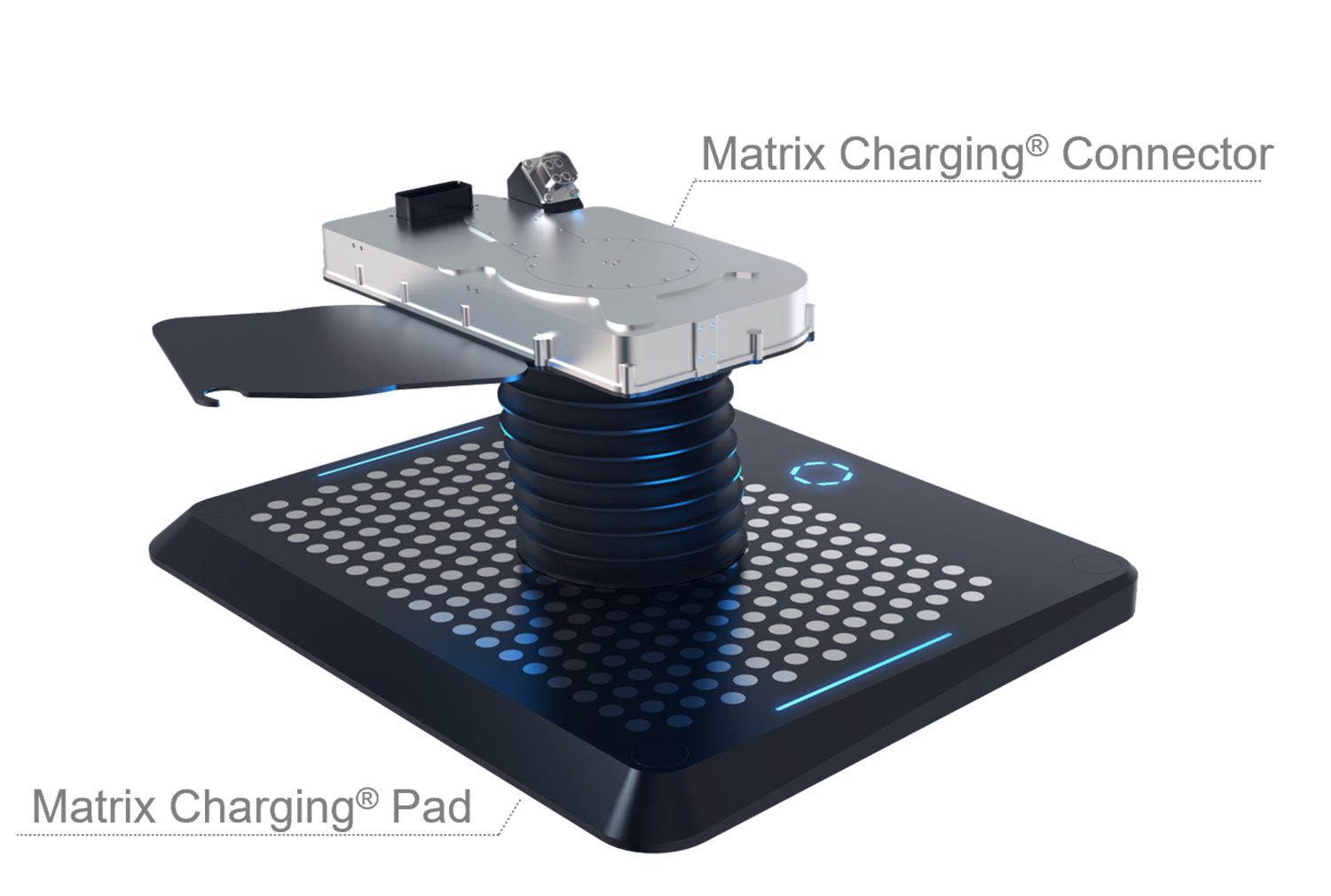
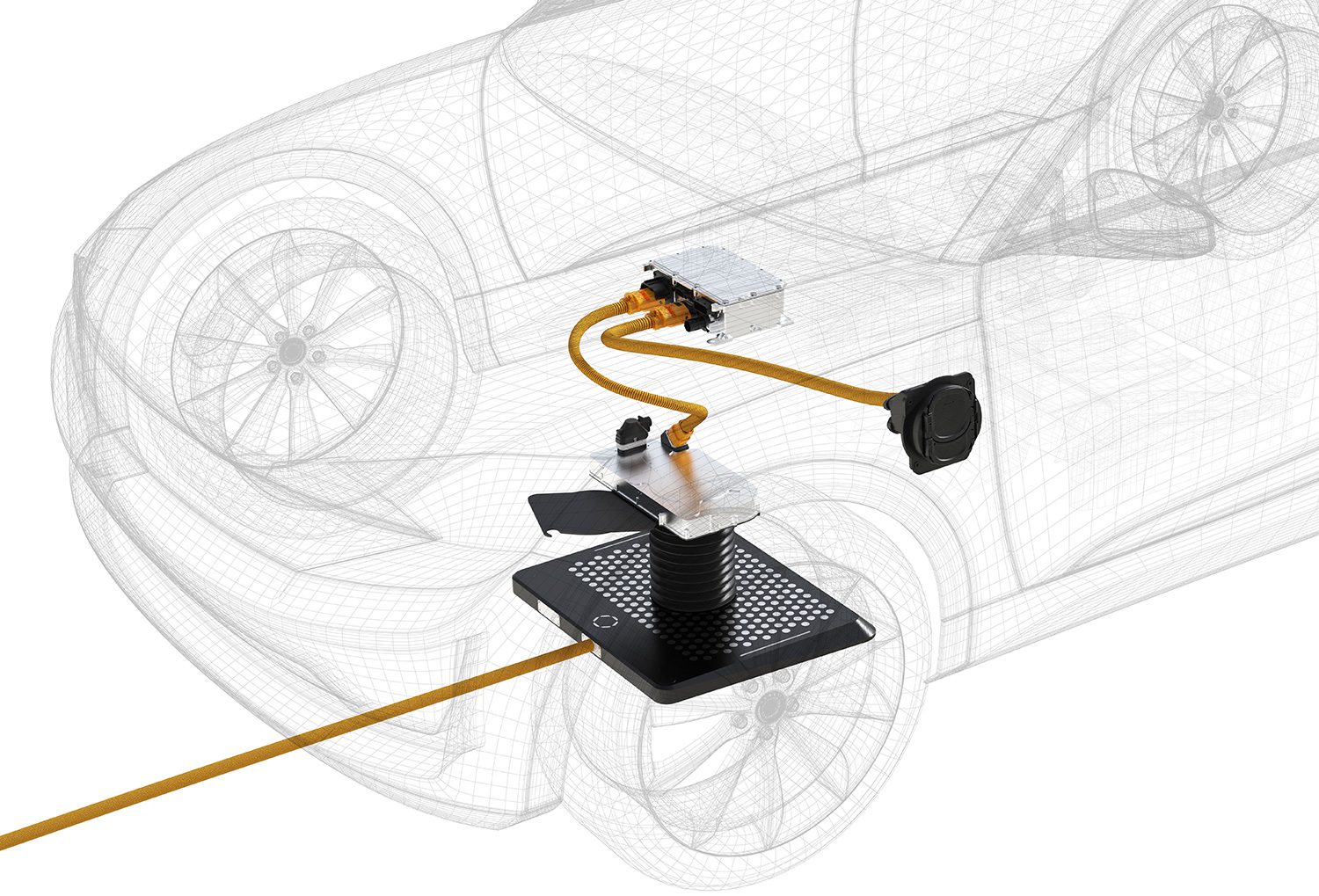
The Matrix Charging Interest Group (MCIG) has announced an industry initiative to standardize Matrix Charging, an automated conductive charging technology for electric vehicles developed by Easelink. MCIG’s cooperative platform aims to establish a cross-brand standard for this interface, enabling interoperability between all vehicles and automated charging infrastructure.
Matrix Charging is already under consideration by multiple global vehicle manufacturers for inclusion in future electric vehicle platforms, according to MCIG. The standardization process addresses the urgent need for a unified charging interface to support automated charging in production vehicles.
MCIG complements existing work in International Organization for Standardization (ISO) and International Electrotechnical Commission (IEC) committees by focusing on industry-driven coordination specific to Matrix Charging. The group seeks to harmonize all interface parameters and specifications efficiently alongside ongoing series development efforts.
To promote adoption, MCIG has implemented a Fair, Reasonable, and Non-Discriminatory (FRAND) licensing policy for essential patents related to Matrix Charging. This policy is intended to foster competition, innovation, product differentiation, and wide market availability.
MCIG is chaired by Menno Treffers, former Chairman of the Wireless Power Consortium and Secretary General of the Zhaga Consortium. Founding members include Audi, Easelink, Nissan, and Voyah. MCIG invites additional companies with strategic interest in Matrix Charging deployment to participate in the standard formation process.
The Chair of Production Engineering of E-Mobility Components (PEM) at RWTH Aachen University is working with industrial partners on the Kreislauf.IN.NRW battery cell recycling research project.
The project, funded by the Ministry for the Environment, Nature Conservation and Transport of the State of North Rhine-Westphalia, aims to investigate the production and functionality of cells containing more than 80% recycled material. The companies participating from the industry are NEUMAN & ESSER, Accurec Recycling, Iondrive EU, and Constantia Patz.
“Recyclable components of lithium-ion battery cells have so far only been considered individually and have not been tested for their actual interaction in new batteries,” said Professor Achim Kampker, head of the PEM research group.
“The global battery industry already uses recycled metal salts such as nickel and cobalt sulfate or lithium hydroxide in some cases, but the precise behavior of the materials in the battery cell—for example, aging, safety, and the necessary purity—is not fully understood,” added Professor Heiner Heimes, a member of the PEM management team.
However, the reintroduction of these materials into battery production is considered essential to comply with the requirements of the EU Battery Regulation regarding minimum recycling quotas for cathode active materials.
In particular, the use of graphite anode material from secondary sources has so far proven unattractive because of a deterioration in the morphology of the active material at the end of its life, increased contamination such as by binders, and technological and economic challenges. The processing of recyclable graphite is considered costly compared to using primary material.
Other battery components, such as the aluminum and copper conductive foils, the separator, and the electrolyte, also present challenges for recycling and reuse. The focus is currently on the active materials, as they comprise 70% percent of the battery. But the recycling of inactive components will also be needed to achieve the principle of the circular economy.
“While recycling most battery components is now technically possible, no battery cell has yet been manufactured that contains at least 80 percent recycled material,” Kampker said.
The Kreislauf.IN.NRW project aims to achieve this and develop a scalable process.
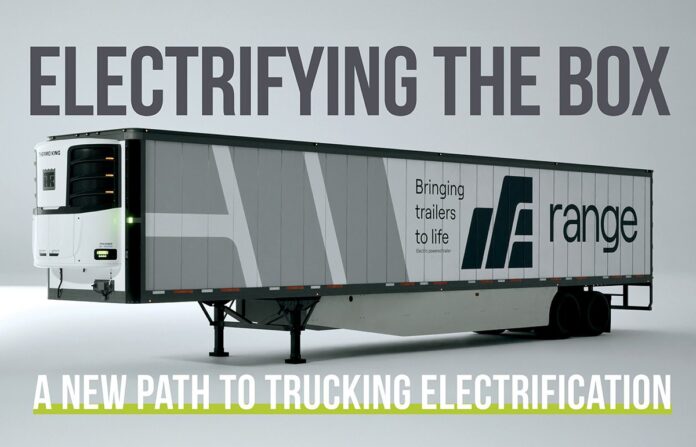
Powered trailers offer a painless path to electrifying heavy-duty transport.
Trucking firms are caught in a bit of a bind. They need to electrify before their competitors do, or risk being undercut on the all-important metric of cost per mile—however, electric trucks come with high upfront costs, and when it comes to long-haul Class 8 trucks, range, weight and charging infrastructure remain challenges.
What if you could eliminate those objections by thinking outside the box—or by electrifying the box itself? That is, why not electrify the trailer instead of the tractor? If you could add batteries and a motor to a trailer, you could realize substantial fuel savings while continuing to use your existing tractors.
A powered trailer, which incorporates a battery pack and an electric motor, offers several advantages as an alternative to (or in addition to) an all-electric truck. It’s a drop-in replacement for existing trailers that can be used with any tractor—diesel or electric. There’s little or no learning curve for drivers. Range is not an issue—if the trailer’s battery runs out of juice, you simply keep rolling. Charging is much less of an issue—a trailer can be charged while loading or unloading, while the tractor drives off to pick up another load. And as we shall see, a powered trailer can include intelligent features that help to make the driving experience easier and safer.
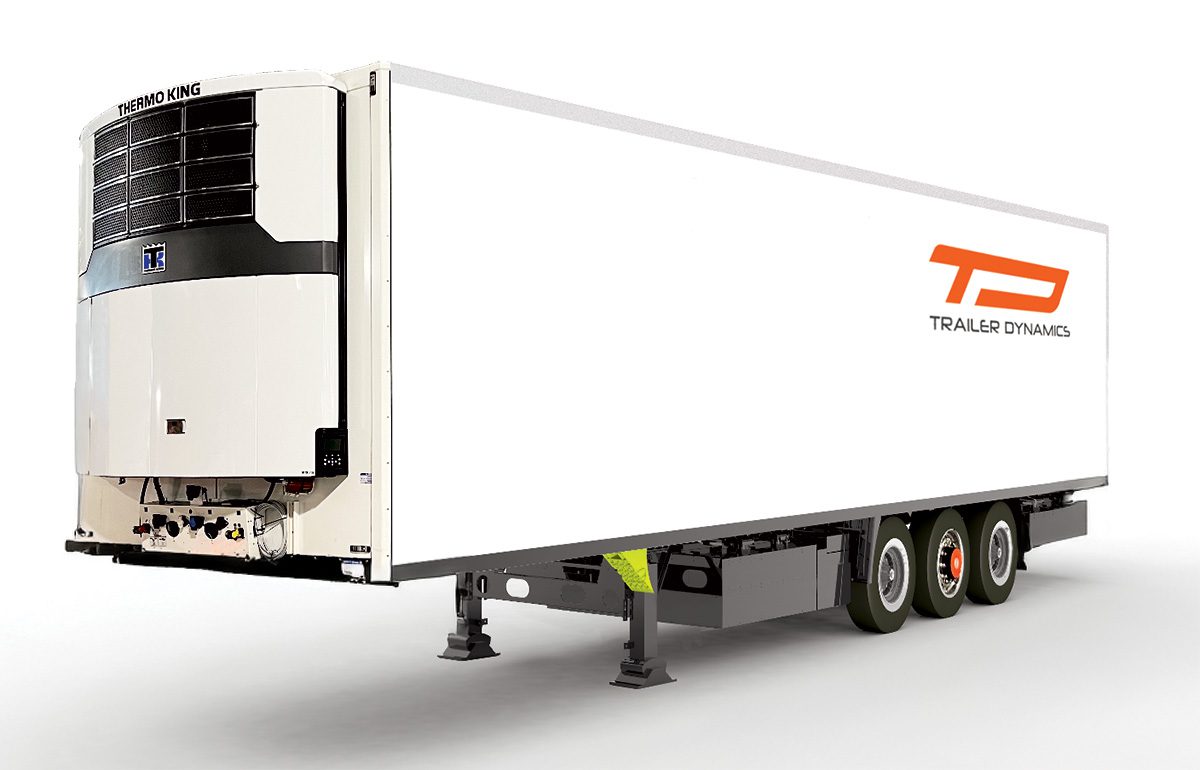
At the moment, there are two companies selling powered trailers—US-based Range Energy and Germany-based Trailer Dynamics (both companies are currently taking orders, but deliveries have not yet begun). Both companies have designed their trailers to pull their own weight, so to speak. Range Energy says its system provides “just enough propulsion to make the trailer feel weightless to whatever is towing it.” As Trailer Dynamics puts it, “The eTrailer is designed to cancel out all its driving resistance on routes of 500-800 km.”
A third company, Revoy, offers a variation on the concept—a powered dolly that fits between tractor and trailer, in effect converting a diesel tractor into a hybrid. In addition to delivering fuel savings, all three of these companies’ products are designed to interact with the tractor to improve handling and safety.
There are also companies developing electrified Transport Refrigeration Units (TRUs), which today are powered by built-in diesel generators.
Range Energy
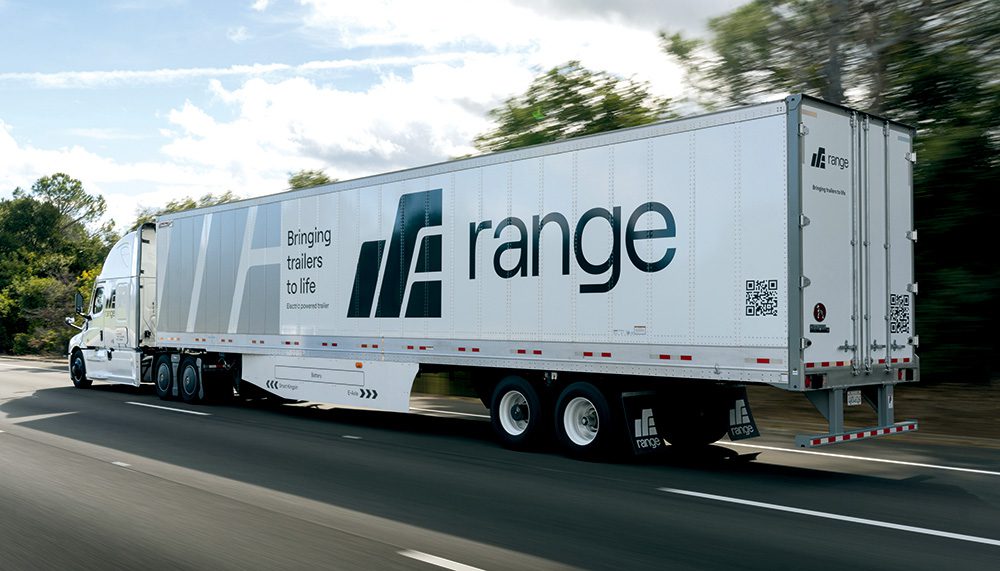
California-based Range Energy, founded in 2021, has developed an eTrailer system that can be installed on any dry van or refrigerated semi-trailer. “We think of it as a less burdensome version of electrification,” Chief Product Officer Jason Chua explained to Charged. “You can hook up your accessories, like a TRU, a liftgate or whatever, and then you’re off and running.”
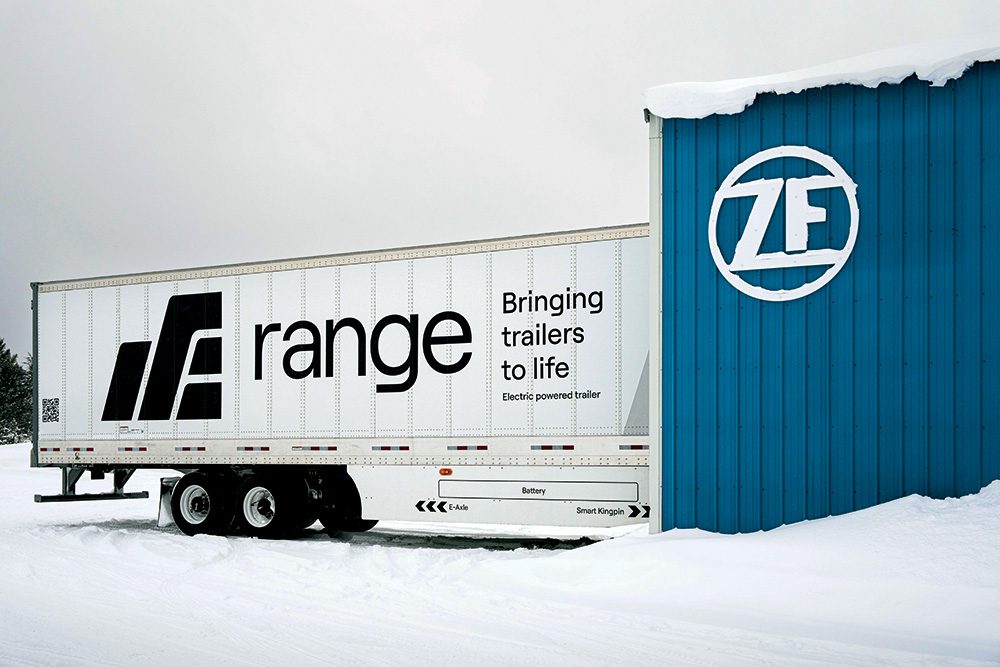
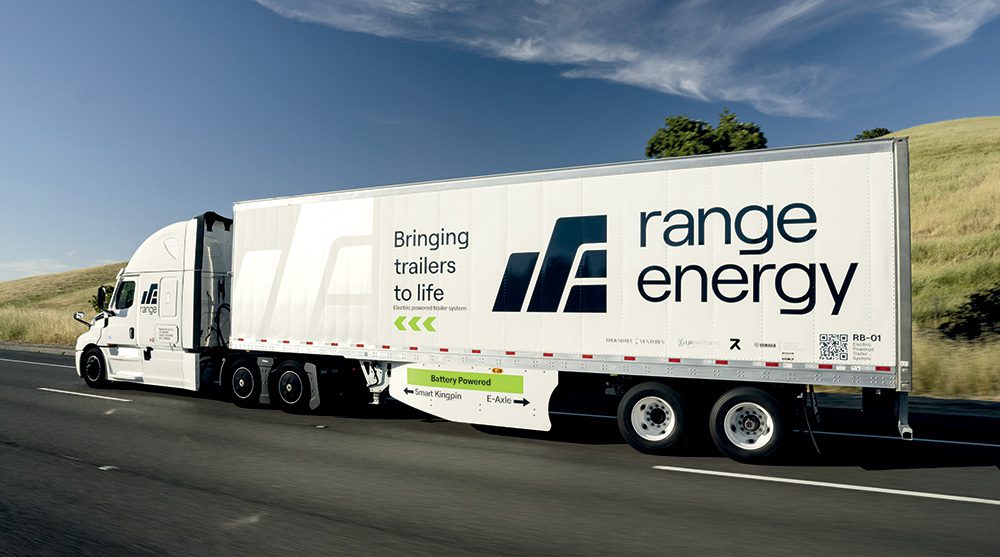
The system, which adds about 5,500 pounds of weight to the trailer, is composed of three major components. The first is an electrified axle, currently provided by Tier 1 supplier ZF. “We are able to use other OEM eAxles, but ZF is what we’re launching with,” Chua told us. “The second component is a high-voltage battery pack—either 200 or 300 kilowatt-hours, but I think early units are probably going to ship with a larger battery pack. The third component is our safety controls system and sensor suite. It’s the world’s first trailer traction control system, so we can do stability work and braking.”
Range is starting out by selling directly to carriers. “Shippers are sometimes involved, and trailer OEMs can be channel partners—we’re collaborating with some of them for testing. But this is a new product category, so we want to get out there and work with fleets, educate them on what we’re doing, get a better understanding of how they run their business, and make sure that we have a really good fit.”
Over the past few months, Range has been taking its beta units on the road with customers for pilots, and has demonstrated a 60-to-70% increase in MPG while also powering a TRU in 100% electric operation.
Range Energy has demonstrated a 60-to-70% increase in MPG while also powering a refrigeration unit in 100% electric operation.
There are a lot of trailers out there, with many different specific configurations of things like rail pitch, liftgate specs and door positioning—that’s why Range opted to go with a retrofittable system rather than selling complete trailers. “That allows us to get this technology deployed faster than the typical replacement age for trailers, which could help us scale quite quickly,” Chua told us.
“Our system is designed to be installed in just a few hours with one or two people using a forklift, so this is something you could do at a dealer location. The battery bolts on to the bottom of the trailer. The eAxle you just swap out with the forward axle on the trailer bogie. You connect the two, and the sensors are already integrated into the system, so that’s about it.”
Keep on trucking
In addition to saving money and reducing emissions, Range Energy’s trailer can adjust torque and braking in real time to improve safety and the driving experience. We were surprised to learn that this requires no data connection between the tractor and the trailer.
A standard semi rig has a connector between tractor and trailer that operates brake lights and the ABS system (it uses the SAE J560 standard). “It’s an electrical connector, it’s not really a data connector,” Chua explained. “You might see other similar systems connected with a CAN bus, but Range’s system doesn’t require that. It’s just the air lines, the brake lights (the J560 connector), and of course the kingpin, and those are the only points of connection between the tractor and the trailer with our system.
The only points of connections between the tractor and Range’s trailer system are the air lines, the brake lights and the kingpin.
“We are able to sense when the driver’s trying to brake from the tractor, and we react quite quickly to those signals. One of the things that we wanted to avoid is new standards, new connectors, training the driver to plug one more thing in. Truckers have a complicated enough job as it is, and our goal is to make this as simple as possible.”
Range’s system can provide extra torque when needed, for example to provide additional acceleration to climb a hill, or to make shifting gears smoother. The system also intelligently manages regenerative braking to improve traction and stopping distance.
Mr. Chua showed us a video of winter testing the company did in northern Michigan to validate the trailer’s traction control. “We did some stopping distance tests, we did some evasive maneuvers, and in pretty much all cases, we saw performance improvements with our system. It has a very fast reaction time and we have a good understanding of the environment with respect to things like how slick a surface is and what the cornering force looks like.”
How does all this work with no data connection? “That’s our secret sauce,” Chua told us. “We have a distributed network of sensors that allows us to understand what’s going on with the relative motion of the trailer and the tractor. Using that information, we can send commands to the powertrain to provide drive torque or regen-braking torque as appropriate.”
Range Energy President and CTO Ali Javidan identified another benefit of powered trailers in an interview with Clean Trucking: “Because the tractor sees a lot less load, we have customers saying, now we can buy the smaller block engine. Our transmissions are lasting five times longer because we’re not wearing through clutches in between shifts. Our brake duty cycle is 3 to 5 times longer because we’re using regen instead of friction brakes.”
Yet another of the advantages of electrifying the trailer instead of the tractor is that it makes charging simpler. “Tractors tend to be in motion a lot more often,” Jason Chua told Charged. “Trailers sit around for 8 to 12 hours a day, because it takes some time to load and unload the trailer.”
Trailers also don’t require the heroic levels of charging power that heavy-duty trucks do. “Our 300 kWh battery pack is large, but it’s not massive. Our system doesn’t require the sort of heavy charging infrastructure like the Megawatt Charging System [MCS] that you’d need for charging electric tractors.”
Riding with the King
Range recently announced a partnership with Thermo King, a Minnesota-based manufacturer of transport temperature control systems. The company already has a hybrid TRU, which Range is integrating with its system.
“Thermo King’s TRUs can run in either diesel or electric mode,” Chua told us. “When you’re at the dock plugged into shore power, they run on electric. We enable that electric operation even while the trailer’s in motion.”
Thermo King has an extensive dealer network, including shops where equipment can be installed. “They’re rolling out high-voltage training across their dealer network. They really are leaning forward on electrification, and we can benefit from that. Rather than stand up hundreds of dealer locations across the country, we can leverage a great partner that already has them, and enable installation, distribution, service and after-sales with people that these fleets already know.”
Chua sees several reasons to target the refrigerated transport (aka cold chain) market. “I think some of the first adopters we’re going to see are food service distribution fleets. They have a great use case for eTrailers in terms of route length and stops. We can save a lot of fuel from the reefer unit, and these are folks that tend to be early adopters of new technology.”
They also have what’s called shore power. The plug at the dock that you plug your refrigeration unit into, we can use that same circuit to charge our system. We can charge with DC or AC.
Targeting refrigerated fleets also presents advantages in respect to charging. “Lots of these fleets have refrigerated warehouses, which already have a decent amount of power available to them. They also have what’s called shore power. The plug at the dock that you plug your refrigeration unit into, we can use that same circuit to charge our system. We can charge with DC or AC.”
When can I buy, and for how much?
Range is currently conducting extended pilots with “some of the largest fleets in the country.” Chua told us that the company is ramping up its manufacturing process, and plans to begin deliveries “some time in 2026.”
So, how much does the system cost? Chua told me in a roundabout way. “We’re looking at a four-to-five-year payback period today. As we scale, our costs will decline and we’re going to get closer to a three-year payback. But right now we’re seeing about a $25,000-per-year net savings per trailer, and you can do the math.”
We can, and it works out to $100,000 to $125,000 for Range Energy’s system (which can be added to a new or existing trailer). Chua told us that, for a new refrigerated trailer, a company would typically pay somewhere between $150,000 and $200,000, depending on the refrigeration unit, liftgates and other accessories required.
At the moment, Range has only one major competitor, and it’s on the other side of the Atlantic. “Trailer Dynamics is covering Europe, we’re covering North America,” says Chua. “Will we look at Europe in the future? Will they look at North America in the future? I think that’s all TBD, right?
Keeping it cool without diesel
Another way of saving energy in transport doesn’t involve propulsion, but rather cooling. Today, keeping food (or medical supplies or other products) chilled or frozen during delivery means running diesel engines on the back of trucks—burning fuel even when vehicles are stationary. In addition to Thermo King, several other companies are testing electric or TRUs.
UK supermarket chain Tesco is testing electric refrigeration technology from British engineering company Sunswap, which incorporates batteries and roof-mounted solar panels. Italy-based SolarEdge e-Mobility is testing a solar-powered e-reefer with an energy recuperation axle. Other electrified TRUs in testing include Schmitz Cargobull’s S.KOe COOL and ConMet’s Nmotion TR series, both of which use an electrified axle to power the TRU.
Trailer Dynamics
Germany-based Trailer Dynamics was founded in 2018. Like Range, it has developed powered trailers that save on fuel and emissions and also offer new safety and driver assistance features. “We have consistently driven forward the eTrailer concept, achieving significant breakthroughs, particularly in the sophisticated control systems essential for seamless interaction between the tractor unit and trailer,” CEO Abdullah Jaber told Charged. “These innovations enable the eTrailer to offer efficient electric drive support, advanced recuperation capabilities and intelligent load management—features which were previously unavailable in trailer technology.”
A complete eTrailer
Trailer Dynamics is taking a different approach from Range Energy—instead of a retrofit kit, TD (with trailer maker KRONE as manufacturing partner) offers “a new, fully integrated semi-trailer with battery, eAxle, power electronics, controls and telematics engineered as one system and validated at OEM trailer level. That lets us optimize weight distribution, energy management, brake blending and functional safety end-to-end, and gives fleets a single warranty and service pathway.”
Trailer Dynamics is taking a different approach—instead of a retrofit kit, it offers a new, fully integrated semi-trailer with battery, eAxle, power electronics, controls and telematics engineered as one system.
Jaber told us that Range Energy’s retrofit kit is “clever, and lowers the adoption barrier for some use cases, but our view is that deep OEM-level integration delivers better durability, drivability and lifecycle TCO for long-haul operations, especially at scale.”
The company’s latest model, the DF2 TD Dry600, features a permissible total weight of 39,000 kg and a net payload capacity of 25,442 kg. The eAxle is equipped with two synchronous motors linked via central helical gears. It delivers total power output of 360 kW (continuous) or 580 kW (peak), and torque of 7,000 Nm (continuous) or 11,500 Nm (peak). Battery capacity is 680 kWh (551 kWh usable). The system runs on an 800-volt architecture, and supports DC charging at up to 350 kW.
Steady rolling
The drive support/recuperation system “intelligently adapts to driving conditions, significantly reducing the towing vehicle’s energy consumption.” In testing, TD’s eTrailer has delivered diesel consumption reductions ranging from 40% to 50%.
Another difference between TD and Range: the Germans use a wired ISO11992 interface (15-pole connector) that “facilitates seamless communication and synchronization between the trailer and the tractor.”
Whereas Range Energy sells to some trailer OEMs, Trailer Dynamics has partnered with one: KRONE, which opened customer orders in 2024. The companies have announced pre-orders with DB Schenker (2,000 eTrailers) and DSV (2,500 units). “We continue to run and expand pilots with large European fleets as we ramp series production,” Jaber told us.
Pricing?
It’s complicated. Quotes are driven by configuration (battery size, axle spec, service model) and duty cycles. “Our commercial model supports CapEx purchase or OpEx models (lease/pay per km) to ensure positive TCO from day one,” Jaber told us. “Fleets typically evaluate payback periods under real routes rather than sticker price.” He did give us one example: DSV is paying €220,000 each for dry-box (non-refrigerated) eTrailers with the highest available battery capacity.
The current transatlantic duopoly in the powered trailer market may not last much longer. ZF, Range’s eAxle supplier in North America, is actively developing e-trailers in Europe; Volvo Penta (in partnership with Finland-based trailer-maker Ekeri) showed an e-trailer prototype in Sweden in May; and in China, trailer-maker CIMC says it has electric trailers in service with port and concrete logistics customers.
For its part, Trailer Dynamics is “preparing to expand into the Americas and Asia, in particular China and Japan.”
Revoy
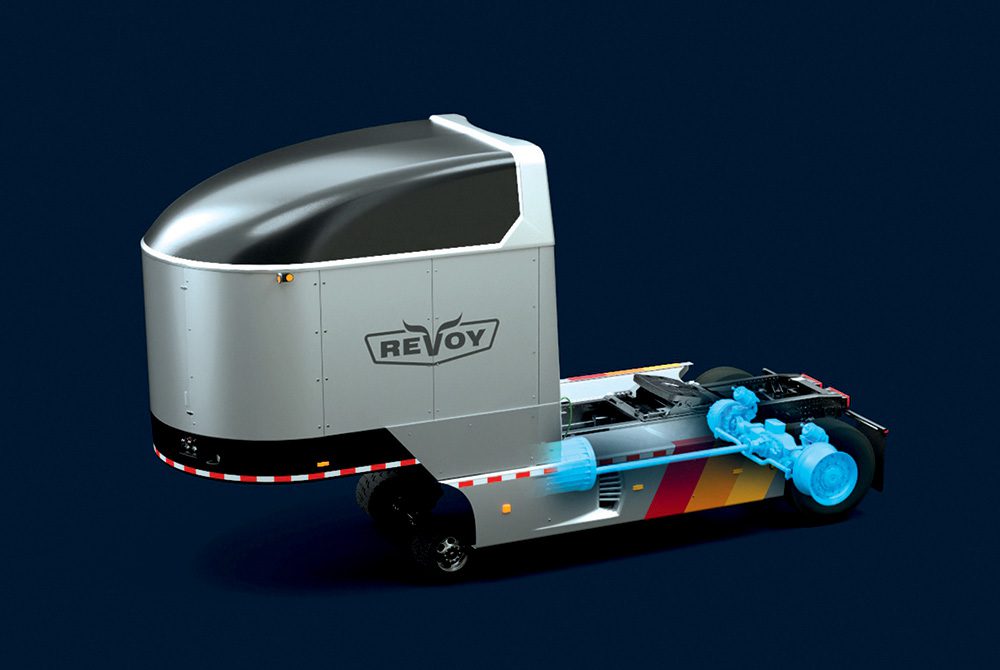
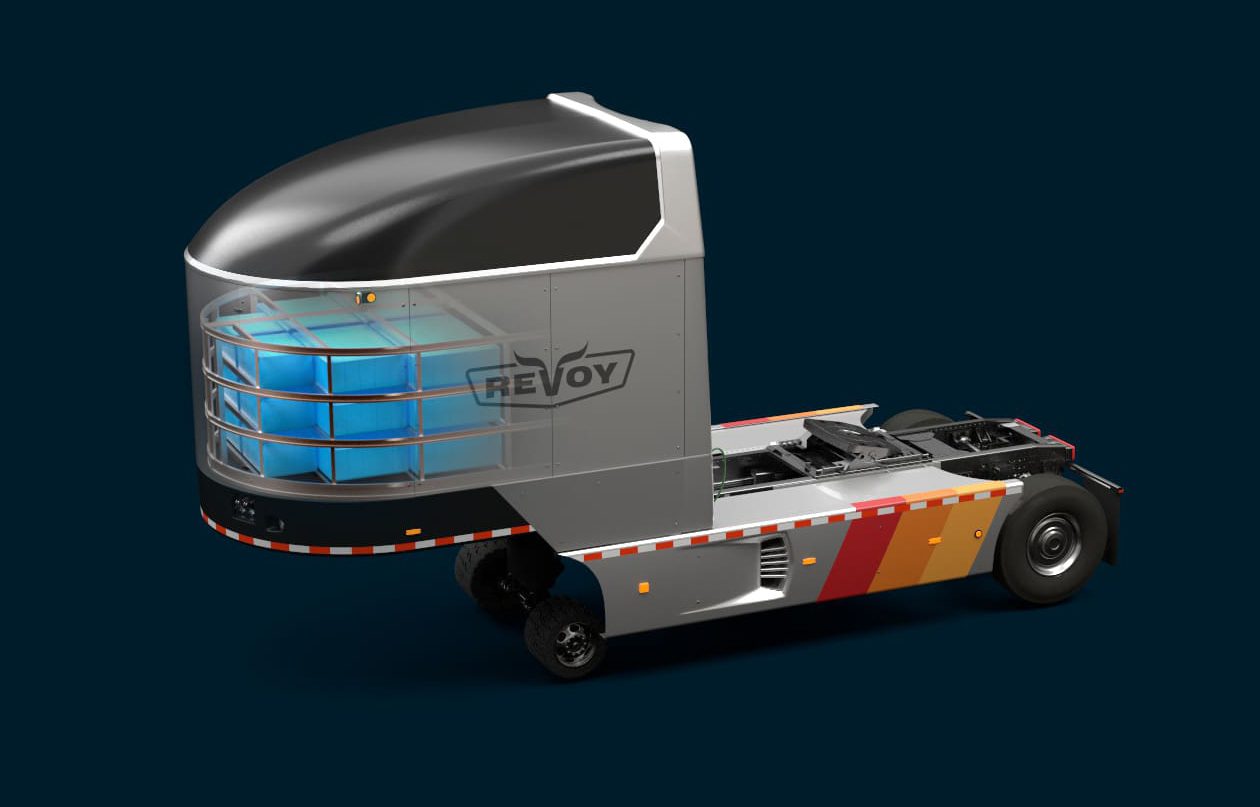
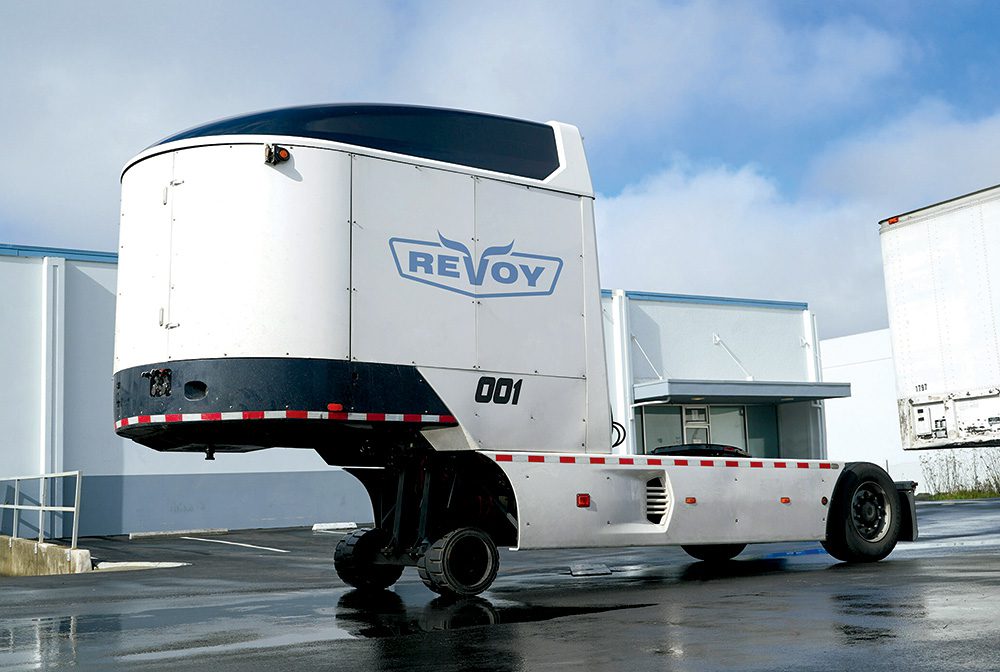
A startup called Revoy offers another type of solution—the Revoy EV is a dolly (technically not a trailer) full of batteries that attaches to a diesel semi-truck to effectively turn it into a hybrid.
Unlike powered trailers made by Range Energy and Trailer Dynamics, the Revoy EV is used with a trucker’s existing, unmodified trailers. Also unlike those companies, Revoy is not selling its product outright, but rather providing it as part of a turnkey service on specific routes.
A startup called Revoy offers a dolly full of batteries that is used with a trucker’s existing trailers.
In 2024, Revoy did a year-long successful technology demonstration with Ryder, operating one such route (in industry parlance, a lane) between Texas and Arkansas. At the company’s swapping station in Dallas, the Revoy EV was attached between a tractor and a semi-trailer, a process that takes about five minutes. The rig then drove 234 miles to a station in Arkansas for another quick swap. The Revoy EV is now in production, and the company is planning to build its first commercial swapping stations in Southern California.
Hello, dolly
The dolly contains a 525 kWh LFP battery pack and a 400 kW electric motor. Range is about 170 miles, and charging typically uses a pair of 360 kW CCS fast chargers, which deliver a full charge in about an hour. The Revoy EV provides enough extra power to increase a rig’s fuel efficiency from 6-8 miles per gallon of diesel to 120 miles per gallon, cutting emissions by 94% and potentially saving a shipper as much as $25,000 in fuel costs per year.
The Revoy EV dolly can increase a rig’s fuel efficiency from 6-8 miles per gallon of diesel to 120 miles per gallon, cutting emissions by 94% and potentially saving a shipper as much as $25,000 in fuel costs per year.
Trucking companies pay by the mile for the service, which is designed to fit smoothly into the current process that shippers use. “What we sell to our customers really is torque,” CEO and founder Ian Rust told reporters in 2024. “They’re just getting power to haul their load.”
Like the powered trailers, Revoy’s dolly is designed not only to save fuel, but to improve the performance of the overall rig. The extra power helps trucks accelerate faster, and the dolly’s regenerative braking decreases the rig’s stopping distance by as much as 30%. Revoy’s technology also adds driver assistance features like blind spot detection, automatic reversing and auto-correction to help prevent rollovers or jackknifing.
Don’t call her a trailer!
“It’s not a trailer because it’s not carrying cargo,” Revoy Chairman Peter Reinhardt explained to Charged. “It’s a dolly. On the National Highway Freight Network [which includes the Interstate system plus a few other major highways], there are restrictions on trailer length, but there are no overall length restrictions on the entire combination. Our dolly is typically included in the length of the whole system.”
There is a regen system, but “it doesn’t end up being that material in terms of fuel savings, since most of the time you’re just cruising down the Interstate. The Revoy EV is really only useful in the National Highway Freight network. It inhabits a specific 170ish-mile lane where it shuttles back and forth between two chargers, and what really drives the economics is high charger utilization.”
The company currently has four dollies in operation. “An economically successful commercial lane probably looks like about 24 Revoys, which is not a huge manufacturing lift, but we think we can get to great diesel-beating economics even at that small scale,” Reinhardt told us. “Then we’ll look to replicate that unit of 24 Revoys across different lanes.”
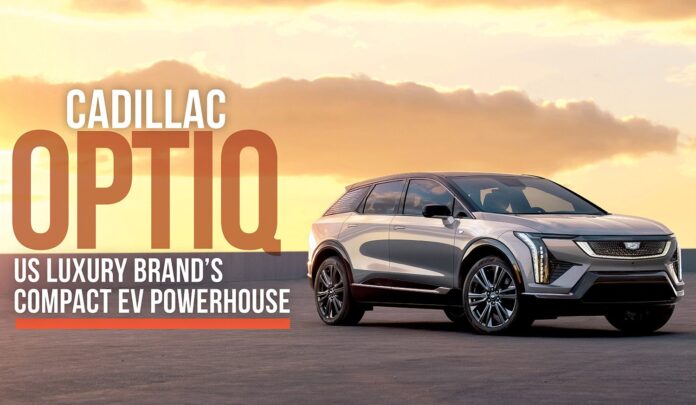
This largish “compact” crossover SUV is luxurious, quiet, and offers substantial range along with premium features, making it a truly competitive luxury EV—and shoppers are noticing.
The conversion of GM’s luxury brand Cadillac to an all-electric product line has been a quietly seismic event over the last decade. The brand is finding (it says) newer, younger and more tech-forward buyers, versus the aging customers who bought its luxury land barges of yore. But while the Lyriq mid-sized crossover SUV went on sale in July 2022, the electric model that may be Cadillac’s most important EV globally didn’t land in showrooms for more than two years after that.
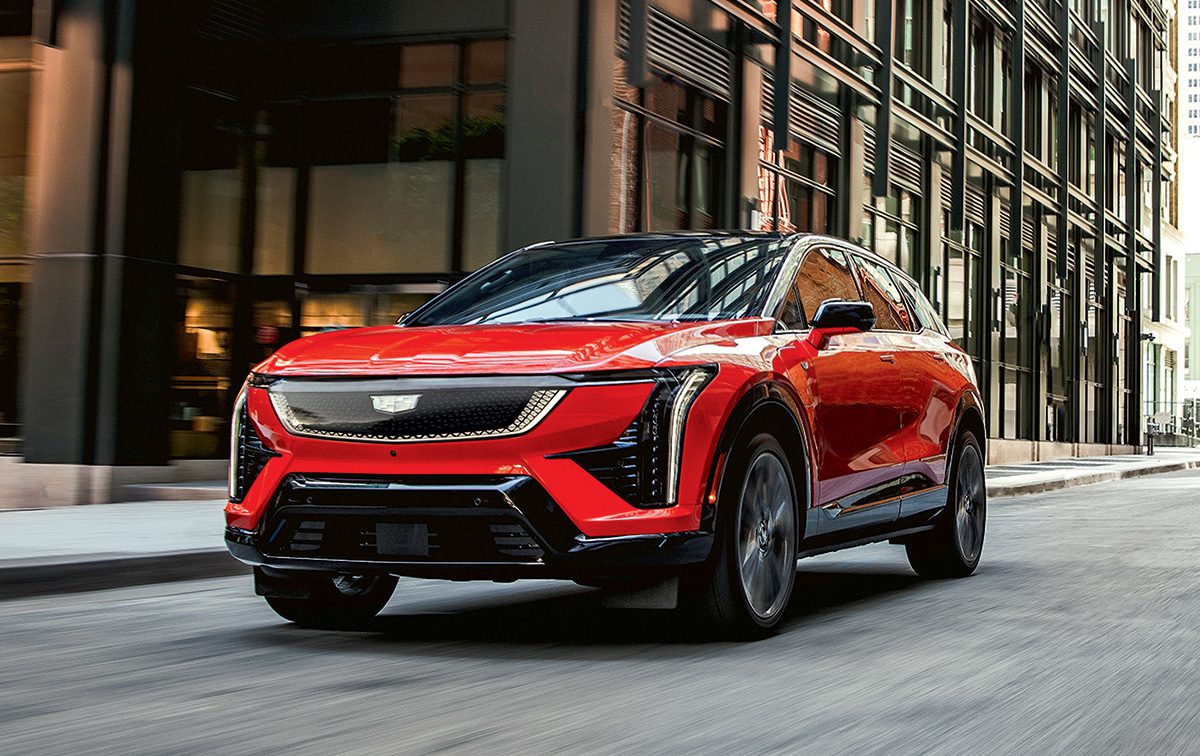
The Optiq, a largish “compact” crossover SUV, could become the luxury brand’s highest-volume vehicle worldwide. At a US starting price of around $50,000, the Optiq is the most affordable Cadillac EV. But it’s also assembled in Mexico, making it subject to tariffs when or if the ever-shifting landscape of trade policy settles down. Still, by the second quarter of this year, it was Cadillac’s second-best selling electric model in the US after the well-established Lyriq.
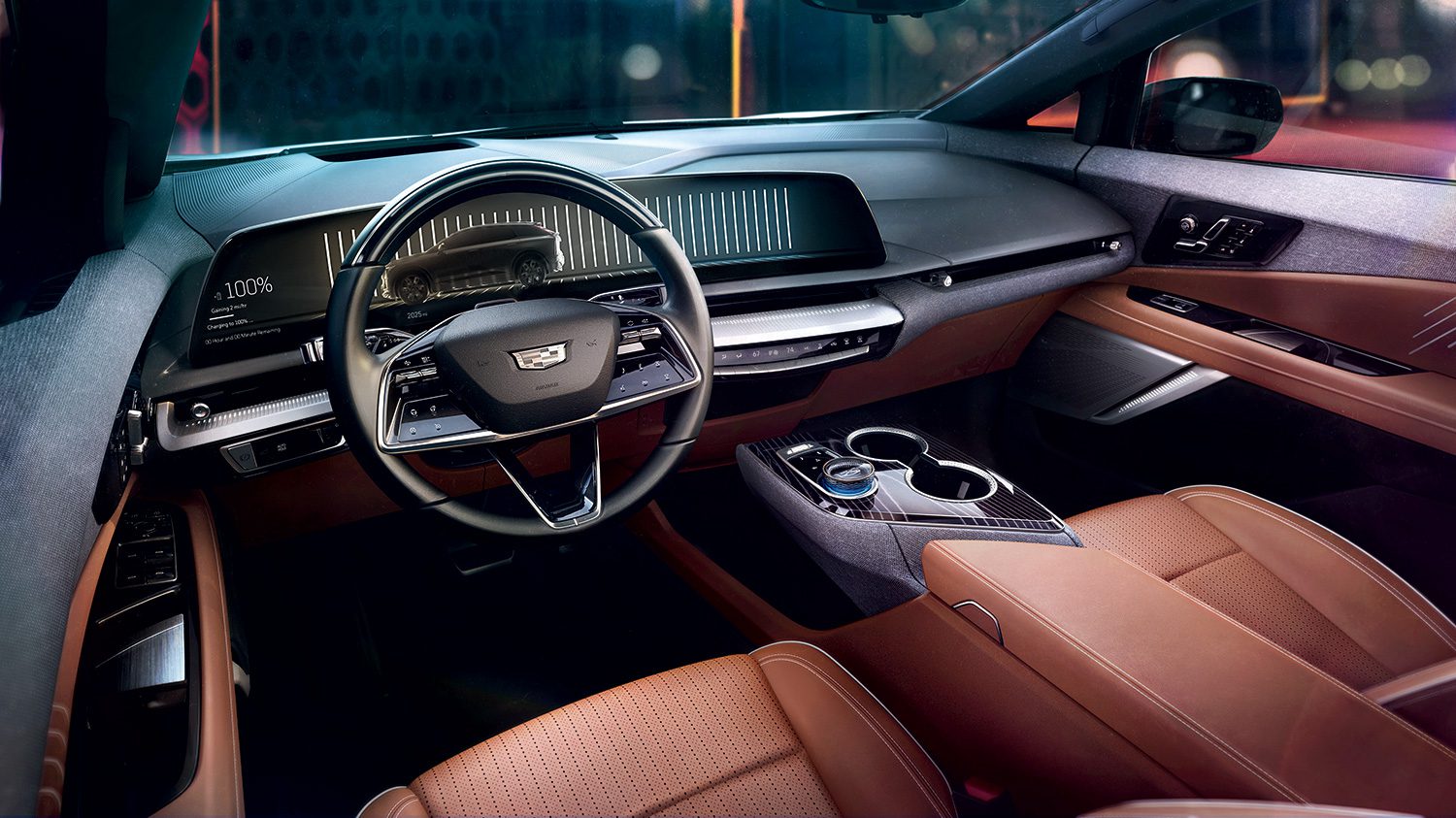
The Optiqs we’ve driven have been calm and quiet inside, with elegant fabrics and trim to cosset occupants. Overall, the Optiq is perfect for long-distance travel or around-town use—and perhaps the best environment for GM’s excellent Super Cruise hands-free adaptive cruise control, which now includes automatic lane changes.
Cadillac’s small SUV isn’t perfect: the exterior styling is more of a judgment call, and the rear quarters are downright peculiar. It’s missing a front trunk and a rear wiper, and neither Android Auto nor Apple CarPlay can be included (in the US) no matter how loud buyers scream. Acceleration of the standard versions is deliberate, though we’ve not yet driven the Optiq-V performance model. That one received rave reviews from both buff books and general outlets.
Two thirds handsome?
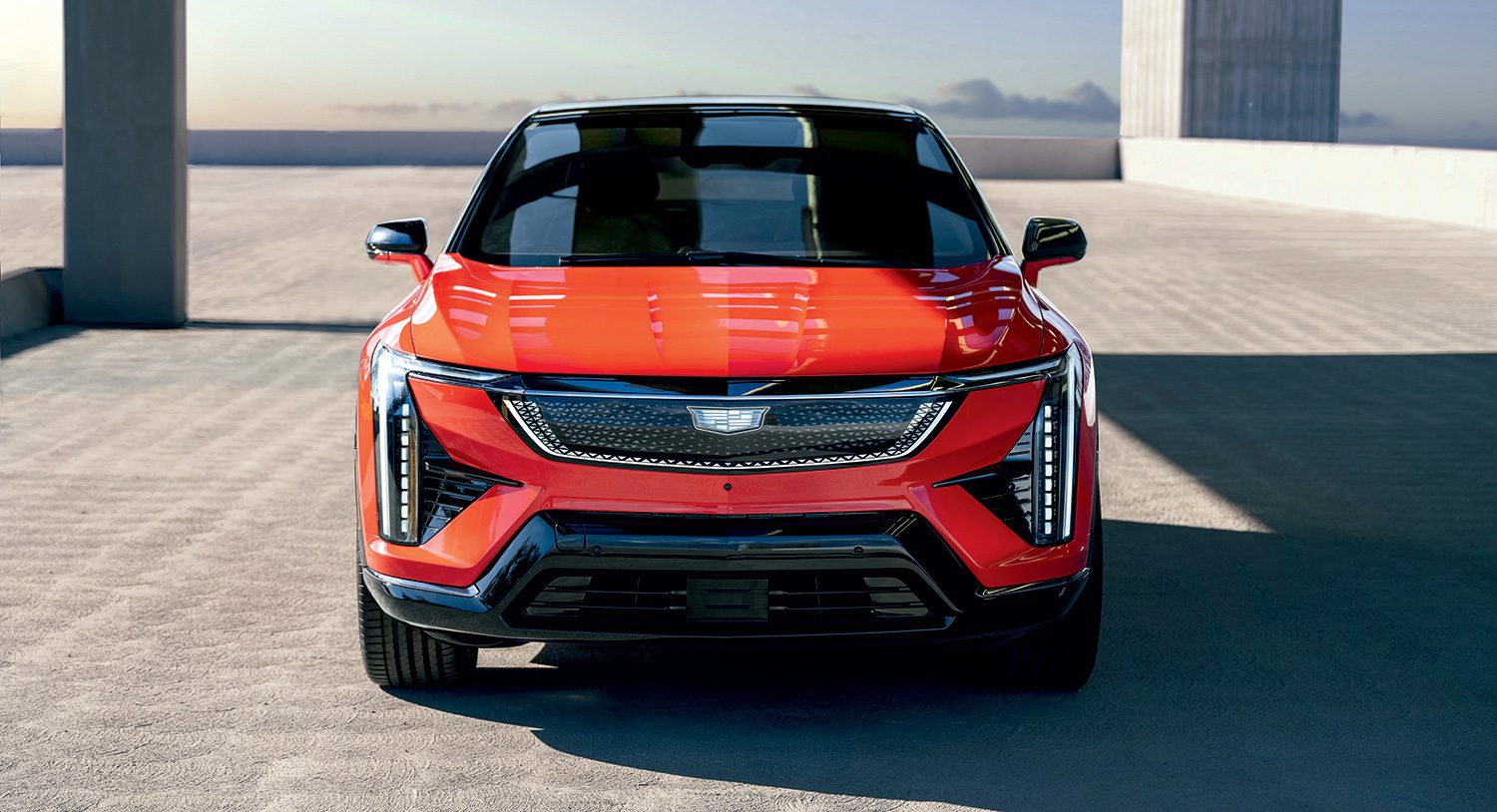
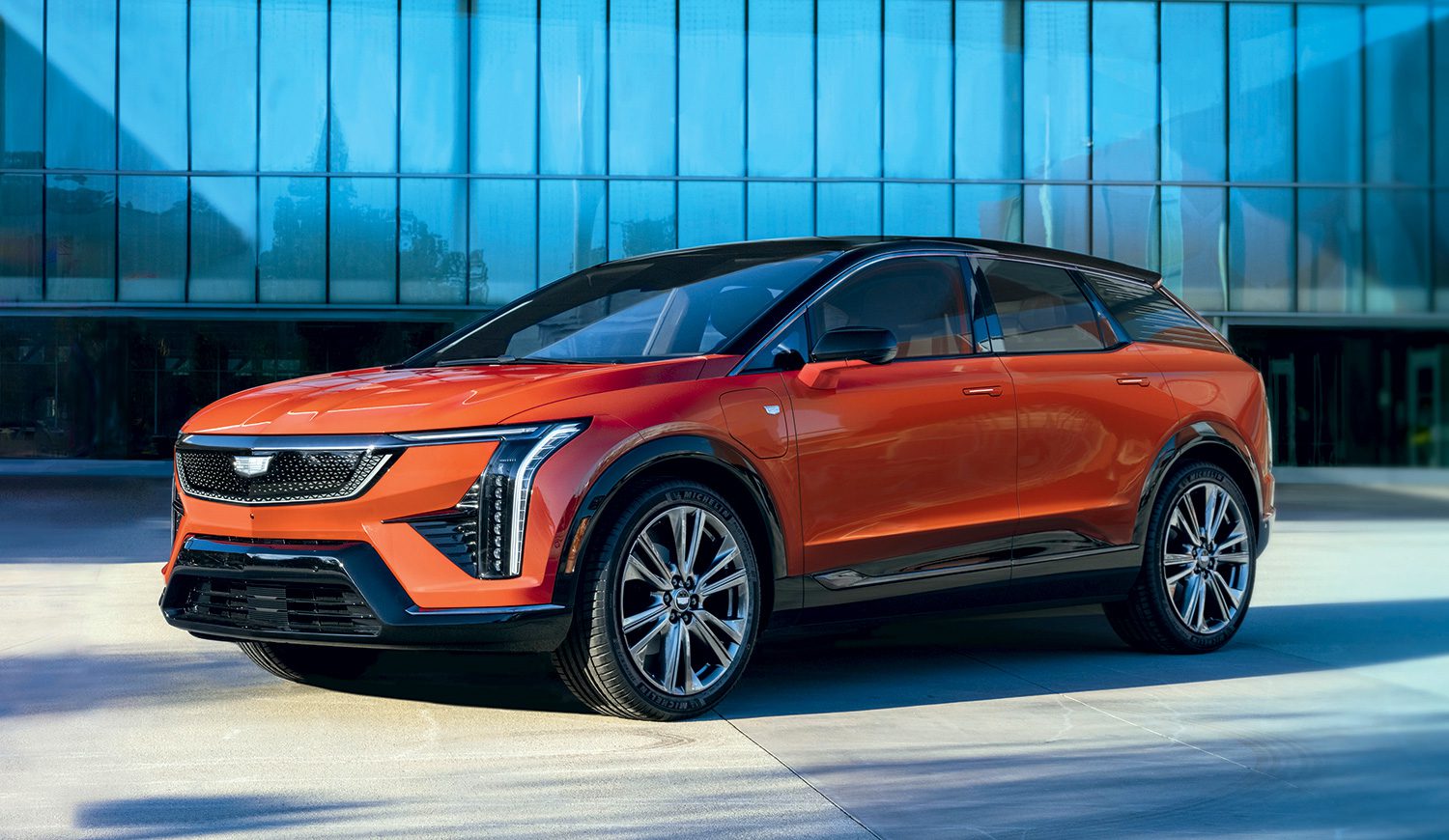
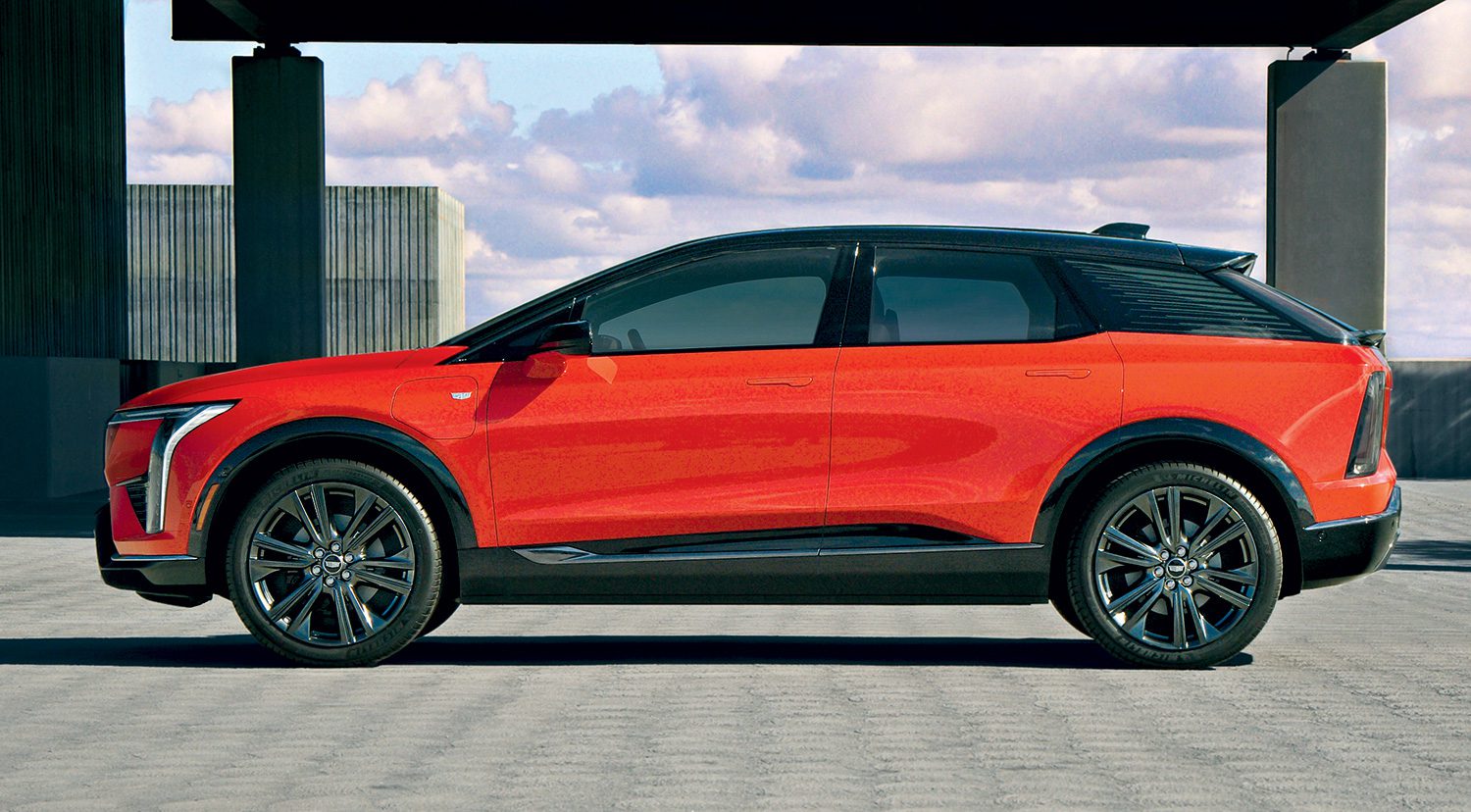
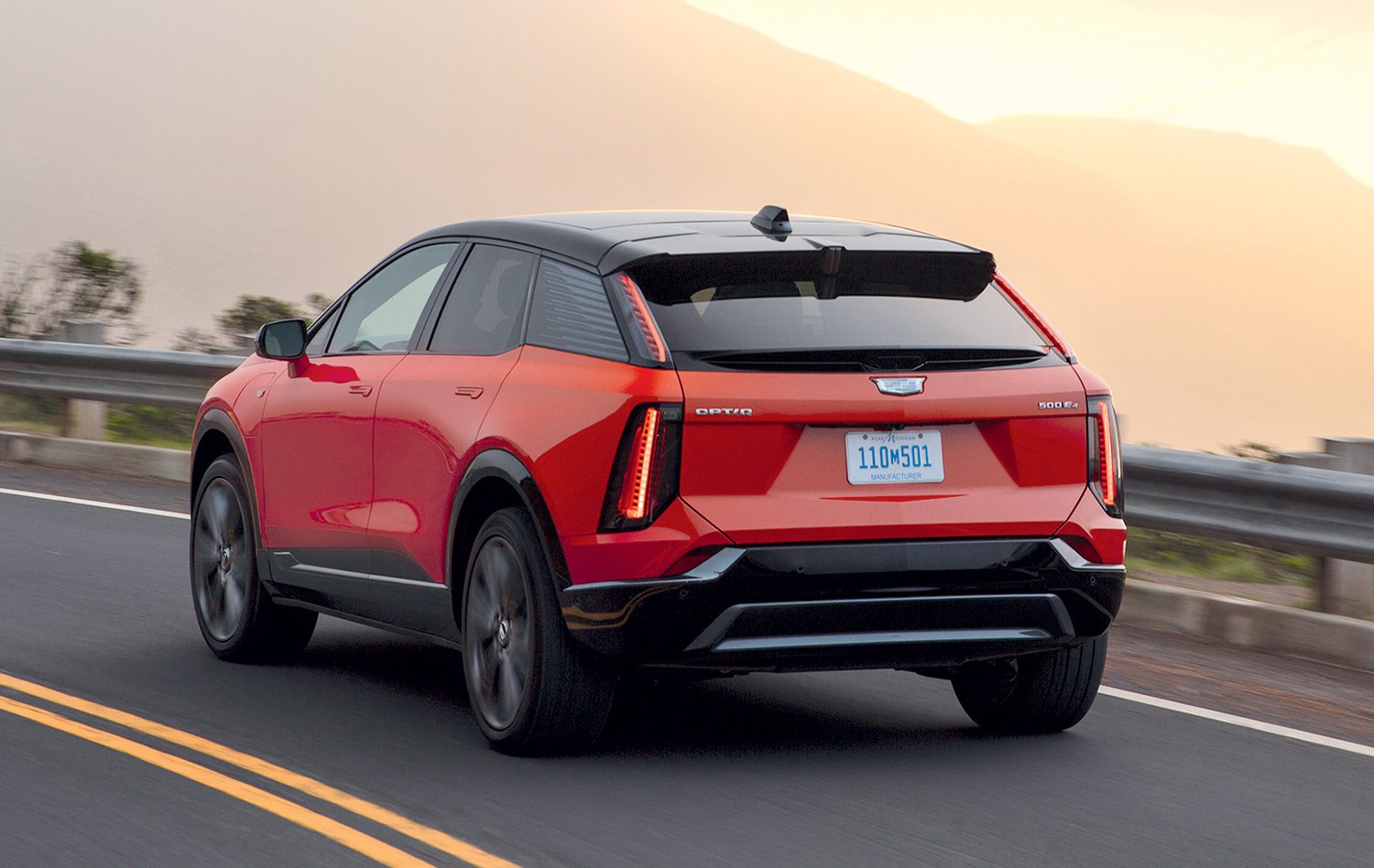
This is the smallest and shortest Cadillac, and the front two-thirds of the Optiq largely echo the other EV models in the lineup. It’s at the rear where things start to go wrong—perhaps from designers trying too hard to be avant-garde in the brand’s shortest vehicle. The combination of a beltline that kicks up, the very short overhang behind the rear wheels, the signature vertical rear lights running up the side of the tailgate, and a strange pattern on the third side windows that superimposes lines that aren’t actually horizontal is just incoherent.
This is the smallest and shortest Cadillac, and the front two-thirds of the Optiq largely echo the other EV models in the lineup.
It offers a little too much visual stimulation in too small a space. The rest of Cadillac’s electric SUVs, as well as the Celestiq ultra-luxury sedan, use the same design cues to better and more pleasing effect.
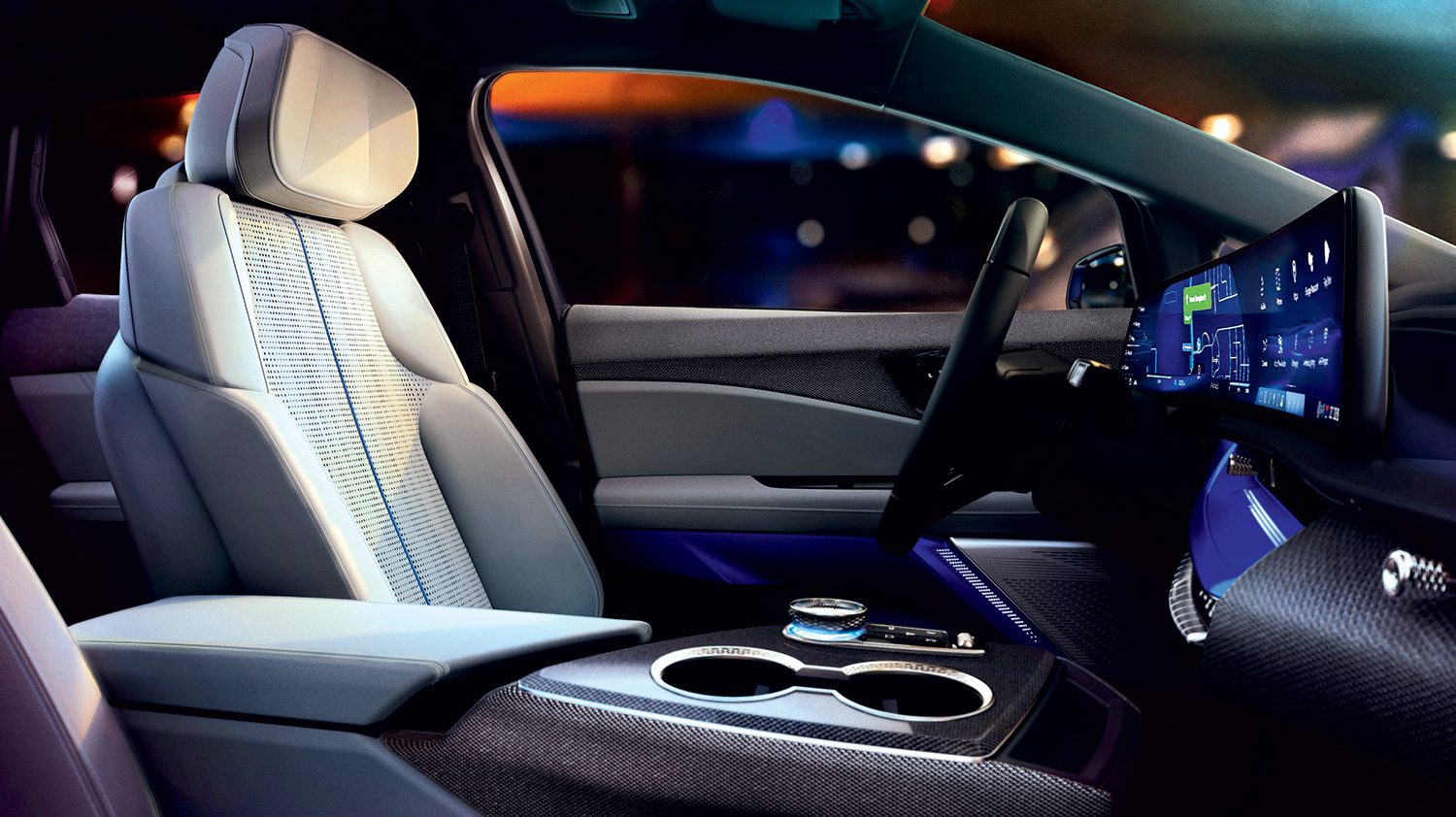
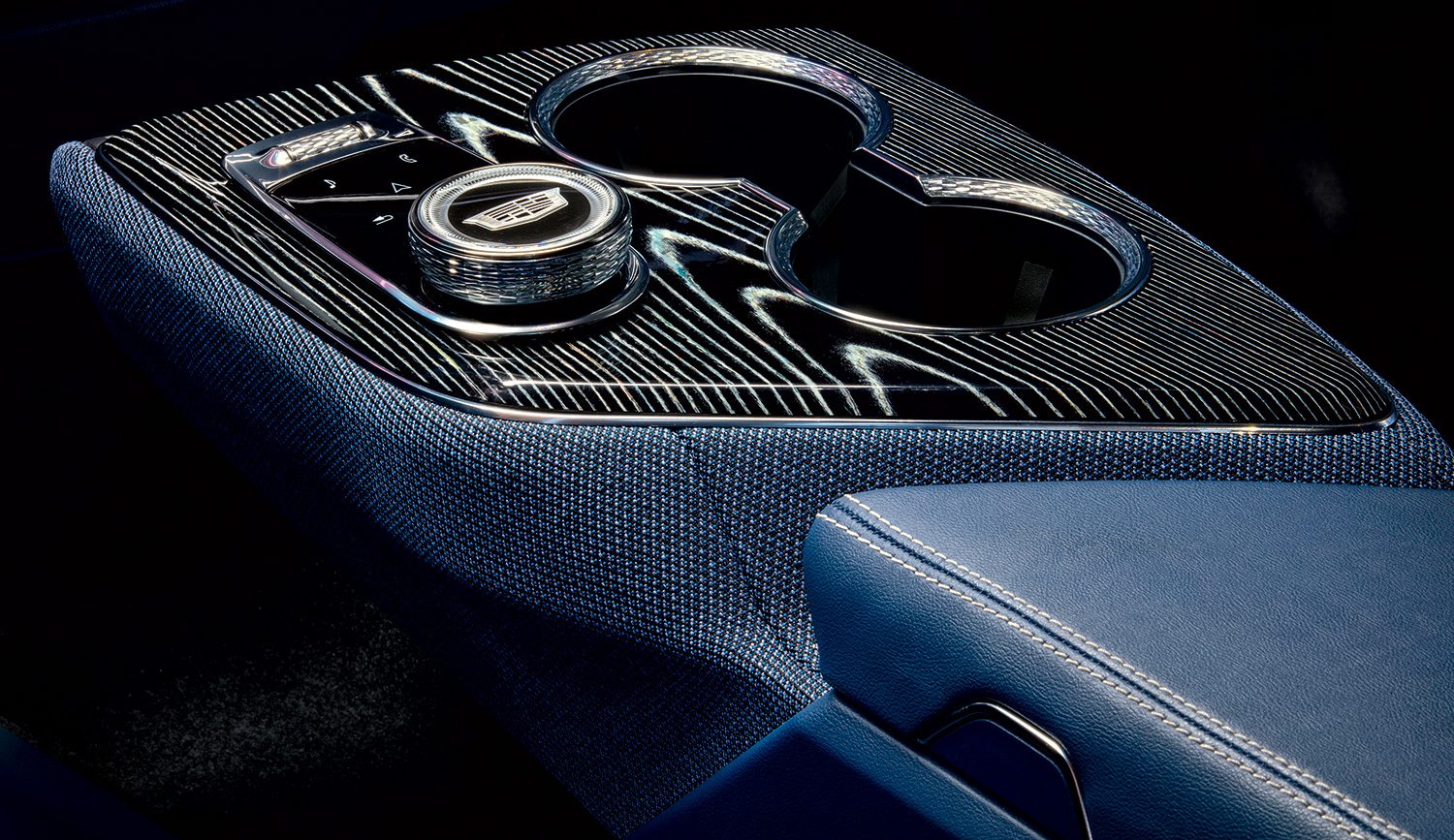
With a high beltline, only the Optiq’s glass roof gives the interior enough light to prevent a slightly claustrophobic feel. Once you get there, though, the interior is splendid. Fabrics feel like real woven cloth, though they’re auto-interior-grade durable, and Cadillac has pulled off the delicate act of using mild bright-blue accent trim just enough—but not too much. US buyers historically haven’t cared about the sustainability of a car’s interior, but the Optiq uses what it calls PaperWood veneer (ingredients include tulip wood and recycled newspaper) and patterned accent fabrics made of yarn from 100% recycled feedstock.
Deliberate acceleration—until the Optiq-V appears
An 85-kilowatt-hour battery pack powers two drive motors with combined output of 224 kilowatts (300 horsepower) and 354 pound-feet (480 newton-meters) of torque. All-wheel drive is standard.
The recently announced Optiq-V performance model will rocket from 0 to 60 mph in 3.5 seconds if drivers use its Velocity Max mode.
Acceleration of the standard Optiq can best be termed deliberate. It’s fine for standard use, and—if any Cadillac owner ever uses it—the Sport mode adds some punch. The standard Optiq just doesn’t offer the kind of kick-in-the-back acceleration found in Teslas. That’s left to the recently announced Optiq-V performance model, whose power rises to 382 kW (519 hp) with 650 lb-ft (880 N-m) of torque. Cadillac says the Optiq-V will rocket from 0 to 60 mph in 3.5 seconds if drivers use its Velocity Max mode. The Optiq-V goes into production this autumn as the priciest model in the Optiq range, starting at $68,795, with a range that GM estimates at 275 miles.
The compact Cadillac holds the road fine and is easy to drive—the weight and suspension are tuned to make potholes less jarring and smooth bad road surfaces. GM has superbly calibrated regenerative braking and one-pedal driving algorithms, and the Optiq’s learning curve overall shouldn’t be as steep as that for a Tesla or other entirely screen-based EVs.
The Optiq hardly leads the pack on charging speed, however. The difference in fast charging times is only a few minutes, but Cadillac is behind in the specs war against 800-volt EVs like the Genesis GV60, which charges at up to 300 kilowatts. On our Optiq road test, the fastest rate we saw was 107 kW (at a station rated for 150 kW) while taking the battery from a 25 percent to a 60 percent charge—after preconditioning before we arrived at the charging site. Cadillac claims the Optiq can gain up to 79 miles of range in only 10 minutes, though that’s the usual manufacturer statistic achieved under ideal circumstances of battery temperature, ambient temperature and low state of charge. As they say, your mileage may vary. The onboard AC charger is capable of up to 11.5 kW.
Optiqs built through most of 2025 use a CCS fast charging port. However, the upcoming Optiq-V will have a native NACS (SAE J3400) connector built in—the first GM electric vehicle so equipped.
Optiqs built through most of 2025 use a CCS fast charging port. However, the upcoming Optiq-V will have a native NACS (SAE J3400) connector built in—the first GM electric vehicle so equipped. The company said in June 2023 that it would adopt NACS across its portfolio. Now, more than two years later, it’s starting to happen; the rest of the Optiq line will likely follow suit.
The combined range rating from the EPA presently sits at 302 miles, which likely means around 260 miles at highway speeds using climate control. Crucially for road trips, that’s still beyond the distance many drivers can comfortably go without a rest stop.
Silent, spacious and Super Cruise
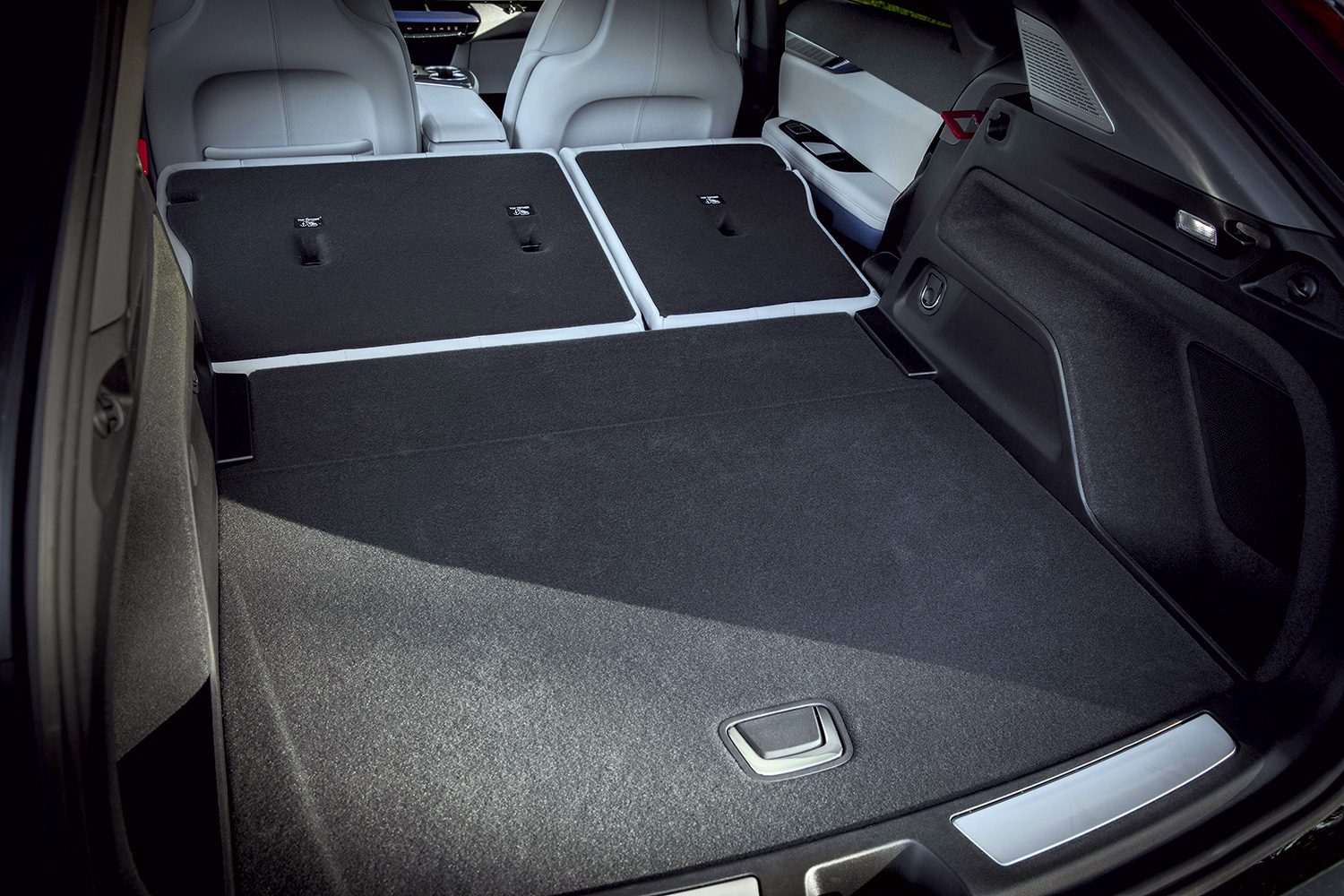
Interior space in the Optiq is ample for four. It’s large enough, even as a so-called compact SUV, to accommodate three people in the rear seat without making them elbow or jostle each other. But like all of GM’s current EV lineup except for the huge trucks, the Optiq has no front trunk—a missed opportunity to underscore an EV advantage that cars with combustion engines simply can’t offer. The Optiq also lacks a rear wiper, whereas the Chevrolet Equinox EV that shares its basic understructure has one as standard. The luxury brand claims airflow through the Optiq’s “rear flow-through spoiler” directs air over the glass at a high enough velocity to keep the rear window clean. After several spring deluges en route, we disagree. Cadillac also suggested that we use the video rear-view mirror function (instead of a rear window we could see through).
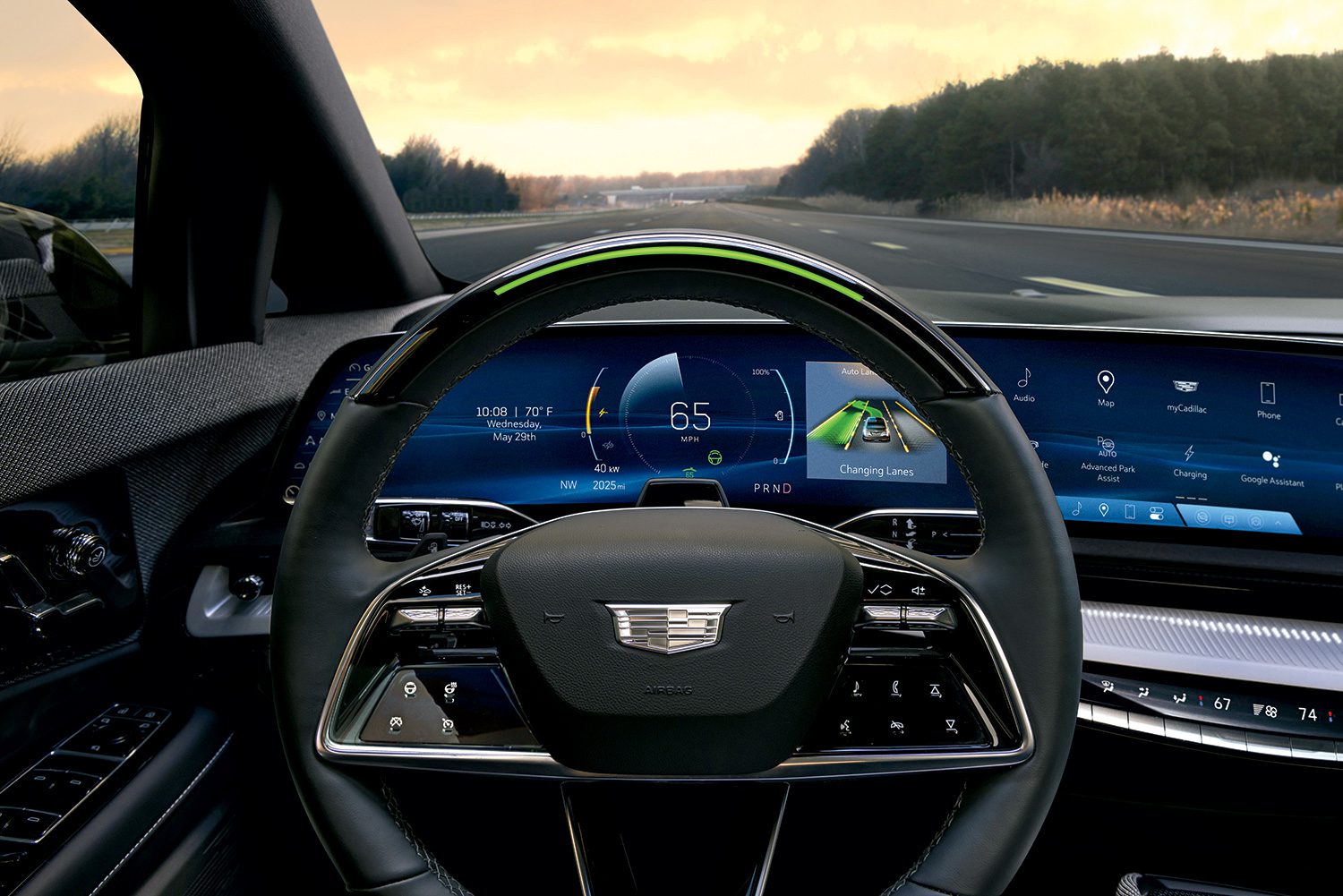
The Cadillac Optiq is probably one of the quietest cars we’ve ever driven, even for an EV. The experience of driving or riding in an Optiq is calm, smooth, pleasant, and altogether nice inside. That makes it an easy vehicle in which to cover miles—especially with the Super Cruise hands-off adaptive cruise control. Many analysts view Super Cruise as the best of the small number of hands-off adaptive cruise control systems offered in cars.
For the last year or so, the system has included automatic lane changes: it will check to ensure the overtaking lane is clear, signal, change lanes, pass the other car, then return to the slower lane. (That last step will be particularly appreciated by everyone who’s sat behind a driver going far too slow in the fast, or overtaking, lane.) Cadillac and other GM brands alert the driver to both lane departures and upcoming lane changes by vibrating the driver’s seat bolster on the relevant side. That conveys the message to the driver, without alerting other occupants as audible warning tones do. Drivers appreciate that.
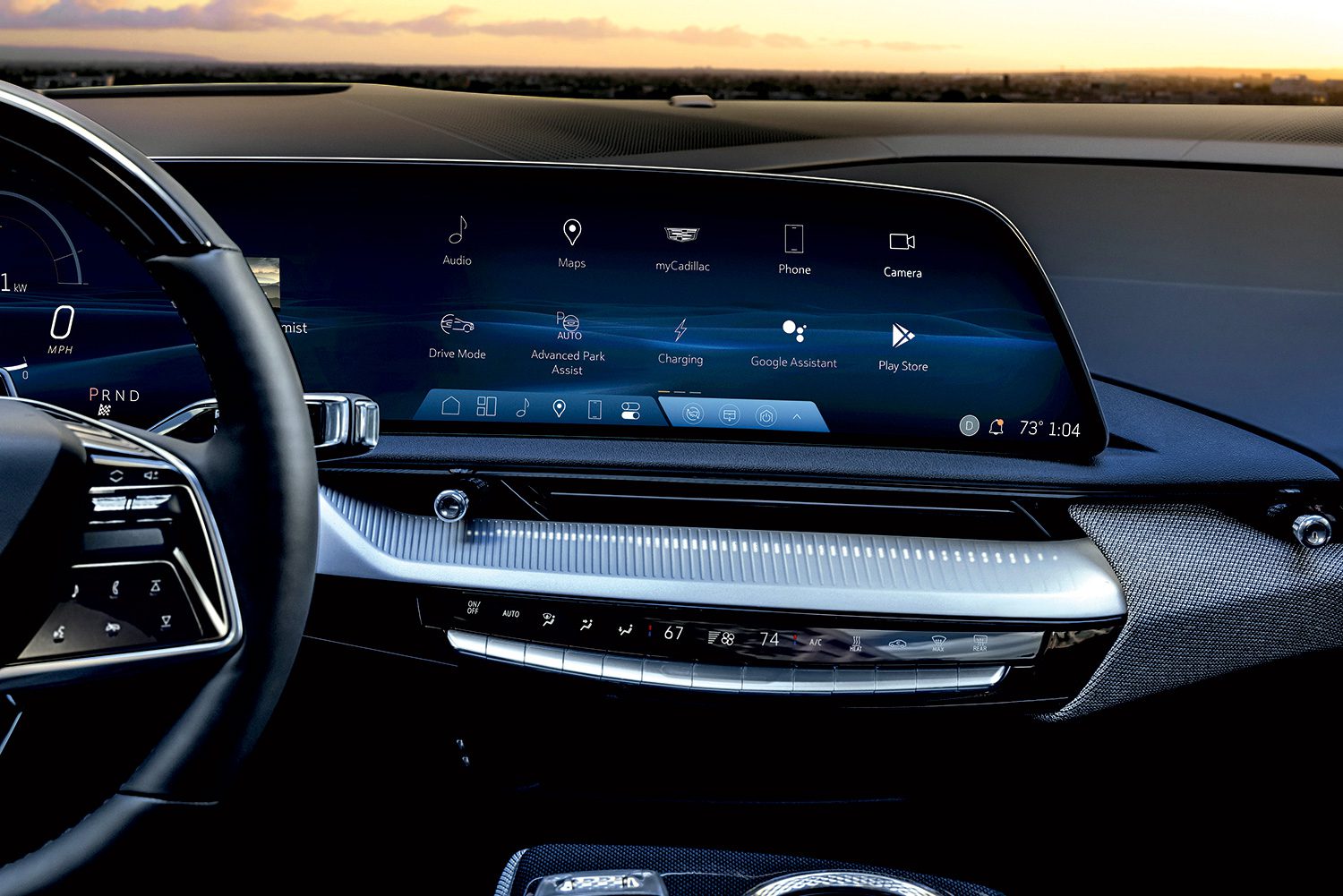
Google Maps in the dash routes the Optiq among charging stations en route and notes a charging site is “slow,” “fast,” or “very fast.”
Google Maps in the dash routes the Optiq among charging stations en route once drivers enter a destination into the system that exceeds the car’s range. Anyone who’s used Google Maps before will find that the mapping and routing works predictably enough, though it’s still not quite up to Tesla standards of seamlessness. Nor are the various charging stations among which the Optiq routes itself, operated by multiple networks, nearly as reliable as Superchargers. The system notes a charging site is “slow,” “fast,” or “very fast”—and importantly, it preconditions the battery automatically if it knows it’s headed for a DC fast charging site.
No phone mirroring (for US buyers)
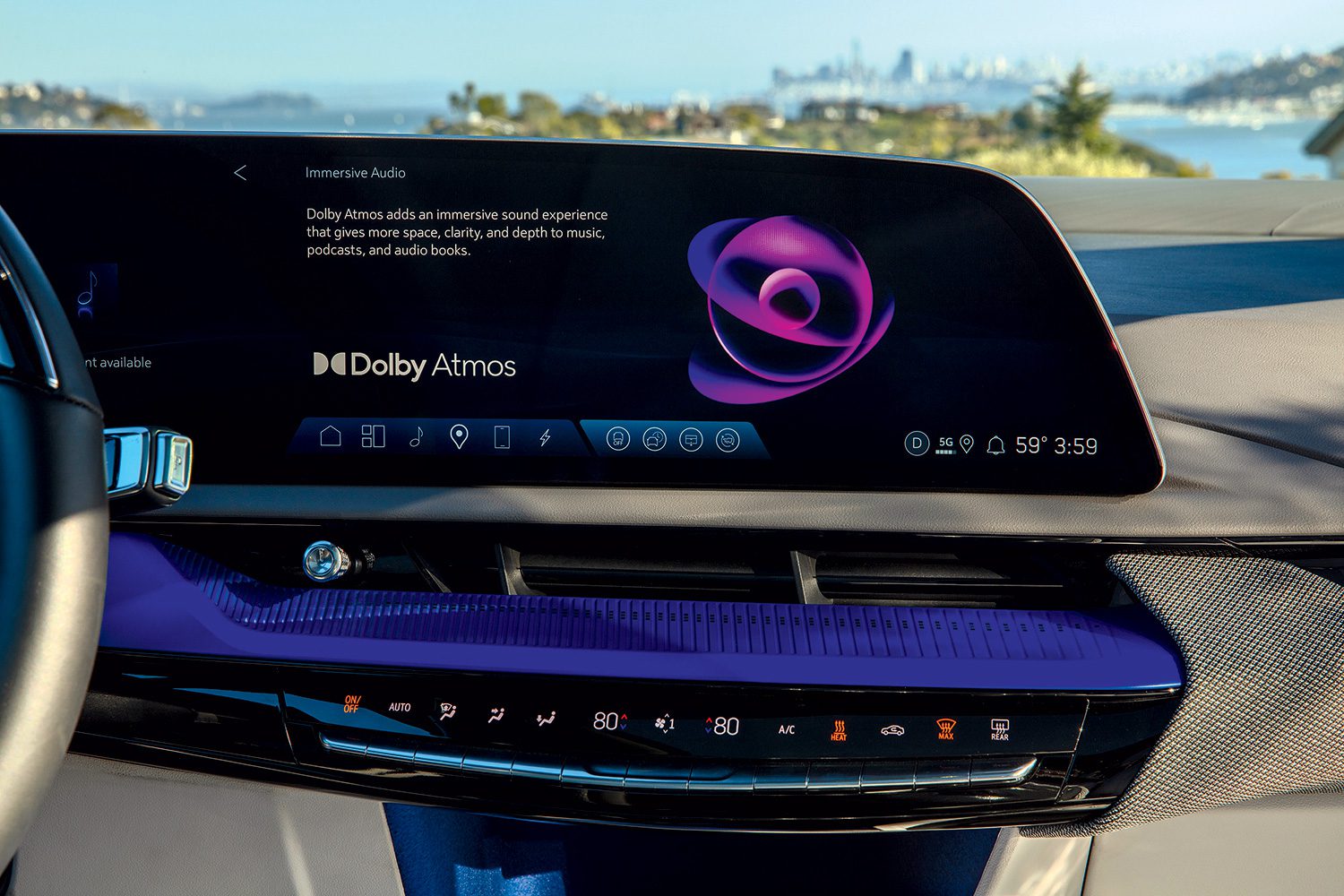
One feature most buyers will likely expect—but not find—is phone mirroring into the central touchscreen via Android Auto or Apple CarPlay. Tesla, Rivian and Lucid have never offered mirroring, and GM has chosen to remove it from its latest electric vehicles (in the US—it’s still right there in the dash for buyers in at least some other countries).
So, drivers and family members will have to remember their user names and passwords for the dozen or more apps in the dash they use regularly. (Do you remember your Spotify login info?) The Optiq gives access to those apps via its cellular connection. For three years. Then the hammer comes down: owners who want to continue to use their apps must pay Cadillac to continue to receive “App Access” beyond that. The fee is $15 each month, or it can be bundled into plans for OnStar and other features. Note that the App Access fee is on top of the $25-per-month cost to continue Super Cruise, which has its own 36-month free trial period.
Both luxury cars and EVs have higher leasing rates than other models, so we surmise the first buyer won’t have to worry over the three-year lease—and GM doesn’t sell new cars to those who will buy these models used. Except now it can target them as a source of recurring monthly fees. Why did GM do this? It’s one aspect of the “digital services revenue” that carmakers promised the financial world would earn them billions of dollars a year in new revenue. Buyers are the losers here; they must pay a monthly fee for a feature they used to get for free. Or revert to the distraction of a handheld phone, the reason phone mirroring was invented in the first place.
After spending eight days and 840 miles in an Optiq around New York City and environs, including forays into the rural agricultural regions of the state, we think it shows real promise. It’s quiet, comfortable, and well-suited to highway miles. Our few reservations sit with its software, and that has to be a matter for the paying customers to take up with GM.
Canada-based Nano One Materials has pre-qualified high-volume battery‑grade raw material inputs from global mining giant Rio Tinto for its One-Pot lithium iron phosphate (LFP) cathode active material (CAM) production process.
Rio Tinto has strategically located lithium assets across key regions and intends to increase the capacity of its Tier 1 lithium assets to over 200,000 tonnes per year of lithium carbonate equivalent (LCE) by 2028.
Nano One conducts qualification of battery‑grade raw materials through a staged testing protocol at increasing scales from A-sample (kilograms) through C-sample (1-10 tonnes) prior to D-samples in a commercial plant setting.
The collaboration includes the purchase of 10 tonnes of lithium carbonate for pilot and customer validation work from Rio Tinto’s Fenix site at the Salar del Hombre Muerto in Catamarca, Argentina qualified at C-sample (tonne scale).
Lithium carbonate from Rio Tinto’s Olaroz site in Jujuy, Argentina was qualified at A-sample (kilogram scale) for diversified sourcing strategy and is progressing to C-sample qualification.
Pre-commercial lithium carbonate samples from the miner’s Rincon project in Argentina have been evaluated for future supply.
By pre-qualifying raw material inputs, the company said it aims to accelerate customer acceptance of its LFP product and LFP CAM licensing packages.
“We are adding value to our technology and license offering by pre-qualifying feedstock that is critical to the production of LFP. This will assist our prospective licensee partners to manage supply chain risks and accelerate time to market for future One-Pot commercial plants,” said Alex Holmes, Chief Operating Officer of Nano One. “There continues to be a need for secure, diversified, and economically localized LFP cathode active material supply chains. We believe that our One-Pot processing technology can be bundled with pre-qualified input feedstocks from premier producers such as Rio Tinto, to help partners, licensees and customers achieve their objectives.”
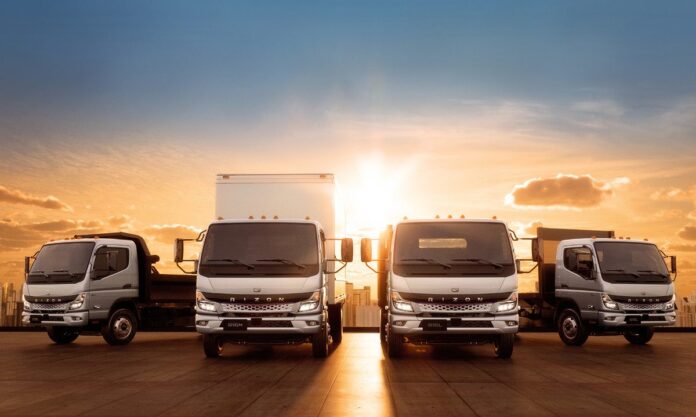
RIZON, Daimler Truck’s all-electric commercial vehicle brand for the North American market, has expanded its US sales network with new dealerships in Arizona, New York, New Jersey and Washington state.
RIZON, Daimler Truck’s ninth and newest, brand, offers Class 4-5 electric trucks.
RIZON is working with three new partners, each offering localized sales, service and fleet support:
Diversified Truck and Equipment Sales (Arizona)
Range Zero Emissions (Washington)
Alta eMobility (New Jersey and New York)
“Seeing RIZON trucks at work in such a wide range of industries, from municipal services to hospitality and fuel delivery, underscores the practicality of electric trucks in everyday operations,” said Alex Voets, General Manager of RIZON USA. “Our expanding customer base and dealership network show that more fleets are recognizing the environmental and operational benefits of going electric.”
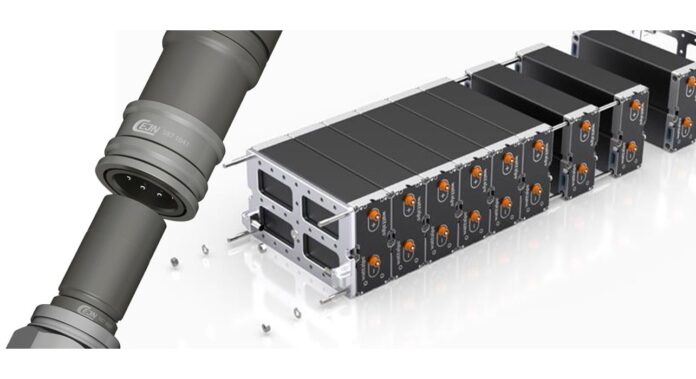
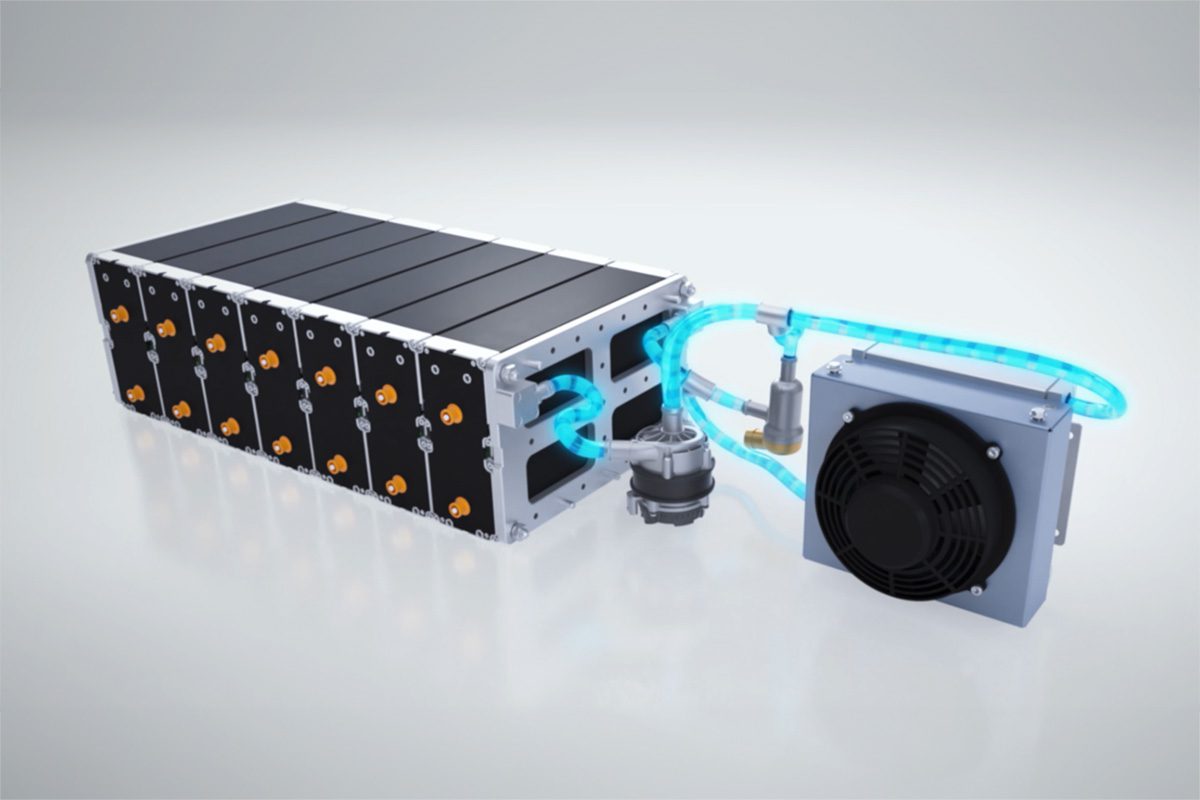
WATTALPS, a French developer of high-performance immersion-cooled batteries, has announced it is incorporating CEJN ultraFLOW quick connect couplings into its advanced battery systems. This integration aims to improve assembly efficiency, support robust thermal management and enhance the durability of battery packs intended for heavy-duty applications, including electric vehicles EVs operating in demanding environments.
WATTALPS designs and manufactures lithium battery solutions with ingress protection ratings of IP67 and IP6K9K. Each battery system is equipped with a battery management system (BMS) that meets automotive standards and is engineered for use in industries such as mining, maritime, agriculture, transportation, and construction.
The integration with CEJN’s ultraFLOW couplings follows successful completion of rigorous tests—including vibration, fire resistance, and immersion evaluations—demonstrating reliability under harsh operational conditions.
WATTALPS batteries are specifically designed to maintain optimal operating temperatures to reduce cell degradation and the resulting adverse effects on performance. The CEJN ultraFLOW couplings provide low pressure drop for effective coolant flow, a leak-free construction to prevent environmental contamination, and high resistance to shocks and corrosion. The couplings also facilitate simplified factory assembly, easier integration into various EV configurations, and adaptation to multiple battery architectures.
“It is crucial for the quality of our batteries that each supplier meets its commitments in terms of quality, cost, and delivery times,” said Matthieu Desbois-Renaudin, co-founder of WATTALPS. “The integration of CEJN’s couplings was driven by their differentiating features, including low-pressure drop, leak-free operation, and high resistance to shocks and corrosion.”
Clarios, a supplier of low-voltage energy storage solutions, has announced the acquisition of Maxwell Technologies, a manufacturer of supercapacitor cells and modules. Clarios says this acquisition will enhance its position in high-performance, short-duration energy storage. Specific terms of the transaction have not been disclosed.
Maxwell Technologies’ supercapacitors are engineered to provide rapid charging and discharging, handling up to 1 million cycles and operating across a temperature range from minus 40 °C to 65 °C. Clarios says that these modules require no maintenance or additional fire-risk mitigation, addressing reliability and longevity challenges in energy storage designs.
In 2019, Tesla acquired Maxwell Technologies, which many believed had less to do with its pioneering work with supercapacitors (aka ultracapacitors) than with its “dry electrode” technology—a far simpler way to make the anodes and cathodes that form a battery cell.
In 2021, UCAP Power, a San Diego-based developer of ultracapacitor-based power solutions, purchased the Korean-based ultracapacitor business of Maxwell Technologies, along with other related assets, including the Maxwell brand.
Clarios states that integrating supercapacitor technology supports its supply chain stability for both US and global original equipment customers, specifically within the EV and broader mobility sector. The acquisition also aligns with Clarios’ focus on battery circularity and low-voltage energy storage innovation.
In addition to applications in automotive systems, Maxwell Technologies’ supercapacitors are also used in grid stabilization, power for data centers, energy generation, military, transportation and industrial automation. Maxwell has shipped over 85 million supercapacitor cells to date, according to Clarios.
“Maxwell’s supercapacitors are designed to provide customers with high-power energy storage solutions that emphasize reliability, safety, and long life,” said Mark Wallace, CEO of Clarios. “This integration strengthens our ability to serve our automotive customers and creates a long-term opportunity to expand our presence in non-automotive sectors. Maxwell’s existing customer relationships in Data Centers, Grid, Military and Industrial applications will be maintained and actively developed under Clarios’ leadership.”
Clarios will operate Maxwell Technologies as an independent, US-based business unit.
Ubiquitous EV charging provider ChargePoint has announced plans to build a new public EV charging site in Canton, Michigan for the Dabaja Brothers Development Group, a metro Detroit real estate development company.
Dabaja Brothers will own and operate the new charging site, and plans to open ChargePoint fast charging stations at several more Michigan locations, including Dearborn and Lavonia. The sites will offer a total of over 40 charging ports.
Each site will feature ChargePoint Express Plus fast charging stations. Each Express Plus station can simultaneously charge two vehicles, and features a proprietary cooling architecture that’s designed to deliver peak charging speeds for sustained periods of time. All of the stations will be managed by the next-generation ChargePoint Platform.
“We started this project because we saw a gap in our community—there was almost nowhere to charge an EV in Canton, and a similar lack of charging across metro Detroit,” said Yousef Dabaja, Owner/Operator at Dabaja Brothers Development Group.
“This initiative will rapidly infill the fast charging deserts across the Detroit area, allowing drivers to quickly recharge their vehicles when and where they need to,” said Rick Wilmer, CEO at ChargePoint.