Tuesday, April 21, 2026
9 C
London
Home Blog Page 100

Kia Niro EV, PHEV, and Hybrid recalled due to airbag issues

0


Kia is recalling 80,255 Niro models because of a wiring issue that could interfere with the deployment of airbags.

The recall encompasses hybrid, plug-in hybrid, and all-electric versions of the Niro from model years 2023-2025 equipped with manually-adjusted front passenger seats. In the affected vehicles, the floor wiring assembly beneath the front passenger seat may become damaged by repeated sliding of the seat for fore and aft adjustment, according to the NHTSA.

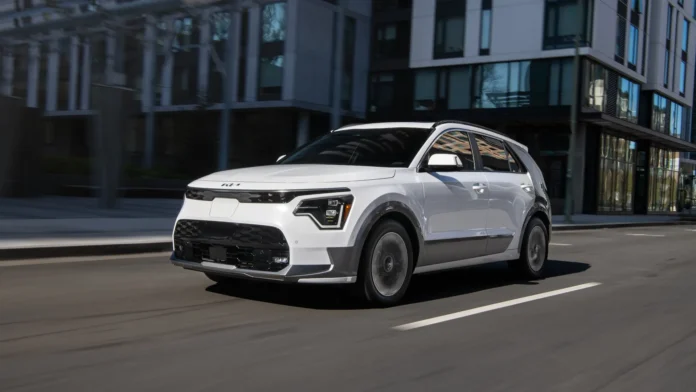
2025 Kia Niro EV

2025 Kia Niro EV

Damaged wires could result in non-deployment of airbags and/or seatbelt pre-tensioners during a crash, inadvertent deployment of the passenger side airbag, and the inability to deactivate the front passenger airbag for a child or underweight seat occupant—increasing the risk of injury. If this condition occurs, drivers may see an illuminated airbag warning light on the dashboard.

Kia told the NHTSA that it is unaware of any crashes, injuries, fatalities, or fires related to this condition, which the automaker determined is due to incorrect routing of the wires under the front passenger seat.

2025 Kia Niro EV

2025 Kia Niro EV

The remedy is inspection and rerouting or, as necessary, replacement of the affected wires, which dealers will do free of charge. Kia expects to mail owner notification letters Mar. 14. Owners can also call Kia’s customer service department at 1-800-333-4542 or visit Kia’s recall site with any questions. Kia’s reference number for this recall is SC332.

This recall covers all model years of the current-generation Niro, which receives minor changes for 2025 and holds steady on pricing across all three powertrain options. It continues to offer up to 53 mpg combined in hybrid form, 33 miles of electric range in plug-in hybrid form, and 253 miles of range in all-electric form, while serving as Kia’s entry point for each powertrain type.


Source link

Polestar transforms its EVs into Arctic Circle rally cars

0


Polestar is looking north with rally-ready versions of its current lineup of electric vehicles.

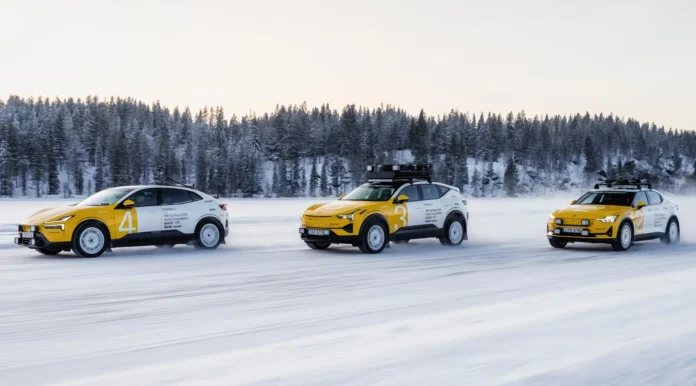
The automaker started down this icy road in 2022 with the Polestar 2 Arctic Circle concept, which featured modifications for snow and ice driving. Now that concept has been joined by Arctic Circle versions of the Polestar 3 and Polestar 4 SUVs, with all three being shown together for the first time Thursday.

Polestar Arctic Circle collection

Polestar Arctic Circle collection

Developed with input from Polestar head of driving dynamics Joakim Rydholm, a veteran driver with multiple Swedish rally podiums to his name, the Arctic Circle concepts all have raised ride heights, three-way-adjustable Öhlins dampers, OZ Racing wheels, Pirelli studded tires, Recaro bucket seats, and Steed driving lights.

Other additions, such as roof racks, show shovels, skid plates and, in the case of the Polestar 3, snow ladders, don’t improve performance but do make life in the wintry conditions these vehicles were intended for easier. And while Polestar hasn’t discussed offering an Arctic Circle option package on its production vehicles, it’s easy to imagine some of these items making it into the automaker’s accessory catalog.

Polestar Arctic Circle collection

Polestar Arctic Circle collection

The addition of the two SUVs for the 2025 model year triples Polestar’s lineup, which previously consisted only of the 2, which is made in China and continues for 2025 but drops its least-expensive and highest-range configurations. The two-row, U.S.-made Polestar 3 swings for efficient performance to further distinguish itself from the three-row Volvo EX90 on which it’s based. And the Polestar 4, which is made in China but set to be made in South Korea later this year, breaks down genre barriers with its unorthodox design.

These Polestar Arctic Circle concepts will make a more formal public debut Feb. 1 at the 2025 F.A.T. Ice Race in Zell am See, Austria. That’s also where Audi is showing its Q6 E-Tron Offroad concept, a more rugged version of the recently-launched Q6 E-Tron electric crossover.


Source link

Ford returns to Pikes Peak in 2025, with a twist on Mustang Mach-E

0


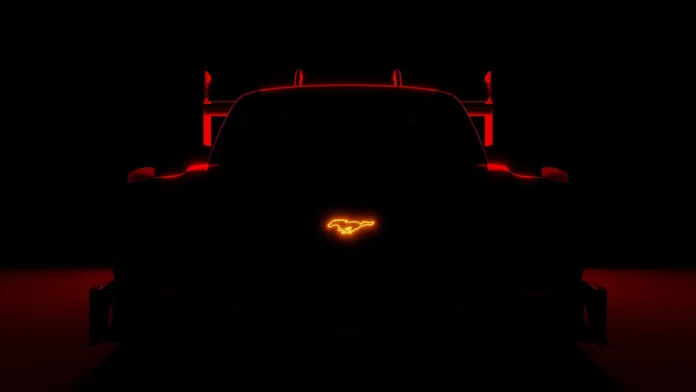
Ford will return to the Pikes Peak International Hill Climb with an electric vehicle this year, aiming for another impressive EV showing at the legendary race.

The automaker confirmed Thursday in a press release that it would send a new one-off demonstrator based on the Mustang Mach-E to the 2025 Pikes Peak Hill Climb, scheduled for late June. It follows EV demonstrators based on the F-150 Lightning pickup truck and Transit van that ran in 2024 and 2023, respectively.

Ford revealed no information yet about this Mach-E-based race car but said it will be driven by Romain Dumas, who also drove both of those demonstrators—the Ford F-150 Lightning SuperTruck and 2023’s SuperVan 4.2. Dumas holds the overall record at Pikes Peak, at 7:57.148, set in the Volkswagen ID.R in 2018.

2018 Volkswagen ID R Pikes Peak race car

2018 Volkswagen ID R Pikes Peak race car

The Frenchman wasn’t able to break his own record in 2024, but he did set the fastest time of last year’s hill climb, at 8:53.533, in the wild SuperTruck, which paired a 1,600-hp propulsion system and an elaborate aerodynamics package developing a claimed 6,000 pounds of downforce at 150 mph to help stick the tires to the narrow and twisting road to the 14,115-foot summit.

Ford F-150 Lightning SuperTruck at 2024 Pikes Peak International Hill Climb

Ford F-150 Lightning SuperTruck at 2024 Pikes Peak International Hill Climb

The 12.5-miles race route is a public road with a very low speed limit the rest of the year.

EVs have been gaining momentum at Pikes Peak, where they have an advantage over oxygen-breathing internal-combustion engines. The less-dense air at altitude robs power from those engines, but not electric motors.

Closed-course records may not be relevant to the average car buyer, but racing is an important part of car enthusiasm, and helps create a positive image for EVs among the people who view cars as more than just basic transportation. And unlike dedicated electric racing series, Pikes Peak shows that EVs can go up against gasoline cars and win—something Ford is likely hoping to continue doing in 2025.


Source link

Ford Mustang Mach-E NASCAR EV prototype gallops past gasoline

0


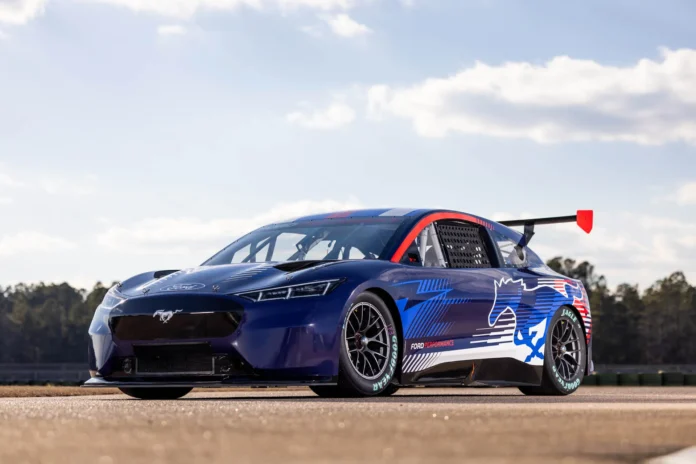
Ford on Thursday unveiled a prototype Mustang Mach-E electric SUV outfitted for NASCAR racing.

The prototype, revealed at a preview event for the automaker’s 2025 motorsports activities, is a Mach-E in name only and doesn’t have much in common with the Mach-E road car. It combines Mach-E style bodywork with a carbon-fiber tub chassis and components from a current NASCAR Cup Series race car, including suspension, brakes, steering, and wheels, Ford said in a brief statement.

Three motors provided an undisclosed amount of power for the Mach-E electric race car, with energy supplied by a 78-kwh battery pack. That’s in between the 72-kwh Standard Range pack and 91-kwh Extended Range pack currently offered in the Mach-E.

The Cup Series is the top rung of the NASCAR ladder, and it currently features purpose-built race cars powered by big thirsty V-8 engines, emitting loads of noise, gasoline fumes, and tailpipe emissions. Initial photos Ford released with the prototype show loads of tire smoke. NASCAR hasn’t even gone hybrid yet, and while hybrid race cars were announced years ago they’ve been delayed to at 2027 at the earliest.

Ford Mustang Mach-E NASCAR Prototype

Ford Mustang Mach-E NASCAR Prototype

Ford Mustang Mach-E NASCAR Prototype

Ford Mustang Mach-E NASCAR Prototype

Ford Mustang Mach-E NASCAR Prototype

Ford Mustang Mach-E NASCAR Prototype

This configuration fits with NASCAR practice. NASCAR may stand for “National Association for Stock Car Auto Racing,” but there isn’t anything “stock” about the cars. They’re designed for the series’ rule set but styled to look like cars fans can buy.

The three-motor powertrain and 78-kwh battery pack match the top-level specs given for a generic electric SUV prototype NASCAR first showed in 2023. That prototype, which also featured sustainable bodywork made with flax, hinted at a path forward for making the series greener, in keeping with a carbon-emission reduction goal adopted in 2023. All current Cup Series manufacturers also sell electric SUVs—Ford has the Mach-E, Chevrolet has the Blazer EV, and Toyota has the bZ4X—so rebranding for each won’t be an issue.

NASCAR hasn’t given any indication of when it might adopt electric cars, although leaked documents hinting of plans for a standalone electric series began in 2022. For now, the NASCAR Mach-E joins a growing collection of Ford electric prototypes, including the seven-motor Mach-E 1400, showing that electric vehicles can be fast and fun.


Source link

Mitsubishi reportedly working on small electric SUV

0


The first of several planned new Mitsubishi electric vehicles will be a small electric SUV, reports Automotive News.

This new model will arrive in the U.S. in the second half of 2026, according to the report, which cites comments from Mitsubishi executives to dealers at the 2025 National Automobile Dealers Association (NADA) show in New Orleans as well as an anonymous source with knowledge of the matter.

2025 Mitsubishi lineup

2025 Mitsubishi lineup

That source told Automotive News that the EV is expected to be a “small crossover coupe-styled vehicle similar to the planned Nissan Leaf replacement.” A new model with more crossover-like styling has long been rumored as a replacement for the aged Leaf hatchback.

Nissan owns 34% of Mitsubishi. The current Mitsubishi Outlander shares its platform with the Nissan Rogue, and the Outlander is available as a plug-in hybrid. But Nissan is potentially now in the process of merging with Honda, and while initial reporting indicated Mitsubishi would join in, subsequent reports claimed the automaker might keep its distance.

Teaser for future Mitsubishi U.S. lineup

Teaser for future Mitsubishi U.S. lineup

If this report proves accurate, the small crossover will be the first all-electric Mitsubishi sold in the U.S. since the retirement of the i-MiEV after the 2017 model year. And it could be the first of several new EVs, hybrids, and plug-in hybrids introduced by Mitsubishi over the next few years—assuming the automaker’s current product plans remain in place.

In May 2024, Mitsubishi unveiled its “Momentum 2030” plan, calling for a one new or refreshed model to be introduced each year between 2026 and the end of the decade, powered by a mix of “advanced-technology internal-combustion engines, hybrids, plug-in hybrids, and battery-electrics.” An accompanying teaser image showed seven vehicles, marking a significant expansion of the lineup. Mitsubishi also teased an electric pickup truck in 2023, but it’s unclear if that model is part of the U.S. product plan.


Source link

Intel claims it can simplify EVs, boost range—with help from Karma

0


  • Could consolidate 50+ ECUs typical in new EVs to just a few
  • Nets a 3-5% gain in efficiency and range, faster charging
  • Simplifies assembly, cuts weight, extends reach of OTA updates
  • Karma Kaveya EV arriving in 2026 is built on Intel architecture

The idea of the software-defined vehicle is, it seems, a billion-dollar buzzword in today’s auto industry. 

Truly, the money’s on it. In November, Volkswagen—recognizing Rivian’s progress in the area—invested up to $5.8 billion in a new joint venture with the U.S. EV maker. The investment is aimed at creating both the electric architecture and the software for what might amount to millions of next-generation software-defined vehicles (SDVs).

While we wait and see what that partnership brings, there’s a widespread consensus among tech suppliers and automakers that SDVs are the future for EVs and beyond—while few have provided a concrete roadmap of how and when they intend to get there.

At CES in Las Vegas earlier this month, Intel stood out as an exception, for its unveiling of a comprehensive, whole-vehicle SDV solution. It claims much more than over-the-air updates, and that it might make EVs not only more adaptive to needs but also more efficient—with up to a 5% gain in EV range and efficiency from its new software-defined layout plus a more responsive driving experience. 
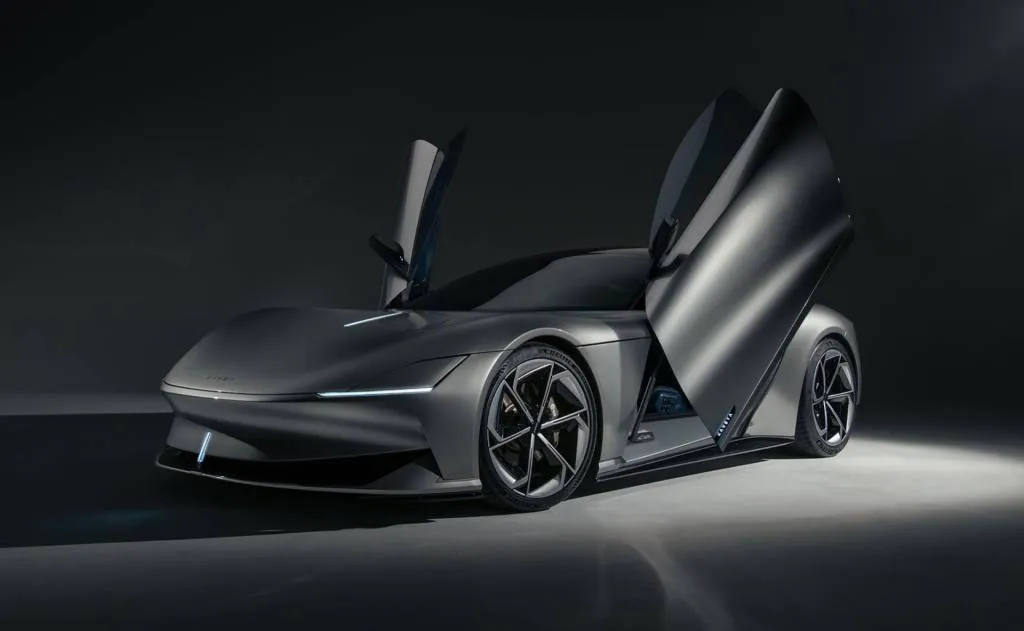
Karma Kaveya

Karma Kaveya

Karma to be “living development prototype” for Intel architecture

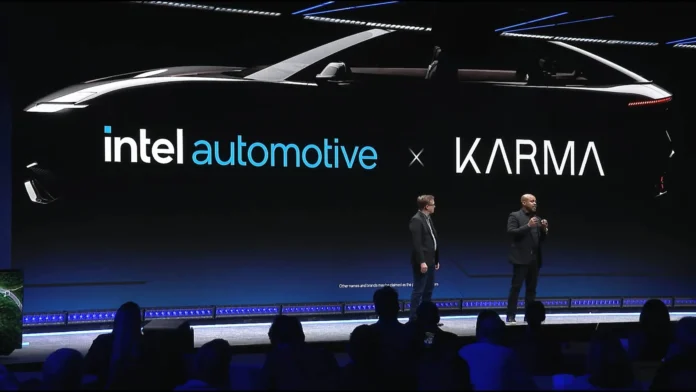
That layout isn’t a far-out concept, and it could be put to the test in less than two years. The Intel whole-vehicle software-defined architecture is due to be incorporated on the Karma Kaveya, a 1,000-hp fully electric all-wheel-drive coupe, with claimed 0-60 mph acceleration under 3.0 seconds, that’s slated for production in 2026. 

“We think that we have the opportunity to be the very first manufacturer to deploy a full ground-up true software-defined vehicle architecture,” said Marques McCammon, at Intel Automotive’s CES presentation. “And we’ll do that with the Karma Kaveya; it will have the ability to have workloads redistributed, be updated via the cloud, and it will serve as a platform for every Karma vehicle going forward.”

McCammon said that the Karma EV will be “a living development prototype for the broader industry, as we ally for the development, acting as a development partner at scale.”

Revealed at CES was Intel’s Adaptive Control Unit (ACU), which claims to consolidate the control of vehicle domains, applications, and safety-critical functions all onto one central processing chip. 

Karma Kaveya concept

Karma Kaveya concept

More than just OTA updates, Intel simplifies hardware

Most modern vehicles employ a number of separate controllers, each with their own wiring and electronic control unit (ECU), either as part of a distributed approach or a consolidated zonal approach. Intel claims that with the ACU it can reduce overall energy demand from an EV’s battery pack by actually adapting the voltage level for high-voltage systems in real time, depending on the conditions (like driving style).

Its method, with a software-defined zonal controller, can freely shift workloads around. Tesla’s Sentry mode for vehicle security, for example, runs on the in-cabin system today and uses 40 to 50 watts constantly, mentioned Jack Weast, Intel’s VP and the general manager of Intel Automotive, in the company’s CES presentation earlier this month. But with a zonal platform it can run on just a few watts, turning on the larger system when there’s an intruder. 

Or, noted Weast later, if you’re at a long stoplight, some aspects of active-safety systems might not need to be powered up.

“The way that we look at it is to think about a data center; you get all these massive racks of computing but you can literally use software to activate one rack or the other, move workloads back and forth,” explained McCammon to Green Car Reports as we took in the show.

The Karma CEO noted the parallels between the idea and one industry standard that started with Intel and evolved from not just communication to scalable power and voltage—that of the USB port.
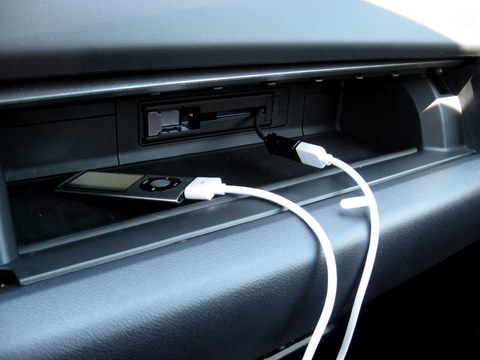
USB port

USB port

This sort of dynamic variable voltage scaling might have been used on portions of the EV platform previously, but expanding the concept to the entire vehicle is something new.

“This is what we’ve been doing in PC platforms for 20 years,” summed Weast in the CES presentation.

It would be a welcome change at this point. Today’s vehicles can be nightmares to service, let alone assemble—essentially rats’ nests of disparate control units, located around the vehicle and often running at different voltages and levels of connectivity, leaving some systems capable of over-the-air updates and others not. More than 50 ECUs isn’t uncommon in new vehicles, and some vehicles have more than 100. 

Intel’s solution could support “multiple topologies,” as part of a whole-vehicle architecture, it claims, and it could be the next step—or one of the next steps—in a quiet revolution in how vehicles are conceived, built, and upgraded. 

Intel Automotive SDV project

Intel Automotive SDV project

Building on Tesla and Rivian, or leapfrogging it?

Industry suppliers have some catching-up, measuring-up, and coordinating on standards to do, while there’s certainly potential to innovate. But some of this responsibility has been in the hands of automakers.

Shifting to a wiring-saving “zonal” architecture, with zones based on physical location rather than specific tasks, is one of the keys. So is shifting to software controls for those zones and the components within them. 

Tesla led more than a decade ago by applying the software-based, over-the-air-update model of smartphones to its vehicles—and applying the zonal approach—converging on the idea of systems that could be readily upgraded or features that might be enabled via software. 

Nio, among others, has also used a zonal approach. Rivian remains an industry darling of this transformation, and it managed in a rethink of its architecture that arrived last year in the 2025 Rivian R1S and R1T to consolidate an already-neat 17 ECUs down to just seven, cutting 1.6 miles of copper wiring from the vehicle, helping optimize efficiency and simplifying the supply chain. 

Under VW’s investment in Rivian, it will license that zonal design and allow future collaboration between the two companies. The approach could lead to more easily upgradable vehicles that might cost less to build and also might better cope with hardware changes over time. 

Intel Adaptive Control Unit for software-defined vehicles

Intel Adaptive Control Unit for software-defined vehicles

Although there’s no complete production vehicle with Intel’s approach yet, it claims an 80% reduction in ECUs, a 60% reduction in wiring harness length, and a 35% or more reduction in power consumption. Further, Intel says that the approach means lower vehicle component costs, allowing a smaller motor and battery pack—and lower-cost EV platforms overall. 

All this said, it’s unclear whether Intel’s solution is merely treading water among tomorrow’s EVs or swimming laps around them. Nearly every automaker by now understands the necessity to simplify in order to compete. Ford CEO Jim Farley, for instance, said in 2023 that its next-generation EVs will be “radically simplified,” with a new electrical architecture that’s fully software updatable. 

Intel and Karma co-branded inverter for software-defined EVs - CES 2025

Intel and Karma co-branded inverter for software-defined EVs – CES 2025

Karma’s EV inverter is a key piece

Back to the energy advantages, Intel says that its approach, including a power management system-on-chip (SoC), helps maximize efficiency for inverters, chargers, and converters. System-wide, the approach recovers up to 40% of what would otherwise be powertrain-system energy losses—netting a 3-5% gain in efficiency and range, by WLTP-cycle testing, along with faster charging and “a more responsive driving experience.” 

The inverter is one of the keys to that, and California’s Karma Automotive developed an inverter unit that’s intended to be part of Intel’s whole-vehicle solution. The silicon carbide inverter is Karma’s own intellectual property, confirmed Marques McCammon to Green Car Reports, and likely to be made in Michigan, but it’s co-branded with Intel.

Intel and Karma co-branded inverter for software-defined EVs - CES 2025

Intel and Karma co-branded inverter for software-defined EVs – CES 2025


By now you might be wondering: Why is the CEO of the California-based niche, low-volume luxury vehicle maker, which is best known for reviving and refining vehicles and systems derived from the first Fisker Automotive, talking industry-altering tech in such a deep way?

It stems from a long partnership when he was a management counterpart at Wind River systems—McCammon on the software side, Weast on the hardware side. 

“We had a vision then of what a software-enabled, or software-defined vehicle was going to be,” McCammon explained to GCR. “But when we thought this up, we always needed someone to go first.”

Fast forward a decade, to about a year ago, and Intel had just acquired Silicon Mobility, which McCammon said was a turning point. 

Intel Automotive EV interface

Intel Automotive EV interface

“We said, where do we start? Everybody’s focused on the cabin, but really energy management, usage, and efficiency is in the powertrain domains.” 

Karma had already been developing its own inverter, its own powertrain domain control unit, and a chipset, McCammon explained, but Intel and Silicon Mobility brought to the table “added a level of software programmability into a system that’s usually very fixed.”

McCammon explained that Karma essentially now it has a programmable API between motor and hardware—something most other modern EVs don’t have. “We were already working on it for our next inverter, for our next generation products,” he said. “It was a natural fit.”

“The inverter is one piece of it—this part we’re talking about today— but we are working on much, much more,” added McCammon.


Source link

GM says its EVs are now "profit positive"

0


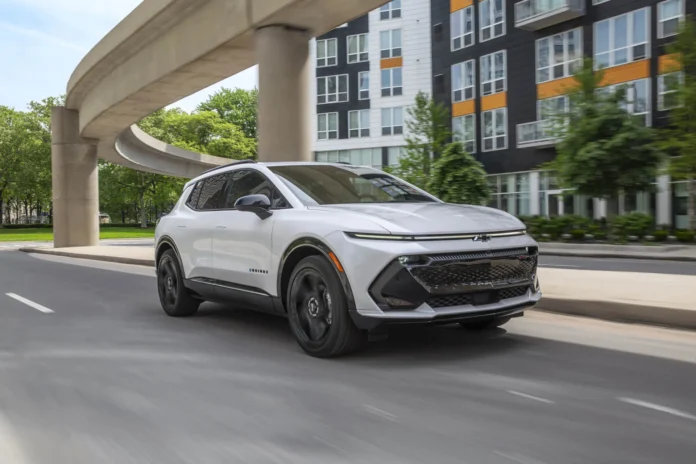
2024 Chevrolet Equinox EVNot counting some long-term costs, GM EVs became profitable in Q4 High-priced Cadillac Escalade IQ and GMC Sierra EV models contribute to that 2024 GM EV sales summed about 189,000 for the year, targeting 300,000 in 2025 General Motors claims that, by at least one metric, its electric vehicles achieved profitability in the fourth quarter of 2024…

Source link

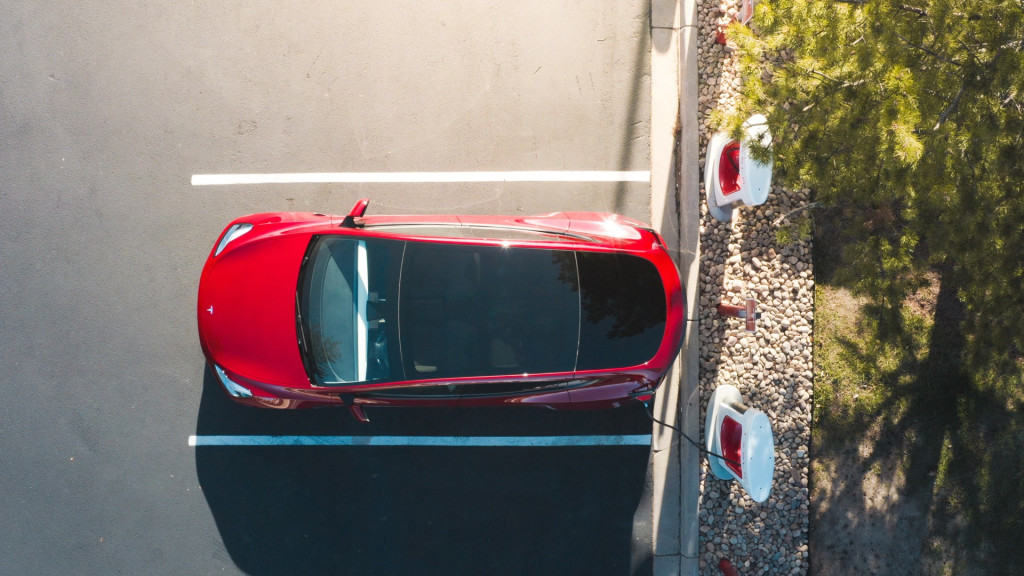
Tesla V4 Supercharger locations now output up to 325 kw

0


  • Tesla pushed an update to Supercharger V4 posts allowing 325-kw peak with Cybertruck
  • True 500-kw, 800-volt charging comes later, with V4 cabinets
  • Peak will be brief, but enough to shave a few minutes off total charge time

Tesla claims to be getting 325 kw of power from its V4 Supercharger DC fast-charging stations. But if you’re a Cybertruck driver, no it’s still not the 800-volt charging you’ve probably been waiting for.

All Superchargers designated V4 can now charge at that new peak output, the automaker said Monday on X, the social media platform owned by Tesla CEO Elon Musk.

V4 will technically allow charging at 800 volts, or up to 1,000 volts. But current V4 locations aren’t yet the complete hardware set. While they may use the new V4 charging posts and connectors, they’re still backed by Tesla’s V3 cabinet (or a modified version of it)—and thus, still not able to take advantage of the Cybertruck’s 800-volt charging.

So prior to the arrival of true V4 cabinets, it appears Tesla is doing this by running their more capable V4 cables and connectors at a potentially scorching current levels well beyond other fast-charging allows at 400 volts. Although Cybertrucks only hit that new peak for a short time—maybe a minute or less by initial accounts—it could shave more five minutes off the Cybertruck’s initial 40-minute 10-80% charging time. 

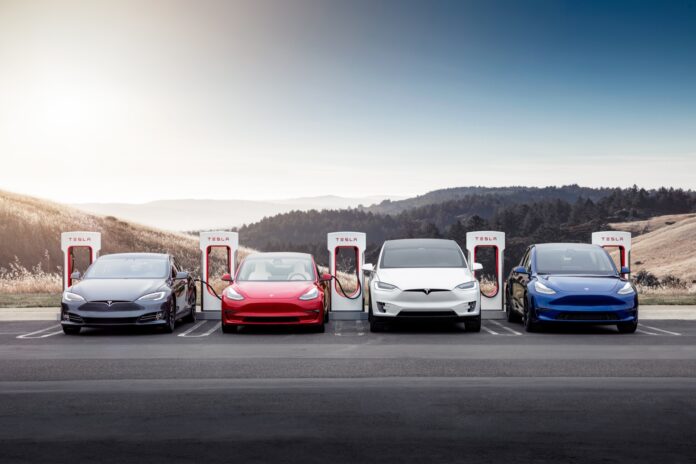
Tesla Supercharger

Tesla Supercharger

Tesla had been testing higher output for Supercharger stations since at least last year, using so-called V3+ stations that combine a V3 cabinet and V4 charge post. Tesla’s announcement specifically mentioned “V4 posts,” indicating that these stations will also offer 325-kw charging. That’s compared to 250 kw for standard V3 Superchargers.

Tesla announced V4 Supercharger hardware in 2022 and made some first installations in 2023—at that time pegged to provide higher-power charging for the Semi and Cybertruck.

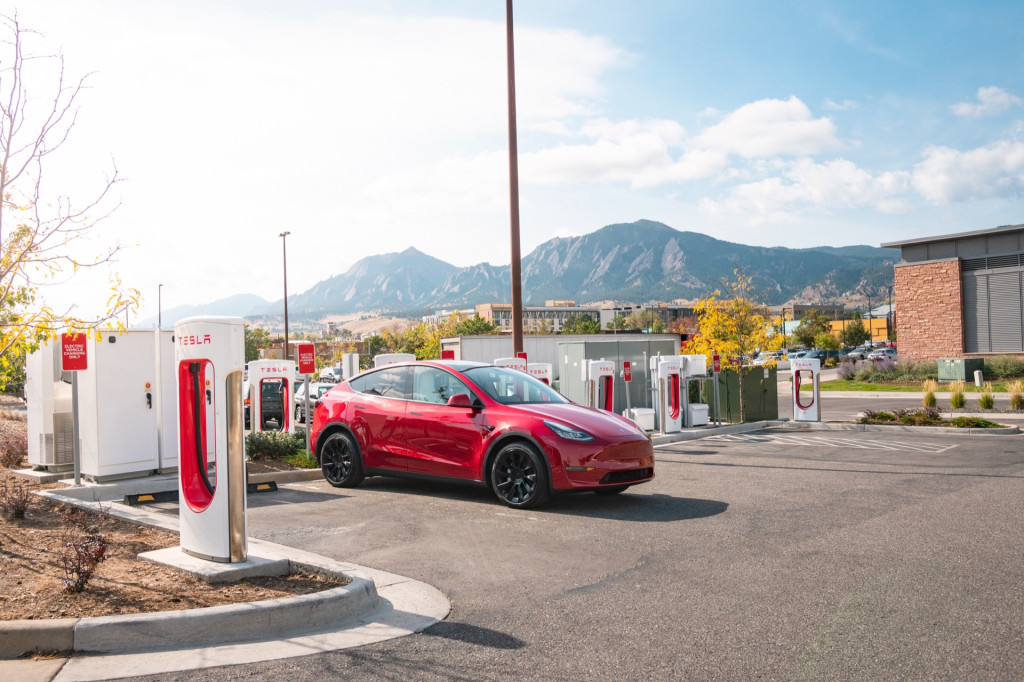
Tesla Supercharger

Tesla Supercharger

The Cybertruck is the only vehicle in the automaker’s lineup that currently boasts 800-volt charging. But some EVs from other brands offer that capability as well—and will soon be appearing at Supercharger stations as more automakers gain access to the network. With this in mind, Tesla has also been adding longer cables to accommodate vehicles with charge ports in different positions than its own.

Instead of simply waiting for Tesla to upgrade its hardware, Stellantis has also tried to patent a system for boosting output of 400-volt DC fast-charging stations for 800-volt EVs that can handle the extra power. That could allow the automaker’s future EVs to charge at higher power levels from 400-volt Superchargers. The Lucid Gravity, which gets Supercharger access Jan. 31, also claims a sustained 225-kw on 500-volt chargers or up to 400 kw on 1,000-volt chargers.


Source link

DOT contradicts itself, claims cleaner cars will jeopardize safety

0


  • New Secretary of Transportation Sean Duffy has ordered the NHTSA to reconsider fuel economy standards
  • The DOT says high fuel economy standards will lead to higher prices and therefore an older fleet
  • The DOT says an older fleet will make cars less safe

The Trump administration is wasting no time in attempting to roll back federal emissions standards, but it appears to be working against some of its own previous decisions in the process.

On Tuesday night, shortly after his confirmation, new Secretary of Transportation Sean Duffy sent a letter to the NHTSA directing that agency to “commence an immediate review and reconsideration of all existing fuel economy standards” for model years 2022 forward, including Corporate Average Fuel Economy (CAFE) standards put in place by the Biden Administration that set higher efficiency targets beyond the end of the decade.

In the letter, Duffy claims that current vehicle-fleet fuel economy standards exceed statutory requirements and that lower targets would thus be sufficient. In direct contradiction to the NHTSA’s previous position on improved fuel efficiency—even under the previous Trump Administration—Duffy argues that lowering fuel economy standards will make cars cheaper and thus safer.

2025 Chevrolet Equinox EV

2025 Chevrolet Equinox EV

“As a result of the regulatory costs, distortions, and pressures imposed by the existing CAFE standards, more Americans will be relegated to driving older and older used vehicles, which statistics show are much less safe in a highway crash,” the new Transportation Secretary wrote.

But when the previous Trump NHTSA and EPA jointly issued the so-called Safer Affordable Fuel-Efficient (SAFE) Vehicles Rule in March 2020, setting steeper fuel economy and emissions standards for model years 2021-2026, the agencies argued that lower fuel consumption and carbon emissions for those somewhat higher standards would still go hand in hand with cost reductions and safety improvements.

Then, it saw a $1,400 cost reduction per new vehicle, and at that time, the NHTSA also said newer vehicles meant safer vehicles, but it still expected the cost savings would allow 2.7 million more new vehicles to be sold by 2029 while raising efficiency standards. The previous logic is explained in the video below.

The letter also recapitulates typical Trump talking points about eliminating subsidies for electric vehicles, claiming lower EV sales will help consumers by keeping new-car prices down, and help the auto industry as well by allowing continued focus on internal-combustion vehicles.

Although Biden’s influence started with 2022, the steeper fleet efficiency standards imposed didn’t go into effect until the 2024 model year—and in the relaxed form covered by the final rule through 2031, they go easy on gasoline trucks and SUVs

2025 Toyota Corolla Hybrid

2025 Toyota Corolla Hybrid

This will raise consumers’ costs at the pump, increase tailpipe pollution and jeopardize U.S. automakers’ future, and no one voted for any of it,” Dan Becker, director of the Center for Biological Diversity’s Safe Climate Transport Campaign, said in a statement. “The only beneficiaries will be oil executives and China’s auto industry, which will be happy to sell electric vehicles around the world with little U.S. competition.”

Any cost reductions from less-efficient new cars will also likely be offset by new tariffs that would raise prices whether cars are assembled in the U.S. or abroad. Recent reports estimate that a proposed 25% tariff on all imports from Canada and Mexico would raise prices on Mexico-built gasoline pickup trucks by $8,000-$10,000 and add $2,100 to the cost of U.S.-assembled vehicles because of increased parts costs.

Consumer organizations and environmental groups called the declaration a favor to a specific oil-company interests at the expense of working families and the planet. “Making cars less fuel efficient was a key demand of oil executives, and this administration is delivering for them,” said Kathy Harris, director for clean vehicles at Natural Resources Defense Council. “For the rest of us, this is a harsh blow when we can afford it least.”

The DOT letter also mentions terminating, where appropriate, state emissions waivers that function to limit sales of gasoline-powered automobiles,” likely a reference to California and its plan to end sales of most vehicles with combustion engines by 2035.

The Supreme Court has already rejected one recent challenge to California’s emissions authority, which was blocked by the Trump Administration in 2019 and then restored by the Biden administration. Last time, this move was supported by several large automakers, including General Motors, Toyota, and Stellantis predecessor Fiat Chrysler Automobiles (FCA). But those automakers are now much further along with their EV rollouts—GM even claims it achieved EV profitability last quarter—giving them more to lose this time.


Source link

Honda reportedly planning sub-$30,000 EV, might be US-built

0


Honda could be reversing course on plans for an affordable electric vehicle, and may even build it in the U.S., according to a new report by Nikkei.

The report says Honda plans to launch a small EV costing less than $30,000 in the U.S. as early as next year. This new EV will also reportedly be U.S.-built, likely to avoid new tariffs on imported vehicles expected to be instituted by the Trump Administration.

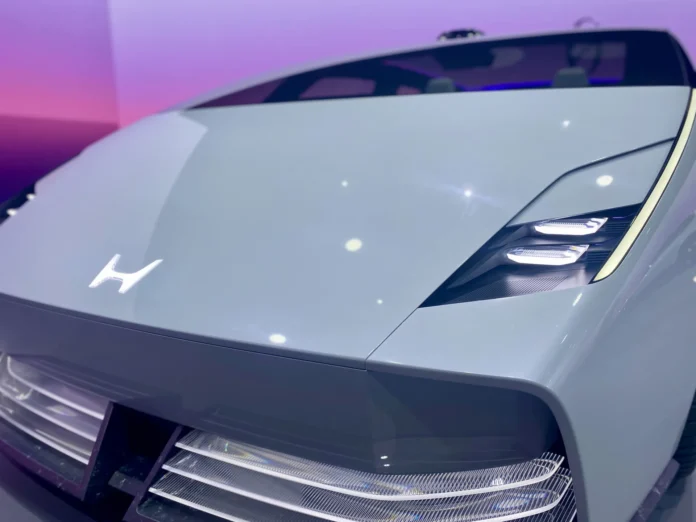
Honda 0 Saloon prototype

Honda 0 Saloon prototype

The sub-$30,000 EV would be the smallest and cheapest of the Honda 0 Series, set to comprise seven models by the end of the decade, on a global scale. Honda recently previewed what it said were the first two 0 Series models with its Saloon (sedan) and SUV prototypes at CES 2025.

At CES, Honda said a production version of the SUV prototype would arrive in the first half of 2026, with the sedan following later in the year. They’ll be built in Ohio, where Honda already produces gasoline cars, alongside the Acura RSX electric SUV and the Afeela 1 electric sedan from the Sony Honda Mobility joint venture. The Acura is due later this year, while the Afeela is scheduled to arrive in 2026 like the Honda-branded models.

Honda 0 SUV prototype

Honda 0 SUV prototype

To prepare for mass EV production in the U.S., Honda is retooling three of its existing plants and creating a $3.5 billion battery plant. The automaker has emphasized throughout that the mix of EV and gasoline-vehicle production is market-dependent, but indicated in 2024 that it would be able to build hundreds of EVs per day at its revamped Marysville Auto Plant in Ohio, potentially surpassing Tesla’s production rate.

Whether a sub-$30,000 EV will be among the vehicles produced in Ohio next year remains to be seen. At CES 2024, Honda CEO Toshihiro Mibe told Green Car Reports that the automaker would like to realize an affordable EV “very late in the 2020s” and that a circa-$30,000 price point would likely be dependent on breakthroughs in battery tech, specifically solid-state batteries.


Source link