Sunday, April 26, 2026
8 C
London
Home Blog Page 46

Charged EVs | EVgo places its bets on Autocharge+ for seamless public EV charging

0


As any user of public EV charging will tell you, the industry badly needs a widely-accepted standard for seamless charging. Just as we ditched dial-up modems in favor of WiFi, we need to lose the apps and credit card readers and implement a system that lets us plug in and walk away—something like the system that Tesla drivers have always enjoyed.

At the moment, there are two different systems for seamless charging in the US: Plug & Charge (the popular name for a feature included the ISO 15118-20 standard) and Autocharge. (based on DIN Spec 70121). Both systems handle authentication and secure billing automatically—drivers simply plug in and go about their business.

Both standards have champions and detractors in the marketplace. Public EV fast charging provider EVgo is pushing ahead with its own version of Autocharge, which it calls Autocharge+. Competitor ChargePoint is throwing in its lot with Plug & Charge.

Actually, EVgo supports Plug & Charge too, but at the moment it’s touting the benefits of Autocharge+. Charged contacted EVgo and asked for clarification, and a spokesperson responded: “Autocharge+ is EVgo’s premier [seamless charging] solution at this time. We are committed to rolling out the Plug and Charge standard once the intricacies around certification and implementation have been addressed, so in the meantime, we continue to support Autocharge+ as our current solution to offer seamless session initiation.” (One of these intricacies is what to call the system. Here at Charged, we say “Plug & Charge,” but EVgo prefers “Plug and Charge,” and ChargePoint is calling it “PnC.”)

Be all that as it may, EVgo customers are embracing Autocharge+. The company reports that it has now delivered over five million Autocharge+ charging sessions, and that some 300,000 of its customers have enrolled in Autocharge+ to date. Nearly 30% of EVgo charging sessions are now initiated using Autocharge+.

Today, some 80 different EV models are eligible for Autocharge+. The technology supports most CCS vehicles as well as new native NACS vehicles. EVgo reports that the highest levels of enrollment have come from drivers of Cadillac, Chevrolet, Ford and Rivian models.

“EVgo collaborates with our automaker partners and performs extensive testing at our Innovation Lab to develop and expand technology solutions like Autocharge+,” said Alex Keros, Senior Vice President at EVgo. “We are focused on the best possible customer experience and will continue to expand and deploy features like Autocharge+ and Plug and Charge across our network.”

Source: EVgo


Source link

Charged EVs | Nuvola’s SafeCoat battery separator withstands nail penetration testing

0


US-based battery company Nuvola Technology has demonstrated that its SafeCoat Direct Deposition Separator (DDS) can prevent thermal runaway in lithium-ion batteries under extreme conditions that typically result in catastrophic fires.

In testing, Nuvola’s 41-layer, 5 Ah lithium-ion pouch cell with SafeCoat DDS survived nail penetration testing, maintaining its charge without ignition or thermal runaway. That was in contrast to a commercial benchmark cell using thermally enhanced separators that erupted into thermal runaway within 10 seconds under identical conditions.

SafeCoat’s nanoporous layer remains structurally intact at temperatures exceeding 220° C, and in contact with direct flame. This prevents the cascading failure that turns one damaged cell into a fire.

SafeCoat is compatible with existing lithium-ion production lines and strengthens US battery manufacturing capacity by reducing reliance on centralized separator facilities that are mostly located in Asia.

Global battery manufacturers serving the EV, medical devices and consumer electronics sectors are evaluating the technology. Early assessments suggest that SafeCoat could lower battery pack costs by reducing insulation requirements for thermal runaway prevention, Nuvola said.

“What’s truly exciting is that this cost-effective and shovel-ready solution delivers most of the safety benefits expected from solid-state batteries—but it’s available today, and it integrates seamlessly into lithium-ion plants operating or under construction,” added Dr. Leland Smith, CTO and co-founder of Nuvola Technology.

Source: Nuvola Technology


Source link

Charged EVs | Concentric’s autonomous forklift battery management system has performed 250,000 two-minute battery swaps

0


Swedish forklift and facility power systems provider Concentric has surpassed 250,000 battery swaps using PowerHIVE, its autonomous forklift battery management system.

Concentric aims to help facilities accelerate their transition from lead-acid to lithium-ion batteries by eliminating expensive charging infrastructure, cutting downtime and reclaiming floor space. Lithium batteries require expansive electrical installations yet still require operators to manage charging and deal with idle forklifts and ancillary equipment, Concentric noted.

The PowerHIVE system standardizes batteries to a single size and centralizes charging in a compact footprint. Standardized batteries often enable a 10% reduction in fleet size while freeing as much as 80% of battery room space for revenue-generating storage, Concentric said.

Operators do not need to touch a 3,000-pound battery, and reloads take two minutes, increasing pallet throughput by up to 15%. Facilities realize a 5-12% increase in their throughput KPIs across receiving, shipping and production processes, according to the company. Customers report up to 37% reductions in energy usage.

“Reaching 250,000 forklift battery swaps in such a short period reflects what our customers already know: PowerHIVE works,” said John Winter, President and CEO of Concentric. “The first 100,000 swaps took 20 months. The next 150,000 happened in seven. That is exponential growth fueled by simplicity and results.”

Source: Concentric


Source link

Charged EVs | bp pulse adds new EV fast charging sites in Arizona, Texas, Florida and Ohio

0


bp pulse continues to expand its network of public DC fast EV chargers across the US. The company just opened its first site in Arizona, along with new locations in Texas, Florida and Ohio.

All these sites offer both CCS and NACS connectors, charging speeds up to 400 kW, and access to rest rooms, food and other amenities on-site or nearby.

bp pulse’s first site in Arizona is located at a Petro Travel Center just off I-10 near the town of Eloy. It has 16 charging bays, all with 400 kW chargers, and features a travel store, on-site diner, ATM and barber shop.

Another new site is found at a Petro Travel Center off I-10 in El Paso, Texas. Here you’ll find 12 charging bays, all with 400 kW chargers, a convenience store, a diner and a barber shop.

In Florida, bp has opened a new site just 3 miles from Fort Lauderdale International Airport (FLL), convenient for ride-hail drivers, rental returns and airport pickups and drop-offs. This site has 16 charging bays, with 150 kW and 400 kW chargers. Hotels, restaurants and convenience stores are nearby.

The new Ohio charging station is at a Travel Centers of America site just off Interstate 70 in Hebron. There are 6 charging bays with 400 kW chargers, as well as a convenience store and fast-food options.

Source: bp pulse


Source link

Charged EVs | Allye Energy wins order for five MAX500 battery storage systems for charging electric construction vehicles

0


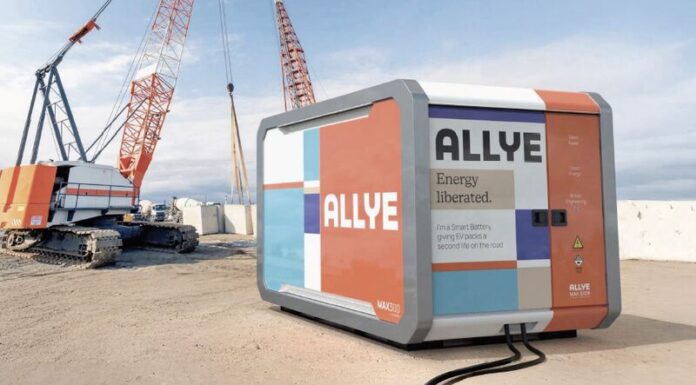
Mobile battery energy storage specialist Allye Energy has secured its largest purchase order to date: five MAX500 battery energy storage systems for deployment in the construction industry.

The MAX500 systems (500 kWh, 420 kW each) will charge zero-emission construction equipment and vehicles at locations where grid constraints and site logistics make fixed charging impractical.

Construction sites often face severe grid constraints, and heavy equipment such as excavators cannot be readily transported to distant charging points. Allye’s mobile battery systems bring charging infrastructure directly to equipment on-site.

“The MAX500 solves one of construction electrification’s most challenging problems: keeping heavy equipment charged and productive across sprawling sites,” said Alistair McNeil, COO of Allye Energy. “Our mobile battery systems bring charging infrastructure to the equipment, maintaining productivity whilst eliminating emissions.”

“The MAX500 systems from Allye offer mobile, zero-emission energy storage that helps construction sites overcome grid constraints whilst maintaining operational uptime,” said Josh Wright, CEO of Vital Power Group, Allye’s distribution partner. “Once deployed on our customers’ sites, the units will be fully supported by our comprehensive maintenance packages.”

The MAX500 is the first system in Allye’s range to feature DC fast recharging, enabling rapid replenishment from 20-80% state of charge in approximately one hour. This capability enables systems to recharge from any public DC fast charger or, for large-scale projects, to recharge each other in the field.

“By enabling our systems to rapidly recharge from DC sources—whether public infrastructure or other battery units—we’ve created a dynamic energy ecosystem that adapts to the complex logistics of large construction sites,” said Jonathan Carrier, founder and CEO at Allye Energy. “This capability will be rolled out across our entire MAX range.”

Allye Energy now offers four battery energy storage systems, tailored to different applications:

  • MAX300 (~300 kWh, 280 kW): a mobile, trailer-mounted system weighing under 3.5 tonnes with minimal ADR requirements. Suitable for construction sites, film and TV production, events and temporary power applications.
  • MAX500 (~500 kWh, 420 kW): offers an optimal balance of capacity, power and mobility for construction applications, featuring integrated DC fast recharging capability.
  • MAX1000 (~1 MWh, 840 kW): a high-capacity system for grid-tied EV charging hubs, manufacturing facilities and construction sites requiring sustained high-power delivery.
  • MAX1500 (~1.5 MWh, 1.25 MW): Allye’s flagship ‘drop and go’ system deployable in under two minutes using a hook loader. Suitable for on-grid and off-grid applications including data centers, ports and industrial electrification.

Source: Allye Energy


Source link

Charged EVs | Critical Materials Recycling and Paladin EnviroTech launch rare earth magnet JV

0


Critical Materials Recycling (CMR) and Paladin EnviroTech have formed a new joint venture, REcapture, focused on recycling rare earth elements (REEs) from consumer, automotive and industrial electronics.

The partnership merges CMR’s processing capabilities for material recovery with Paladin’s environmental technology platform and global collection network.

CMR’s scalable technology, which was originally developed at Ames National Laboratory, recovers rare earth oxides including neodymium, praseodymium, dysprosium and terbium from end-of-life devices such as motors, speakers, hard drives and other electronic components.

The first REcapture collection systems are already operating across North America, servicing key industrial and consumer electronics recycling networks. Expansion plans include partnerships with manufacturers, recyclers and other stakeholders to increase the rate of rare earth material recycling.

“Our mission with REcapture is simple yet transformative: to make rare earth recycling as accessible and impactful as ferrous or copper recycling,” said Dan Bina, CEO of CMR and Co-Chair of REcapture. “By integrating our recovery technology with Paladin’s collection and processing systems, we can divert strategic materials from waste streams and reduce reliance on foreign supply chains.”

“REcapture is a natural evolution of our work,” said Brian Diesselhorst, CEO of Paladin and Co-Chair of REcapture. “By combining CMR’s rare earth recovery expertise with our sourcing, collection and processing capabilities, we’re delivering a practical, data-driven solution to one of the most pressing resource challenges of our time.”

Source: Paladin EnviroTech


Source link

Charged EVs | Allstar expands its commercial EV charging network with access to First Charge’s depot charging

0


UK-based EV, fuel and business expense payment company Allstar has partnered with First Charge, UK bus operator First Bus’s commercial EV charging service, to expand depot charging access for electric vans and HGVs across 10 UK locations.

The partnership offers depot charging speeds up to 360 kW, larger bays suitable for e-vans and eHGVs, and negotiated pricing to reduce vehicle downtime and operational costs for eligible Allstar customers. The network encompasses more than 28,000 locations in the UK, including more than 76,000 chargers.

Allstar’s work to improve accessibility to EV charging includes solutions for public charging, near-home charging and home charging—and now negotiated pricing as well as integrated payment and reporting solutions for eligible Allstar customers at First Charge’s depot charge points.

“Through First Charge, we are unlocking the potential of our depot charging infrastructure for use beyond our own bus charging needs, helping more fleets access ultra-rapid charging to make the switch to zero-emission vehicles,” said Faizan Ahmad, Decarbonization Director at First Bus.

Source: Allstar


Source link

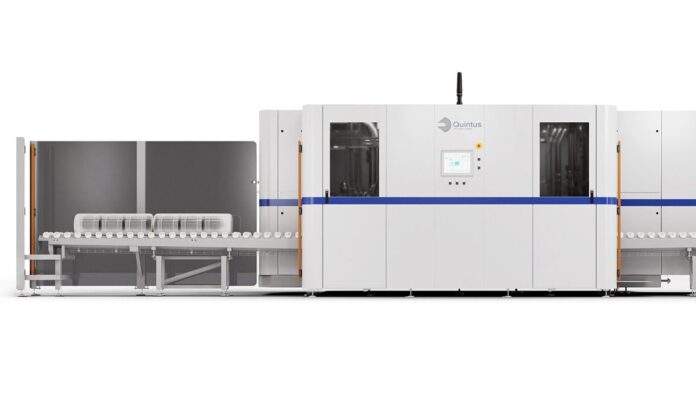
Charged EVs | Quintus unveils pilot-scale warm isostatic presses for all-solid-state battery production

0


Swedish high-pressure systems manufacturer Quintus Technologies has engineered its new series QIB 300 and QIB 600 Warm Isostatic Presses to validate processes for volume manufacturing of all-solid-state batteries (ASSBs).

Warm Isostatic Pressing delivers high-density, defect-free structures and higher conductivity than other methods, according to Quintus. The technology also allows for simultaneous densification of multi-layered cells, increasing capacity and reducing processing cost per kWh.

Quintus designed the WIP series specifically for pilot-scale ASSB production. It supports pressures up to 600 MPa and temperatures up to 145° C to achieve optimal compaction and bonding. Horizontal loading enables fast, automated batch processing and high throughput, and customizable fixtures optimize cell loading, improve pack density and reduce cost per cell. The system’s compact, efficient footprint is designed to minimize installation time and operating costs.

Quintus offers application expertise and lifecycle support to support customers. At the company’s Battery Application Centers, engineers provide assistance in material testing, process optimization and system integration. The Quintus Care Program delivers tailored service plans to maximize uptime.

“The shift to all-solid-state batteries will redefine mobility and energy storage—but it can only succeed with manufacturing technologies that deliver consistency, safety and scalability,” said Johan Hjärne, CEO of Quintus Technologies. “Our QIB 300 and 600 series presses reduce technical risk and time-to-market and offer better economics per kilowatt hour of battery capacity, giving the industry the confidence and tools it needs to move from research breakthroughs to real-world industrial production.”

Source: Quintus Technologies


Source link

Charged EVs | LG Energy Solution teams up with South8 Technologies to enter aerospace battery sector

0


South Korea battery manufacturer LG Energy Solution has formed a strategic partnership with South 8 Technologies to jointly develop space-rated lithium-ion batteries optimized for extreme temperatures as low as -60° C.

South 8 Technologies is a US startup company that has developed a liquefied gas (LiGas) electrolyte, which is designed to enhance battery performance by enabling ultra-low temperature operation, outperforming conventional liquid electrolytes, which struggle below -20° C.

The two companies’ cooperation is part of a larger aerospace initiative involving KULR Technology and NASA to develop batteries for deep space missions that can withstand the harshest environments.

KULR, a provider of energy storage solutions for aerospace and defense, recently secured funding of $6.7 million from the Texas Space Commission to develop low-temperature lithium-ion battery solutions for lunar and Martian exploration missions. The program is being carried out in close collaboration with NASA Johnson Space Center (JSC).

LG Energy Solution aims to play a key role in this joint effort, supporting the design, testing and evaluation of lithium-ion battery cells. South 8 Technologies will then manufacture enhanced battery cells using its liquefied gas electrolyte and electrolyte filling technology. These cells will be integrated into KULR’s One Space battery architecture platform.

LG Energy Solution first connected with South 8 Technologies through its Startup Challenge Program in 2019 and has continued to collaborate with the startup. In 2024, the companies signed a joint development agreement and began the development of the liquefied gas electrolyte-based batteries. The latest agreement further cements the relationship between the two companies.

“The liquefied gas electrolyte technology fundamentally addresses the long-standing issues of battery performance degradation in extreme cold environments,” said Je Young Kim, CTO of LG Energy Solution. “We anticipate that this technology will unlock unprecedented possibilities to pioneer new products and applications including space.”

Source: LG Energy Solution


Source link

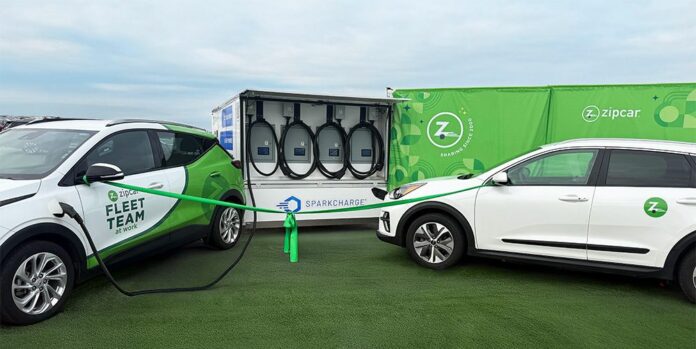
Charged EVs | SparkCharge’s Mobile Battery-Powered Trailer delivers 320 kW DC charging for Zipcar’s EVs

0


EV fleet charging network SparkCharge has partnered with the Massachusetts Clean Energy Center (MassCEC) and car-sharing network Zipcar to create a DC fast charging hub that uses a mobile, battery-equipped charging solution.

Located at Zipcar’s maintenance facility in East Boston, the pilot facility supports a rotating fleet of Zipcar EVs.

SparkCharge’s Mobile Battery-Powered Trailer delivers 320 kW DC fast charging. It is integrated with Zipcar’s existing on-site power, and draws supplemental energy from the grid to recharge its batteries between sessions, ensuring consistent, high-speed charging without overloading the local grid.

SparkCharge explains that using its mobile charger can eliminate the need for major grid upgrades.

“At SparkCharge, we believe electrification should never be limited by where the grid is or how long it takes,” said Joshua Aviv, founder and CEO of SparkCharge. “With this program in East Boston, we’re showing how fleets can deploy at scale, in any community, and deliver clean mobility today.”

Source: SparkCharge


Source link